
Andere Kunden interessierten sich auch für
 Governance for the Sustainable Development Goals113,99 €
 Governance for the Sustainable Development Goals83,99 €
 Populism Around the World61,99 €
 The Recovery Myth129,99 €
 Environmental and Ecological Sustainability Through Indigenous Traditions92,99 €
 Wellbeing and Devolution38,99 €
 Urban Solidarity, Local Governance and Territorial Resilience in Haiti31,99 €


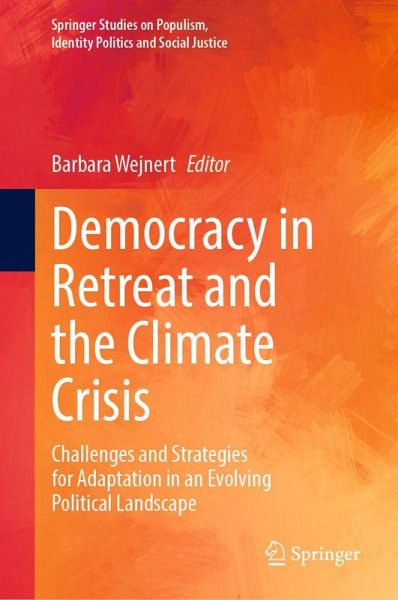
This volume sheds light on the complex global landscape of democracy weakening and autocracy strengthening, along with their profound impact on the response to the climate crisis. The book is divided into three sections and adopts a multidisciplinary approach. The first section examines various pathways of global democracy erosion and autocracy growth, including challenges posed by voters, politicians, unelected officials, and climate skeptics.
In the second section, the focus shifts to climate change politics in a divided world, investigating the challenges political polarization poses to a sustainable future. The chapters cover key topics, such as energy security, responses to environmental disasters, environmental sustainability, sustainable development, and human rights.
The impact of eroding democracy on the natural environment and the sustainability concerns during the climate change era is explored in the third section, viewed through a rarely used humanities lens. Studies on pro-climatic national symbols, ecofeminism, eco-justice, and the Sustainable Development Goals ante litteram provide the context for this final section.
This book offers invaluable insights into our evolving world. For scholars, students, policymakers, and activists in fields such as autocracy, democracy, politics of climate change, political sociology, international relations, and sustainability, it presents strategies to navigate climate change adaptation in a rapidly changing, less democratic world.
In the second section, the focus shifts to climate change politics in a divided world, investigating the challenges political polarization poses to a sustainable future. The chapters cover key topics, such as energy security, responses to environmental disasters, environmental sustainability, sustainable development, and human rights.
The impact of eroding democracy on the natural environment and the sustainability concerns during the climate change era is explored in the third section, viewed through a rarely used humanities lens. Studies on pro-climatic national symbols, ecofeminism, eco-justice, and the Sustainable Development Goals ante litteram provide the context for this final section.
This book offers invaluable insights into our evolving world. For scholars, students, policymakers, and activists in fields such as autocracy, democracy, politics of climate change, political sociology, international relations, and sustainability, it presents strategies to navigate climate change adaptation in a rapidly changing, less democratic world.