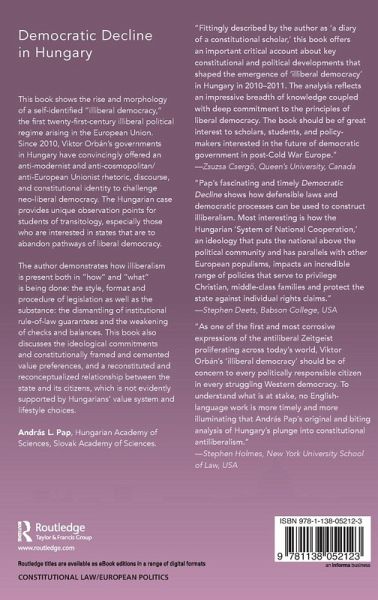
This book shows the rise and morphology of a self-identified 'illiberal democracy', the first 21st century illiberal political regime arising in the European Union. The Hungarian case provides unique observation points for students of transitology, especially those who are interested in states which are to abandon pathways of liberal democracy.
This book shows the rise and morphology of a self-identified 'illiberal democracy', the first 21st century illiberal political regime arising in the European Union. The Hungarian case provides unique observation points for students of transitology, especially those who are interested in states which are to abandon pathways of liberal democracy.
András L. Pap is Research Professor and Head of Department for Constitutional and Administrative Law at the (formerly Hungarian Academy of Sciences) Centre for Social Sciences, Institute for Legal Studies, as well as Professor of Law at the Faculty of Economics at Eötvös University (ELTE) in Budapest, Hungary. For 25 years, until its closing in 2025, he was Adjunct (Recurrent Visiting) Professor in the Nationalism Studies Program at the Central European University (CEU) in Budapest and Vienna.
Inhaltsangabe
Introduction Part I. Chronology and explanations: what happened in Hungary in 2010-2012 Chapter 1. Democratic U-turn, the chronology of building an illiberal democracy 1. Meanwhile in Hungary: An illiberal democracy in the making 2. The legislative juggernaut 3. Dismantling rule of law guarantees 4. Expanding the electorate and gerrymandering 5. And the new constitution... 6. Constitutional partnership or cemented clientelism? 7. Immediate responses Chapter 2. Causes and explanations 1. Values and political culture 2. Orbán and his strategy: The rhetoric and politics of the "dark side" 3. A little help from the constitutional structure... 4. Economic hardship Part II. The microfabric of the Hungarian illiberal democracy' Chapter 3. Illiberalism as constitutional identity 1. Terminology and conceptualization 2. Illiberalism and the emergence of a new political community: The System of National Cooperation 3. Illiberalism and the System of National Cooperation 4. Illiberal democracy as constitutional identity Chapter 4. Intimate citizenship and value preferences in the new constitution 1. The SNC as a workfare state 2. The SNC as a Christian state 3. Family in the SNC 4. Equality of intimate citizenship in the SNC 5. Reproductive rights in the SNC 5. Paternalism and essentialism in the SNC 6. Conclusions Chapter 5. Illiberal multiculturalism: deceptive premises, misguided policies 1. Illiberal transnationalism: The nation and the constitution in internal and external homelands 2. Illiberal multiculturalism: The nation and the minorities 3. Conclusion Chapter 6. Communitarians, dignity, and privacy: personhood and transparency in the System of National Cooperation 1. Communities as primary agents of dignity 2. Liberal instruments for illiberal objectives: privacy as a tool to obstruct public accountability and to protect the dignity of government institutions and officials 3. Privacy as a tool for ethnic discrimination and marginalization 4. Concluding thoughts Chapter 7. Closing Remarks Index
Introduction Part I. Chronology and explanations: what happened in Hungary in 2010-2012 Chapter 1. Democratic U-turn, the chronology of building an illiberal democracy 1. Meanwhile in Hungary: An illiberal democracy in the making 2. The legislative juggernaut 3. Dismantling rule of law guarantees 4. Expanding the electorate and gerrymandering 5. And the new constitution... 6. Constitutional partnership or cemented clientelism? 7. Immediate responses Chapter 2. Causes and explanations 1. Values and political culture 2. Orbán and his strategy: The rhetoric and politics of the "dark side" 3. A little help from the constitutional structure... 4. Economic hardship Part II. The microfabric of the Hungarian illiberal democracy' Chapter 3. Illiberalism as constitutional identity 1. Terminology and conceptualization 2. Illiberalism and the emergence of a new political community: The System of National Cooperation 3. Illiberalism and the System of National Cooperation 4. Illiberal democracy as constitutional identity Chapter 4. Intimate citizenship and value preferences in the new constitution 1. The SNC as a workfare state 2. The SNC as a Christian state 3. Family in the SNC 4. Equality of intimate citizenship in the SNC 5. Reproductive rights in the SNC 5. Paternalism and essentialism in the SNC 6. Conclusions Chapter 5. Illiberal multiculturalism: deceptive premises, misguided policies 1. Illiberal transnationalism: The nation and the constitution in internal and external homelands 2. Illiberal multiculturalism: The nation and the minorities 3. Conclusion Chapter 6. Communitarians, dignity, and privacy: personhood and transparency in the System of National Cooperation 1. Communities as primary agents of dignity 2. Liberal instruments for illiberal objectives: privacy as a tool to obstruct public accountability and to protect the dignity of government institutions and officials 3. Privacy as a tool for ethnic discrimination and marginalization 4. Concluding thoughts Chapter 7. Closing Remarks Index
Es gelten unsere Allgemeinen Geschäftsbedingungen: www.buecher.de/agb
Impressum
www.buecher.de ist ein Internetauftritt der buecher.de internetstores GmbH
Geschäftsführung: Monica Sawhney | Roland Kölbl | Günter Hilger
Sitz der Gesellschaft: Batheyer Straße 115 - 117, 58099 Hagen
Postanschrift: Bürgermeister-Wegele-Str. 12, 86167 Augsburg
Amtsgericht Hagen HRB 13257
Steuernummer: 321/5800/1497
USt-IdNr: DE450055826






![The Decline and Fall of Samuel Sawbones, M.D., on the Klondike [microform]](https://bilder.buecher.de/produkte/66/66196/66196830m.jpg "The Decline and Fall of Samuel Sawbones, M.D., on the Klondike [microform]")