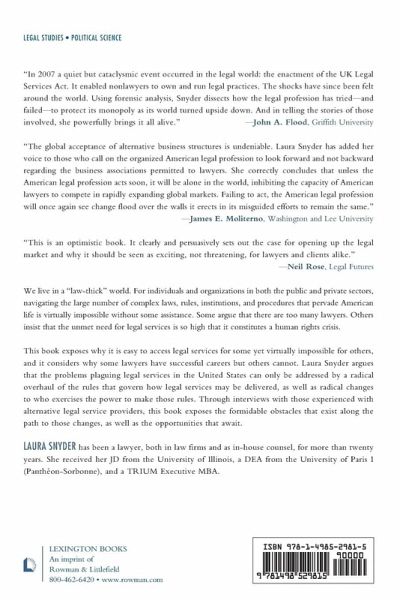
This book responds to the common objections to alternative business structures, describes the opportunities that such structures offer, exposes how lawyer self-regulation operates to obstruct the modernization of legal services, and includes interviews with persons who have experience with alternative legal service providers in other countries.
This book responds to the common objections to alternative business structures, describes the opportunities that such structures offer, exposes how lawyer self-regulation operates to obstruct the modernization of legal services, and includes interviews with persons who have experience with alternative legal service providers in other countries.
Preface Introduction Part I: The Opposition to Alternative Structures Chapter 1: Alternative Structures will Undermine Professionalism and Ethics Chapter 2: There Is No Way to Regulate Alternative Structures Chapter 3: The Adoption of Alternative Structures Will Jeopardize Self-Regulation of the Profession Chapter 4: There is No Demonstrated Need, Demand, or Problem Chapter 5: New Delivery Models Can be Developed Without Changing Rule 5.4 Chapter 6: The Payment of Salary is Adequate Compensation for Non-Lawyers Chapter 7: No One in Their Right Mind Would Want to Invest in a Law Firm Chapter 8: Alternative Structures Will Lead to a Consolidated Market Controlled by Large Law Firms Chapter 9: Alternative Structures Cannot Help Those Who Canot Pay for Legal Services Chapter 10: Alternative Structures Will Make Things Harder for Un- and Underemployed Lawyers Chapter 11: The Burden of Proof Has Not Been Met Part II: The Opportunities Offered by Alternative Structures Chapter 12: Opportunities for Funding for Legal Aid Chapter 13: Opportunities for Downstream Markets and the Economy as a Whole Chapter 14: Opportunities for Lawyers Chapter 15: Opportunities for In-House Legal Departments in the Public and Private Sectors Chapter 16: Opportunities for an Improved Regulatory Approach Chapter 17: Opportunities for Failure Part III: Access to Justice Chapter 18: Unacknowledged Complexity Chapter 19: Access to Justice Comes in All Shapes and Sizes, Sometimes Obvious and Sometimes Not Chapter 20: Unmet Need as Human Rights Crisis Part IV: The (Non)-Regulation of Legal Services and the World Stage Introduction to Part IV Chapter 21: Abdication of Regulatory Power Chapter 22: International Obligations and Commitments Chapter 23: Endless Objections and Calls for Evidence and the Lawyer Monopoly on Legal Services (Or, Having Your Cake and Eating It, Too) Chapter 24: Good Governance Requires.Actual Governance Part V: Stories (Letting the Old Lady Scream) Chapter 25: Stories Tom Curran, CEO, Kings Court Trust Alexander Hamilton, CEO, Radiant Law John Kain, Managing Director, Kain C+C Christopher Mills, Partner and COO, Schillings Ken Jagger, CEO, AdventBalance David Simon, Chair, Triton Global Luke Geary, Managing Partner, Salvos Legal and Salvos Legal Humanitarian Jenny Holloway, Associate Dean, Nottingham Law School and Nick Johnson, Pro Bono Director, Nottingham Law School Legal Advice Centre Archana Makol, Director, BT Law Ltd. Greg Tucker, CEO, Maurice Blackburn Dina Tutungi, General Manager-Personal Injury Victoria, Slater and Gordon Lawyers Jordan Mayo, Managing Director, Smedvig Capital Elisabeth Davies, Chair, Legal Services Consumer Panel Michael McDevitt, Co-Founder & Chief Executive Officer, Tandem Legal Group Monica Goyal, Founder and Principal, Aluvion Law David Clementi
Preface Introduction Part I: The Opposition to Alternative Structures Chapter 1: Alternative Structures will Undermine Professionalism and Ethics Chapter 2: There Is No Way to Regulate Alternative Structures Chapter 3: The Adoption of Alternative Structures Will Jeopardize Self-Regulation of the Profession Chapter 4: There is No Demonstrated Need, Demand, or Problem Chapter 5: New Delivery Models Can be Developed Without Changing Rule 5.4 Chapter 6: The Payment of Salary is Adequate Compensation for Non-Lawyers Chapter 7: No One in Their Right Mind Would Want to Invest in a Law Firm Chapter 8: Alternative Structures Will Lead to a Consolidated Market Controlled by Large Law Firms Chapter 9: Alternative Structures Cannot Help Those Who Canot Pay for Legal Services Chapter 10: Alternative Structures Will Make Things Harder for Un- and Underemployed Lawyers Chapter 11: The Burden of Proof Has Not Been Met Part II: The Opportunities Offered by Alternative Structures Chapter 12: Opportunities for Funding for Legal Aid Chapter 13: Opportunities for Downstream Markets and the Economy as a Whole Chapter 14: Opportunities for Lawyers Chapter 15: Opportunities for In-House Legal Departments in the Public and Private Sectors Chapter 16: Opportunities for an Improved Regulatory Approach Chapter 17: Opportunities for Failure Part III: Access to Justice Chapter 18: Unacknowledged Complexity Chapter 19: Access to Justice Comes in All Shapes and Sizes, Sometimes Obvious and Sometimes Not Chapter 20: Unmet Need as Human Rights Crisis Part IV: The (Non)-Regulation of Legal Services and the World Stage Introduction to Part IV Chapter 21: Abdication of Regulatory Power Chapter 22: International Obligations and Commitments Chapter 23: Endless Objections and Calls for Evidence and the Lawyer Monopoly on Legal Services (Or, Having Your Cake and Eating It, Too) Chapter 24: Good Governance Requires.Actual Governance Part V: Stories (Letting the Old Lady Scream) Chapter 25: Stories Tom Curran, CEO, Kings Court Trust Alexander Hamilton, CEO, Radiant Law John Kain, Managing Director, Kain C+C Christopher Mills, Partner and COO, Schillings Ken Jagger, CEO, AdventBalance David Simon, Chair, Triton Global Luke Geary, Managing Partner, Salvos Legal and Salvos Legal Humanitarian Jenny Holloway, Associate Dean, Nottingham Law School and Nick Johnson, Pro Bono Director, Nottingham Law School Legal Advice Centre Archana Makol, Director, BT Law Ltd. Greg Tucker, CEO, Maurice Blackburn Dina Tutungi, General Manager-Personal Injury Victoria, Slater and Gordon Lawyers Jordan Mayo, Managing Director, Smedvig Capital Elisabeth Davies, Chair, Legal Services Consumer Panel Michael McDevitt, Co-Founder & Chief Executive Officer, Tandem Legal Group Monica Goyal, Founder and Principal, Aluvion Law David Clementi
Es gelten unsere Allgemeinen Geschäftsbedingungen: www.buecher.de/agb
Impressum
www.buecher.de ist ein Internetauftritt der buecher.de internetstores GmbH
Geschäftsführung: Monica Sawhney | Roland Kölbl | Günter Hilger
Sitz der Gesellschaft: Batheyer Straße 115 - 117, 58099 Hagen
Postanschrift: Bürgermeister-Wegele-Str. 12, 86167 Augsburg
Amtsgericht Hagen HRB 13257
Steuernummer: 321/5800/1497
USt-IdNr: DE450055826