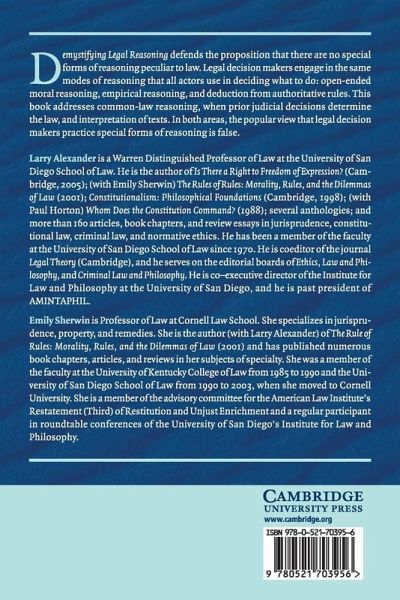
Demystifying Legal Reasoning defends the proposition that there are no special forms of reasoning peculiar to law. Legal decision makers engage in the same modes of reasoning that all actors use in deciding what to do: open-ended moral reasoning, empirical reasoning, and deduction from authoritative rules. This book addresses common law reasoning when prior judicial decisions determine the law, and interpretation of texts. In both areas, the popular view that legal decision makers practise special forms of reasoning is false.
Demystifying Legal Reasoning defends the proposition that there are no special forms of reasoning peculiar to law. Legal decision makers engage in the same modes of reasoning that all actors use in deciding what to do: open-ended moral reasoning, empirical reasoning, and deduction from authoritative rules. This book addresses common law reasoning when prior judicial decisions determine the law, and interpretation of texts. In both areas, the popular view that legal decision makers practise special forms of reasoning is false.
Professor Alexander is a Warren Distinguished Professor of Law at University of San Diego School of Law. He is the author of: Is There a Right to Freedom of Expression? (Cambridge, 2005); (with Emily Sherwin) The Rules: Morality, Rules, and the Dilemmas of Law (2001); Constitutionalism: Philosophical Foundations (Cambridge, 1998); (with Paul Horton) Whom Does the Constitution Command? (1988); several anthologies; and over 160 articles, book chapters, and review essays in jurisprudence, constitutional law, criminal law, and normative ethics. He has been a member of the faculty at the University of San Diego School of Law since 1970. He is co-editor of the journal Legal Theory (Cambridge), and he serves on the editorial boards of Ethics, Law and Philosophy and Criminal Law and Philosophy. He is co-executive director of the Institute for Law and Philosophy at the University of San Diego, and he is past president of AMINTAPHIL.
Inhaltsangabe
Part I. Law and its Function: 1. Moral controversy Part II. Common Law Reasoning: Deciding Cases When Prior Judicial Decisions Determine the Law: 2. Ordinary reason applied to law: natural reasoning and deduction from rules 3. The mystification of common-law reasoning 4. Common law practice Part III. Reasoning from Canonical Legal Text: 5. Interpreting statutes and other posited rules 6. Infelicities of the intended meaning of canonical texts and norms constraining interpretation 7. Non-intentionalist interpretation 8. Is constitutional interpretation different? Why it isn't and is 9. All or nothing.
Part I. Law and its Function: 1. Moral controversy Part II. Common Law Reasoning: Deciding Cases When Prior Judicial Decisions Determine the Law: 2. Ordinary reason applied to law: natural reasoning and deduction from rules 3. The mystification of common-law reasoning 4. Common law practice Part III. Reasoning from Canonical Legal Text: 5. Interpreting statutes and other posited rules 6. Infelicities of the intended meaning of canonical texts and norms constraining interpretation 7. Non-intentionalist interpretation 8. Is constitutional interpretation different? Why it isn't and is 9. All or nothing.
Es gelten unsere Allgemeinen Geschäftsbedingungen: www.buecher.de/agb
Impressum
www.buecher.de ist ein Internetauftritt der buecher.de internetstores GmbH
Geschäftsführung: Monica Sawhney | Roland Kölbl | Günter Hilger
Sitz der Gesellschaft: Batheyer Straße 115 - 117, 58099 Hagen
Postanschrift: Bürgermeister-Wegele-Str. 12, 86167 Augsburg
Amtsgericht Hagen HRB 13257
Steuernummer: 321/5800/1497
USt-IdNr: DE450055826