
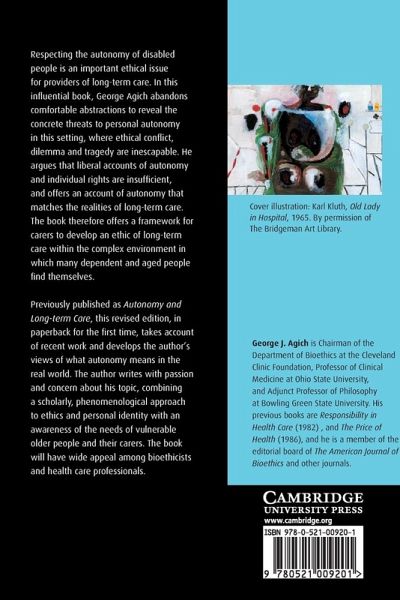
Respecting the autonomy of disabled people is an important ethical issue for providers of long-term care. In this influential book, George Agich abandons comfortable abstractions to reveal the concrete threats to personal autonomy in this setting, where ethical conflict, dilemma and tragedy are inescapable. He argues that liberal accounts of autonomy and individual rights are insufficient, and offers an account of autonomy that matches the realities of long-term care. The book therefore offers a framework for carers to develop an ethic of long-term care within the complex environment in which…mehr
Respecting the autonomy of disabled people is an important ethical issue for providers of long-term care. In this influential book, George Agich abandons comfortable abstractions to reveal the concrete threats to personal autonomy in this setting, where ethical conflict, dilemma and tragedy are inescapable. He argues that liberal accounts of autonomy and individual rights are insufficient, and offers an account of autonomy that matches the realities of long-term care. The book therefore offers a framework for carers to develop an ethic of long-term care within the complex environment in which many dependent and aged people find themselves. Previously published as Autonomy and Long-term Care, this revised edition, in paperback for the first time, takes account of recent work and develops the author's views of what autonomy means in the real world. It will have wide appeal among bioethicists and health care professionals.
George Agich is Chairman of the Department of Bioethics at the Cleveland Clinic Foundation, Professor of Clinical Medicine at Ohio State University and Adjunct Professor of Philosophy at Bowling Green State University. His previous books are Responsibility in Health Care (1982), and The Price of Health (1986), and he is a member of the editorial board of The American Journal of Bioethics and other journals.
Inhaltsangabe
1. Introduction Long-term care images Autonomy Autonomy and long-term care: the problem 2. The liberal theory of autonomy Pluralism, toleration, and neutrality The State and positive autonomy Some problems of positive autonomy Liberal principles in long-term care Nursing home admission practices The use of restraints The perils of liberal theory Communitarianism and the contextualist alternative Practical implications of the debate over the foundation of ethics Conflict and conversation The function of rights Limitation of rights Paternalism and the development of persons From paternalism to parentalism Summary 3. Long-term care: myth and reality Myths of old age Nursing homes Therapeutic relationships Concepts of illness and disease Models of care The concept of a practice Home care Summary 4. Actual autonomy Result-oriented theories Action-oriented theories The concrete view of persons Autonomy: a developmental perspective Narrative approaches Dependence in human development Sickness as dependence Autonomy and identification The paradox of development and problems of identification Implications for long-term care Summary 5. A phenomenological view of social action Sociality and the everyday world General Features of the social nature of persons Space Time Communication Affectivity Summary 6. Autonomy and long-term care: another look Social reality of Eastside Appeal to autonomy as independence A phenomenologically informed analysis Lessons from Eastside Conclusion Bibliography Index.
Es gelten unsere Allgemeinen Geschäftsbedingungen: www.buecher.de/agb
Impressum
www.buecher.de ist ein Internetauftritt der buecher.de internetstores GmbH
Geschäftsführung: Monica Sawhney | Roland Kölbl | Günter Hilger
Sitz der Gesellschaft: Batheyer Straße 115 - 117, 58099 Hagen
Postanschrift: Bürgermeister-Wegele-Str. 12, 86167 Augsburg
Amtsgericht Hagen HRB 13257
Steuernummer: 321/5800/1497
USt-IdNr: DE450055826