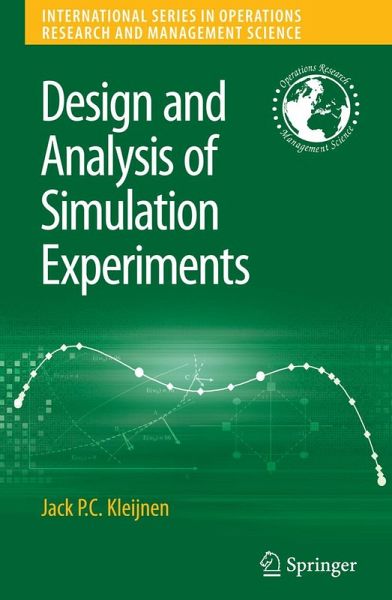
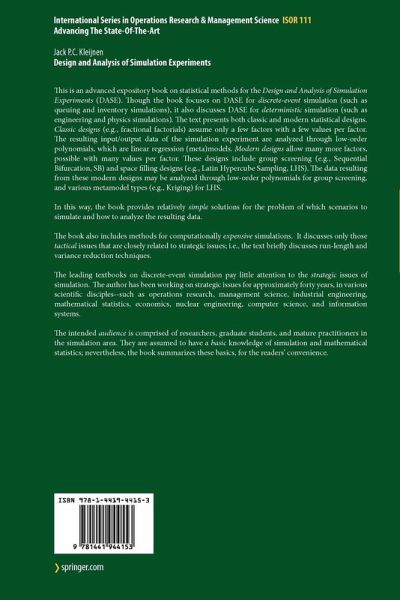
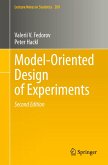
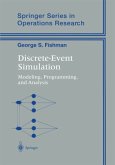
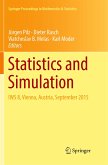
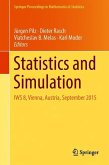
Simulation is a widely used methodology in all the Applied Science disciplines. It provides a flexible, powerful and intuitive tool for investigating how to design a process or system, and how to maximize its efficiency. Simulation's effectiveness depends greatly on how well the simulation experiments are designed and analyzed. Design and Analysis of Simulation Experiments will focus on this crucial phase in the overall process of applying simulation. The book will include the best of both classic and modern methods of simulation experimentation, and as a result, it will provide a…mehr
Simulation is a widely used methodology in all the Applied Science disciplines. It provides a flexible, powerful and intuitive tool for investigating how to design a process or system, and how to maximize its efficiency. Simulation's effectiveness depends greatly on how well the simulation experiments are designed and analyzed. Design and Analysis of Simulation Experiments will focus on this crucial phase in the overall process of applying simulation. The book will include the best of both classic and modern methods of simulation experimentation, and as a result, it will provide a state-of-the-art treatment of the topic. This book will be the standard reference book on the topic for both researchers and sophisticated practitioners in the area, and it will be used as a textbook in courses or seminars focusing on this topic.
Produktdetails
Produktdetails
International Series in Operations Research & Management Science 111
Jack P.C. KLEIJNEN is Emeritus Professor of "Simulation and Information Systems" at Tilburg University, where he is still an active member of both the "Department of Management" and the "Operations Research Group" of the "Center for Economic Research (CentER)" in the Tilburg School of Economics and Management. His research concerns the statistical design and analysis of experiments with simulation models, in many scientific disciplines including management science, operations research, and engineering. He was a consultant for several organizations in the USA and Europe, and served on many international editorial boards and scientific committees. He also spent several years in the USA, at universities and private companies. He received a number of national and international awards; e.g., in 2008 the Queen of the Netherlands appointed him a Knight in the "Order of the Netherlands Lion" and in 2005 the INFORMS Simulation Society awarded him the "Lifetime Professional Achievement Award" (LPAA). While being an Emeritus Professor, he wrote the second version of "Design and analysis of simulation experiments", and in 2015 he supervised his last Ph.D. student Ehsan Mehdad.
Inhaltsangabe
Preface.- Introduction.- Black Box Metamodels.- Low-Order Polynomial Regression.- Metamodels and Designs: A Single Factor.- Low-Order Polynomial Models and Designs: Multiple Factors.- Low-Order Polynomial Models and Screening Designs: Hundreds of Factors.- Kriging Metamodels.- Latin Hypercube Sampling (LHS) and other Space-Filling Designs.- Cross-Validation of Metamodels.- Conclusions and Further Research.
Preface.- Introduction.- Black Box Metamodels.- Low-Order Polynomial Regression.- Metamodels and Designs: A Single Factor.- Low-Order Polynomial Models and Designs: Multiple Factors.- Low-Order Polynomial Models and Screening Designs: Hundreds of Factors.- Kriging Metamodels.- Latin Hypercube Sampling (LHS) and other Space-Filling Designs.- Cross-Validation of Metamodels.- Conclusions and Further Research.
Rezensionen
"This work represents a lucid, comprehensive, authoritative, and highly informative presentation of the techniques and methodology associated with simulation experimentation. The book is 'lucid' because, as the word implies, it sheds light on the subject matter of simulation experimentation and optimization; it is 'comprehensive' because it addresses all of the essential topics in the field; it is 'authoritative'' because it captures the essence of the best research in the field, as evidenced by its more than 400 authoritative citations; and it is ''informative' in that it distills the most important scholarship of the last six decades into a 210-page study of the DASE field. Jack Kleijnen has once again produced a cutting-edge approach to the design and analysis of simulation experiments. His 1974-75 books were an incisive compilation of statistical methodology in simulation and introduced the term metamodeling to the lexicon of simulation experimentation. His 2008 volume Design and Analysis of Simulation Experiments promises to popularize the term DASE in the same way. Many of us who specialize in the field of simulation experimentation and optimization have avidly followed Kleijnen's writings for almost four decades. This latest work leads the way in this endeavor, and is a vital addition to the important scholarship in the field." (William E. BILES, JASA, June 2009, Vol. 104, No. 486)
Es gelten unsere Allgemeinen Geschäftsbedingungen: www.buecher.de/agb
Impressum
www.buecher.de ist ein Internetauftritt der buecher.de internetstores GmbH
Geschäftsführung: Monica Sawhney | Roland Kölbl | Günter Hilger
Sitz der Gesellschaft: Batheyer Straße 115 - 117, 58099 Hagen
Postanschrift: Bürgermeister-Wegele-Str. 12, 86167 Augsburg
Amtsgericht Hagen HRB 13257
Steuernummer: 321/5800/1497
USt-IdNr: DE450055826