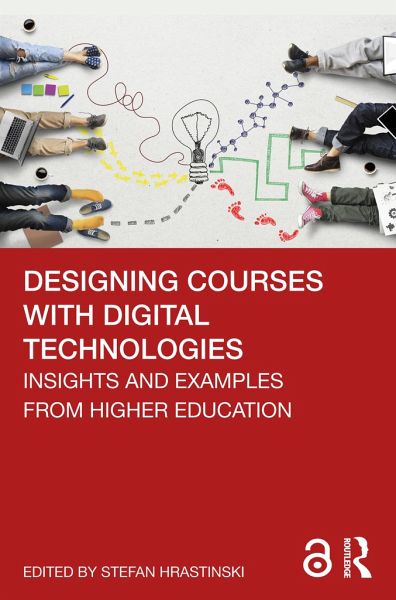
Designing Courses with Digital Technologies offers guidance for higher education instructors integrating digital technologies into their teaching, assessment and overall support of students. Written by and for instructors from a variety of disciplines, this book presents evaluations that the contributors have implemented in real-life courses, spanning blended and distance learning, flipped classrooms, collaborative technologies, video-supported learning and beyond. Chapter authors contextualize their approaches beyond simple how-tos, exploring both the research foundations and professional…mehr
Designing Courses with Digital Technologies offers guidance for higher education instructors integrating digital technologies into their teaching, assessment and overall support of students. Written by and for instructors from a variety of disciplines, this book presents evaluations that the contributors have implemented in real-life courses, spanning blended and distance learning, flipped classrooms, collaborative technologies, video-supported learning and beyond. Chapter authors contextualize their approaches beyond simple how-tos, exploring both the research foundations and professional experiences that have informed their use of digital tools while reflecting on their successes, challenges and ideas for future development.
Chapter 6 of this book is freely available as a downloadable Open Access PDF at http://www.taylorfrancis.com under a Creative Commons Attribution-Non Commercial-No Derivatives (CC-BY-NC-ND) 4.0 license.
Stefan Hrastinski is Professor in the Division of Digital Learning and Director of Research Education in the Department of Learning in Engineering Sciences at KTH Royal Institute of Technology, Sweden.
Inhaltsangabe
Introduction Stefan Hrastinski, KTH Royal Institute of Technology
Section A: Discussion forums and blogs
Discussion forums in literature and film Carolina Leon Vegas, Dalarna University
Discussion forums in management Richard Cotterill, University of York
Knowledge construction through blogs Maria Limniou, University of Liverpool
Section B: Collaboration
Online pair programming David Parsons, Darcy Vo, Karen Lambrechts, The Mind Lab
Digital collaboration tools Eric Loepp, Nicole Weber, University of Washington Whitewater
Problem-based learning in international online groups Alastair Creelman, Linnaeus University, Maria Kvarnström, Linköping University, Jörg Pareigis, Karlstad University, Lars Uhlin, Linköping University, Lotta Åbjörnsson, Lund University
Section C: Collaborative writing and reading
Collaborative writing in group work Katarina Lindahl, Dalarna University
Collaborative writing in the classroom Angel Fan, The Chinese University of Hong Kong, Angela Daly, University of Strathclyde
Contributing to public debate through collaborative writing Patric Wallin, Norwegian University of Science and Technology
Collaborative annotation to support students' online reading skills Matt East, Talis, Hope Williard, Jamie Wood, University of Lincoln
Section D: Group work
Students as content creators Jane Guiller, John Smith, Glasgow Caledonian University
Virtual teams Ann-Sofie Hellberg, Jonas Moll, Örebro University
Section E: Flipped classroom
Teaching Mandarin vocabulary using a flipped approach Xinyi Tan, Coastal Carolina University
Flipped math teaching in diagnostic medicine Bei Zhang, University of Vermont
Flipping an online module in computational physics Christophe Demazière, Tom Adawi, Christian Stöhr, Chalmers University of Technology
Section F: Video
Video assignments BethAnne Paulsrud, David Gray, Katherina Dodou, Dalarna University
Interactive videos Rob Lowney, Maria Loftus, Dublin City University
Authentic vlogs Felicity Healey-Benson, University of Wales
Section G: Video conference
Relation building in break out groups Kristin Landrø, Camilla Hellesøy Krogstie, Gunhild Marie Roald, Patric Wallin, Norwegian University of Science and Technology
Using video conference for group problem solving Siming Guo, Coastal Carolina University
Recording synchronous online teaching to develop practice Tim Gander, The Mind Lab
Section H: Student induction and responsive teaching
Student-generated induction in a lecture theatre Nicholas Bowskill, University of Derby
Pre-class surveys to inform course design Angela van Barneveld, Helen DeWaard, Lakehead University
Introduction Stefan Hrastinski, KTH Royal Institute of Technology
Section A: Discussion forums and blogs
Discussion forums in literature and film Carolina Leon Vegas, Dalarna University
Discussion forums in management Richard Cotterill, University of York
Knowledge construction through blogs Maria Limniou, University of Liverpool
Section B: Collaboration
Online pair programming David Parsons, Darcy Vo, Karen Lambrechts, The Mind Lab
Digital collaboration tools Eric Loepp, Nicole Weber, University of Washington Whitewater
Problem-based learning in international online groups Alastair Creelman, Linnaeus University, Maria Kvarnström, Linköping University, Jörg Pareigis, Karlstad University, Lars Uhlin, Linköping University, Lotta Åbjörnsson, Lund University
Section C: Collaborative writing and reading
Collaborative writing in group work Katarina Lindahl, Dalarna University
Collaborative writing in the classroom Angel Fan, The Chinese University of Hong Kong, Angela Daly, University of Strathclyde
Contributing to public debate through collaborative writing Patric Wallin, Norwegian University of Science and Technology
Collaborative annotation to support students' online reading skills Matt East, Talis, Hope Williard, Jamie Wood, University of Lincoln
Section D: Group work
Students as content creators Jane Guiller, John Smith, Glasgow Caledonian University
Virtual teams Ann-Sofie Hellberg, Jonas Moll, Örebro University
Section E: Flipped classroom
Teaching Mandarin vocabulary using a flipped approach Xinyi Tan, Coastal Carolina University
Flipped math teaching in diagnostic medicine Bei Zhang, University of Vermont
Flipping an online module in computational physics Christophe Demazière, Tom Adawi, Christian Stöhr, Chalmers University of Technology
Section F: Video
Video assignments BethAnne Paulsrud, David Gray, Katherina Dodou, Dalarna University
Interactive videos Rob Lowney, Maria Loftus, Dublin City University
Authentic vlogs Felicity Healey-Benson, University of Wales
Section G: Video conference
Relation building in break out groups Kristin Landrø, Camilla Hellesøy Krogstie, Gunhild Marie Roald, Patric Wallin, Norwegian University of Science and Technology
Using video conference for group problem solving Siming Guo, Coastal Carolina University
Recording synchronous online teaching to develop practice Tim Gander, The Mind Lab
Section H: Student induction and responsive teaching
Student-generated induction in a lecture theatre Nicholas Bowskill, University of Derby
Pre-class surveys to inform course design Angela van Barneveld, Helen DeWaard, Lakehead University
Es gelten unsere Allgemeinen Geschäftsbedingungen: www.buecher.de/agb
Impressum
www.buecher.de ist ein Internetauftritt der buecher.de internetstores GmbH
Geschäftsführung: Monica Sawhney | Roland Kölbl | Günter Hilger
Sitz der Gesellschaft: Batheyer Straße 115 - 117, 58099 Hagen
Postanschrift: Bürgermeister-Wegele-Str. 12, 86167 Augsburg
Amtsgericht Hagen HRB 13257
Steuernummer: 321/5800/1497
USt-IdNr: DE450055826