
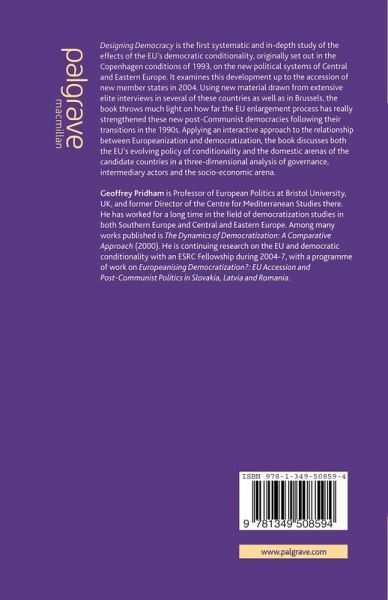
Designing Democracy is the first systematic and in-depth study of the effects of the EU's democratic conditionality, originally set out in the Copenhagen conditions of 1993, on the new political systems of Central and Eastern Europe. Using new material drawn from extensive elite interviews in several of these countries as well as in Brussels, the book throws much light on how far the EU enlargement process has really strengthened these new post-Communist democracies following their transitions in the 1990s.
GEOFFREY PRIDHAM is Professor of European Politics at Bristol University, UK, and is formerly Director of the Centre for Mediterranean Studies there. He has worked for a long time in the field of democratisation studies in both Southern Europe and Central and Eastern Europe. Among many works published is The Dynamics of Democratization: A Comparative Approach (2000). He is continuing research on the EU and democratic conditionality with an ESRC Fellowship during 2004-7, with a programme of work on Europeanising Democratisation?: EU Accession and Post-Communist Politics in Slovakia, Latvia and Romania.
Inhaltsangabe
Preface Theoretical Perspectives on European Enlargement and Democratisation The EU's Conditionality Strategy: Its Development Before and After the Fall of Communism EU Enlargement, Democratisation and Domestic Politics in Post-Communist Europe: Patterns and Problems of Motivation Post-Communist Accession Governments: Policy Orientation, Institutional Adaptation and Implementing Democratic Conditionality The Political Arena and Intermediary Actors in Candidate Countries: Political Parties, Opinion Makers and Public Impacts The Socio-Economic Arena and Deepening Democracy: Economic Transformation, Civil Society and Ethnic Minorities in Candidate Countries Conclusion: Europeanisation and Democratisation - Convergent, Parallel or Conflicting Processes? Sources and Bibliography Index
Rezensionen
'The book is very well researched with extensive notes and source materials...[it] will be most useful for researchers in the area of democracy studies as it explores the recent enlargement in a comparative context and provides valuable insights into the new member states.' - Political Studies Review
Es gelten unsere Allgemeinen Geschäftsbedingungen: www.buecher.de/agb
Impressum
www.buecher.de ist ein Internetauftritt der buecher.de internetstores GmbH
Geschäftsführung: Monica Sawhney | Roland Kölbl | Günter Hilger
Sitz der Gesellschaft: Batheyer Straße 115 - 117, 58099 Hagen
Postanschrift: Bürgermeister-Wegele-Str. 12, 86167 Augsburg
Amtsgericht Hagen HRB 13257
Steuernummer: 321/5800/1497
USt-IdNr: DE450055826