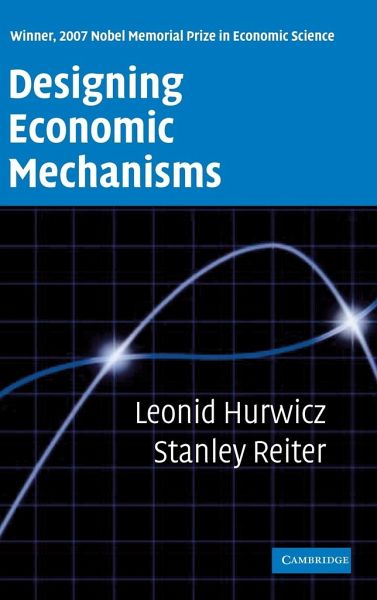
A mechanism is a mathematical structure that models institutions through which economic activity is guided and coordinated. There are many such institutions; markets are the most familiar ones. Lawmakers, administrators and officers of private companies create institutions in order to achieve desired goals. They seek to do so in ways that economize on the resources needed to operate the institutions, and that provide incentives that induce the required behaviors. This book presents systematic procedures for designing mechanisms that achieve specified performance, and economize on the resources…mehr
A mechanism is a mathematical structure that models institutions through which economic activity is guided and coordinated. There are many such institutions; markets are the most familiar ones. Lawmakers, administrators and officers of private companies create institutions in order to achieve desired goals. They seek to do so in ways that economize on the resources needed to operate the institutions, and that provide incentives that induce the required behaviors. This book presents systematic procedures for designing mechanisms that achieve specified performance, and economize on the resources required to operate the mechanism. The systematic design procedures are algorithms for designing informationally efficient mechanisms. Most of the book deals with these procedures of design. When there are finitely many environments to be dealt with, and there is a Nash-implementing mechanism, our algorithms can be used to make that mechanism into an informationally efficient one. Informationally efficient dominant strategy implementation is also studied.
Leonid Hurwicz is Regents' Professor of Economics Emeritus at the University of Minnesota. Internationally renowned for his pioneering research on economic theory, particularly in the areas of mechanism and institutional design and mathematical economics, he received the national Medal of Science in 1990. A member of the National Academy of Sciences and the American Academy of Arts and Sciences, Professor Hurwicz is a former President and Fellow of the Econometric Society. The recipient of six honorary doctorates, he serves on the editorial board of several journals and coedited and contributed to two collections for Cambridge University Press, Studies in Resource Allocation Processes (1978, with Kenneth Arrow) and Social Goals and Social Organization (1987, with David Schmeidler and Hugo Sonnenschein). His recent publications include papers in Economic Theory (2003, with Thomas Marschak), Review of Economic Design (2001, with Stanley Reiter), and Advances in Mathematical Economics (2003, with Marcel K. Richter).
Inhaltsangabe
1. Mechanisms and mechanism design 1.1. Introduction to mechanisms and mechanism design 1.2. Environments and goal functions 1.3. Mechanisms: message exchange processes and game forms 1.4. Initial dispersion of information and privacy preservation 1.5. Mechanism design 1.6. Mechanism design Illustrated in a Walrasian example 1.7. The rectangles method applied to the Walrasian goal function-informal 1.8. Introductory discussion of informational efficiency concepts 1.9. Regulation of logging in a national forest - an example of mechanism design 2. From goals to means: constructing mechanisms 2.1. Mechanism construction: phase one 2.2. Phase two: constructing decentralized 2.3.1. Flagpoles-principles 2.4.1. Phase two: via condensation: principles 2.5. Overlaps 2.6.1 Main results 3. Designing informationally efficient mechanisms using the language of aets 3.1. Introduction 3.2. Mechanism design 3.3. Mechanisms and coverings 3.4. A systematic process (an algorithm) for constructing and rRM covering 3.5 Transversals 3.6. Coverings and partitions 3.7. Informational efficiency 3.8. Example 1.9 revisited - a graphical presentation 3.9. Informationally efficient mechanisms with strategic behavior 4. Revelation mechanisms (co-authored with Kenneth R. Mount) 4.1. Introduction 4.2. Initial set theoretic constructions 4.3. The topological case 4.4. Proofs and examples.
1. Mechanisms and mechanism design 1.1. Introduction to mechanisms and mechanism design 1.2. Environments and goal functions 1.3. Mechanisms: message exchange processes and game forms 1.4. Initial dispersion of information and privacy preservation 1.5. Mechanism design 1.6. Mechanism design Illustrated in a Walrasian example 1.7. The rectangles method applied to the Walrasian goal function-informal 1.8. Introductory discussion of informational efficiency concepts 1.9. Regulation of logging in a national forest - an example of mechanism design 2. From goals to means: constructing mechanisms 2.1. Mechanism construction: phase one 2.2. Phase two: constructing decentralized 2.3.1. Flagpoles-principles 2.4.1. Phase two: via condensation: principles 2.5. Overlaps 2.6.1 Main results 3. Designing informationally efficient mechanisms using the language of aets 3.1. Introduction 3.2. Mechanism design 3.3. Mechanisms and coverings 3.4. A systematic process (an algorithm) for constructing and rRM covering 3.5 Transversals 3.6. Coverings and partitions 3.7. Informational efficiency 3.8. Example 1.9 revisited - a graphical presentation 3.9. Informationally efficient mechanisms with strategic behavior 4. Revelation mechanisms (co-authored with Kenneth R. Mount) 4.1. Introduction 4.2. Initial set theoretic constructions 4.3. The topological case 4.4. Proofs and examples.
Es gelten unsere Allgemeinen Geschäftsbedingungen: www.buecher.de/agb
Impressum
www.buecher.de ist ein Internetauftritt der buecher.de internetstores GmbH
Geschäftsführung: Monica Sawhney | Roland Kölbl | Günter Hilger
Sitz der Gesellschaft: Batheyer Straße 115 - 117, 58099 Hagen
Postanschrift: Bürgermeister-Wegele-Str. 12, 86167 Augsburg
Amtsgericht Hagen HRB 13257
Steuernummer: 321/5800/1497
USt-IdNr: DE450055826