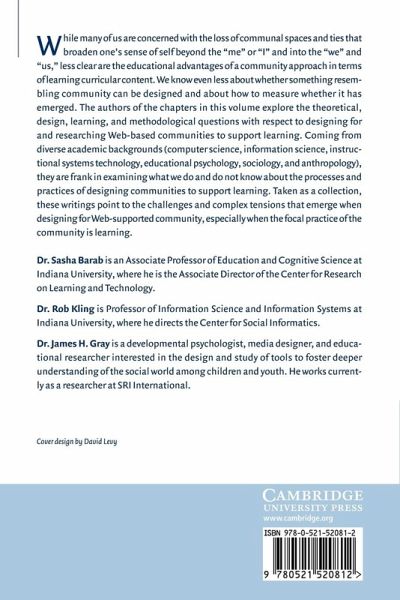
This volume explores the theoretical, design, learning, and methodological questions relevant to designing for and researching web-based communities to support the learning process. Coming from diverse academic backgrounds, the authors examine what we do and do not know about the processes and practices of designing communities to support educational processes. Taken as a collection, the chapters point to the challenges and complex tensions that emerge when designing for a web-supported community, especially when the focal practice of the community is learning.
This volume explores the theoretical, design, learning, and methodological questions relevant to designing for and researching web-based communities to support the learning process. Coming from diverse academic backgrounds, the authors examine what we do and do not know about the processes and practices of designing communities to support educational processes. Taken as a collection, the chapters point to the challenges and complex tensions that emerge when designing for a web-supported community, especially when the focal practice of the community is learning.
Part I. Coming To Terms With Community: 1. Introduction: designing for virtual communities in the service of learning Sasha Barab, Rob Kling and James Gray; 2. Models of community learning and online learning in communities Margaret Riel and Linda Polin; Part II. Designing for Web-supported Community: 3. Designing system dualities: building online community Sasha Barab, James MaKinster and Rebecca Scheckler; 4. Characterizing collective behavior online: the social organization of hangouts, clubs, associations, teams and communities Rob Kling and Christina Courtright; 5. Online teacher communities: technology snake-oil or powerful catalysts for professional development? Mark Schlager and Judi Fucso; 6. Community of practice a metaphor for online design? Thomas Schwen; Part III. Characterizing Community/Member Participation: 7. Autonomy, interaction and knowledge-building as bases for learning at the math forum Ann Renninger; 8. An exploration of community in a knowledge forum classroom: an activity system analysis Jim Hewitt; 9. Co-evolution of technological design and pedagogy in an online learning community Amy Bruckman; 10. From ambitious vision to partially satisfying reality: an evolving socio-technical design supporting community and collaborative learning in teaching education Sharon Derry, Julia Lee, Jong-Baeg Kim and Jennifer Seymour; Part IV. Researching Online Community: 11. Using social network analysis to study online learning communities Emmanuel Koku and Barry Wellman; 12. Computer-mediated discourse analysis: an approach to researching online communities Susan Herring; 13. Shared 'we' and shared 'they' indicators of group identity in online teacher professional development Kirk Sluder and Sasha Barab; 14. Sociocultural analysis of online professional development: a case study of personal, interpersonal, and community aspects James Gray and Deborah Tatar.
Part I. Coming To Terms With Community: 1. Introduction: designing for virtual communities in the service of learning Sasha Barab, Rob Kling and James Gray; 2. Models of community learning and online learning in communities Margaret Riel and Linda Polin; Part II. Designing for Web-supported Community: 3. Designing system dualities: building online community Sasha Barab, James MaKinster and Rebecca Scheckler; 4. Characterizing collective behavior online: the social organization of hangouts, clubs, associations, teams and communities Rob Kling and Christina Courtright; 5. Online teacher communities: technology snake-oil or powerful catalysts for professional development? Mark Schlager and Judi Fucso; 6. Community of practice a metaphor for online design? Thomas Schwen; Part III. Characterizing Community/Member Participation: 7. Autonomy, interaction and knowledge-building as bases for learning at the math forum Ann Renninger; 8. An exploration of community in a knowledge forum classroom: an activity system analysis Jim Hewitt; 9. Co-evolution of technological design and pedagogy in an online learning community Amy Bruckman; 10. From ambitious vision to partially satisfying reality: an evolving socio-technical design supporting community and collaborative learning in teaching education Sharon Derry, Julia Lee, Jong-Baeg Kim and Jennifer Seymour; Part IV. Researching Online Community: 11. Using social network analysis to study online learning communities Emmanuel Koku and Barry Wellman; 12. Computer-mediated discourse analysis: an approach to researching online communities Susan Herring; 13. Shared 'we' and shared 'they' indicators of group identity in online teacher professional development Kirk Sluder and Sasha Barab; 14. Sociocultural analysis of online professional development: a case study of personal, interpersonal, and community aspects James Gray and Deborah Tatar.
Es gelten unsere Allgemeinen Geschäftsbedingungen: www.buecher.de/agb
Impressum
www.buecher.de ist ein Internetauftritt der buecher.de internetstores GmbH
Geschäftsführung: Monica Sawhney | Roland Kölbl | Günter Hilger
Sitz der Gesellschaft: Batheyer Straße 115 - 117, 58099 Hagen
Postanschrift: Bürgermeister-Wegele-Str. 12, 86167 Augsburg
Amtsgericht Hagen HRB 13257
Steuernummer: 321/5800/1497
USt-IdNr: DE450055826