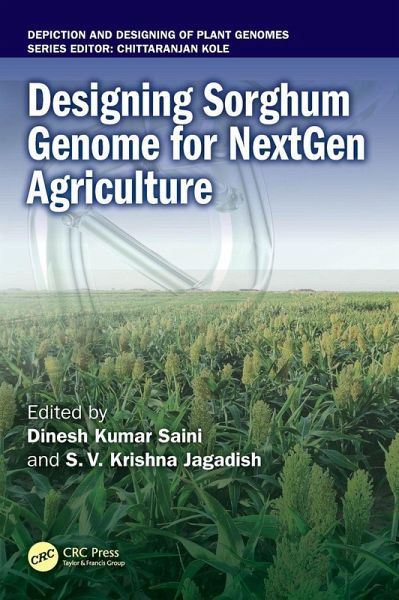
The book explores the latest advancements aimed at improving sorghum's resilience and productivity. This comprehensive resource provides cutting-edge insights into how modern scientific tools and methods are being leveraged to design the sorghum genome for enhanced yield, stress tolerance and nutritional value.
The book explores the latest advancements aimed at improving sorghum's resilience and productivity. This comprehensive resource provides cutting-edge insights into how modern scientific tools and methods are being leveraged to design the sorghum genome for enhanced yield, stress tolerance and nutritional value.
Dinesh Kumar Saini is a Research Associate in the Department of Plant and Soil Science at Texas Tech University, specializing in crop breeding and genomics. He holds a master's degree in Genetics and Plant Breeding from Chaudhary Charan Singh University, India. During his Ph.D. at Punjab Agricultural University, he received prestigious fellowships, including DST-INSPIRE and ICAR-SRF, along with multiple academic honors, including the Chancellor and Vice-Chancellor Medals. His research focuses on the physiological, molecular, and histological mechanisms driving climate resilience and yield potential in grain sorghum. He has co-authored over 55 peer-reviewed articles, 20 book chapters, and numerous abstracts. He actively reviews for reputed journals, serves on editorial boards, and is a member of several professional societies. S. V. Krishna Jagadish is a Professor and Thornton Distinguished Chair of Plant and Soil Science at Texas Tech University. He earned a master's degree in Agronomy from the University of Agricultural Sciences, India, and a Ph.D. in Crop Physiology from the University of Reading, UK. He previously held positions at the International Rice Research Institute, Philippines, and later became a Professor at Kansas State University. Dr. Jagadish has received numerous awards, including the Kansas State Gamma Sigma Delta Outstanding Research Award and International Fellow of the Indian Society of Plant Physiology. With over 200 peer-reviewed publications, 16,500+ citations, an H-index of 73, and $25 million in grant funding, his research focuses on abiotic stress tolerance in sorghum, forage systems, water conservation, and soil health, promoting sustainability in the U.S. Southern High Plains.
Inhaltsangabe
Foreword Preface to the Series Preface Acknowledgements List of Contributors List of Abbreviations 1. Global Importance, Production Trends, and the Need for Designing the Sorghum Genome to Address Future Climatic Conditions 2. Advancing Sorghum Improvement by Harnessing Genetic Diversity Through Advanced Tools and Speed Breeding 3. Bioinformatics Tools and Resources for Sorghum Omics 4. Advances in Molecular Mapping in Sorghum Genome Design 5. Sorghum Genomics and Pan-Genomics in the Next-Generation Sequencing Era 6 . Mutagenesis, Transgenesis, and Targeted Gene Editing in Sorghum Improvement 7. Genomic Selection as a Tool to Accelerate Genetic Gain in Sorghum Improvement: Current Status, Integration with Phenomics and Future Prospects 8. Progress in Hybrid Breeding for Enhanced Grain Yield, Stress Tolerance, and Quality Improvement in Grain Sorghum 9. Omics and Systems Biology Approaches for Developing Climate-Ready Sorghum: Opportunities and Challenges 10. Leveraging Physiological Responses to Abiotic Stresses for Next Generation Sorghum Breeding 11. Molecular Engineering of Sorghum Root-Phenes for Increased Abiotic Stress Resilience 12. Redesigning the Sorghum Root Microbiome for Improved Water and Nutrient Use Efficiency 13. Omics Approaches to Modulate Sorghum Seed Compositional Dynamics for Improved Health Alternatives 14. Leveraging High-Throughput Phenotyping and Artificial Intelligence for Accelerating Sorghum Improvement 15. Utilizing Crop Simulation Modeling to Address Climate Change Challenges in Sorghum Production: Opportunities and Challenges About the book editors
Foreword Preface to the Series Preface Acknowledgements List of Contributors List of Abbreviations 1. Global Importance, Production Trends, and the Need for Designing the Sorghum Genome to Address Future Climatic Conditions 2. Advancing Sorghum Improvement by Harnessing Genetic Diversity Through Advanced Tools and Speed Breeding 3. Bioinformatics Tools and Resources for Sorghum Omics 4. Advances in Molecular Mapping in Sorghum Genome Design 5. Sorghum Genomics and Pan-Genomics in the Next-Generation Sequencing Era 6 . Mutagenesis, Transgenesis, and Targeted Gene Editing in Sorghum Improvement 7. Genomic Selection as a Tool to Accelerate Genetic Gain in Sorghum Improvement: Current Status, Integration with Phenomics and Future Prospects 8. Progress in Hybrid Breeding for Enhanced Grain Yield, Stress Tolerance, and Quality Improvement in Grain Sorghum 9. Omics and Systems Biology Approaches for Developing Climate-Ready Sorghum: Opportunities and Challenges 10. Leveraging Physiological Responses to Abiotic Stresses for Next Generation Sorghum Breeding 11. Molecular Engineering of Sorghum Root-Phenes for Increased Abiotic Stress Resilience 12. Redesigning the Sorghum Root Microbiome for Improved Water and Nutrient Use Efficiency 13. Omics Approaches to Modulate Sorghum Seed Compositional Dynamics for Improved Health Alternatives 14. Leveraging High-Throughput Phenotyping and Artificial Intelligence for Accelerating Sorghum Improvement 15. Utilizing Crop Simulation Modeling to Address Climate Change Challenges in Sorghum Production: Opportunities and Challenges About the book editors
Es gelten unsere Allgemeinen Geschäftsbedingungen: www.buecher.de/agb
Impressum
www.buecher.de ist ein Internetauftritt der buecher.de internetstores GmbH
Geschäftsführung: Monica Sawhney | Roland Kölbl | Günter Hilger
Sitz der Gesellschaft: Batheyer Straße 115 - 117, 58099 Hagen
Postanschrift: Bürgermeister-Wegele-Str. 12, 86167 Augsburg
Amtsgericht Hagen HRB 13257
Steuernummer: 321/5800/1497
USt-IdNr: DE450055826