
Andere Kunden interessierten sich auch für
 Designing the Complex City38,99 €
 Histories of Urban Planning and Political Power37,99 €
 The Protection of Green Spaces for Climate Change Adaptation178,99 €
 Companion to Public Space47,99 €
 Rural Planning Futures38,99 €
 Community Matters54,99 €
 Spatial Implications and Planning Criteria for High-Speed Rail Cities and Regions40,99 €



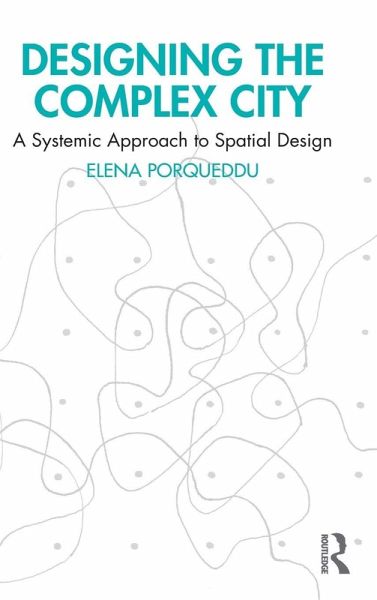
How can designers address the emergent self-organizing nature of complex urban environments? Designing the Complex City highlights how both an excess and a lack of design control might contrast the lively complexity of cities, their adaptive and evolutionary capacity. By using key concepts from systems thinking, complexity sciences, life sciences, cognitive sciences, and social sciences, the book frames a systemic spatial design approach aimed at enhancing the potential of different spatial design disciplines to navigate place-specific emergent transformations without overdetermining their formal outcome. A range of heterogeneous case studies, developing at different scales, show how embracing a design approach that is embodied, open-ended, contextually responsive, incremental and adaptive does not question the relevance of designers' specific skills in shaping the physical structure of cities; it may rather increase their potential to effectively intervene in complex adaptive cycles of urban decay and self-regeneration.
Designing the Complex City provides insights for students, researchers, and academics in architecture, interior design, urban and landscape design, planning theory, and urban studies. It is essential reading for all designers who seek to proactively and meaningfully intervene in spontaneous socio-spatial dynamics.
Designing the Complex City provides insights for students, researchers, and academics in architecture, interior design, urban and landscape design, planning theory, and urban studies. It is essential reading for all designers who seek to proactively and meaningfully intervene in spontaneous socio-spatial dynamics.
"Complexity calls for alternative spatial designs, a message Elena Porqueddu conveys with compelling clarity. Highlighting flow, change and adaptability across various levels, she leaves no room for doubt about their implications for designers. Furthermore, she proposes an approach to design that gracefully addresses the challenges of spontaneous urban transformation"
Gert de Roo, Professor in Planning, University of Groningen, Netherlands
"The field of design seems to often undervalue the disruptive implications of complexity. This book tries to fill this gap in an original way by developing a fresh approach that is both theoretically and practically challenging in this regard."
Stefano Moroni, Professor in Planning, Polytechnic University of Milan, Italy
Gert de Roo, Professor in Planning, University of Groningen, Netherlands
"The field of design seems to often undervalue the disruptive implications of complexity. This book tries to fill this gap in an original way by developing a fresh approach that is both theoretically and practically challenging in this regard."
Stefano Moroni, Professor in Planning, Polytechnic University of Milan, Italy