14,99 €
inkl. MwSt.
Versandkostenfrei*Erscheint vorauss. 6. August 2026
Melden Sie sich
hier
hier
für den Produktalarm an, um über die Verfügbarkeit des Produkts informiert zu werden.
oder sofort lesen als eBook

7 °P sammeln
Andere Kunden interessierten sich auch für
 Science and Ideology56,99 €
 The Scientific Papers of the Honourable Henry Cavendish26,99 €
 Containing Iran25,99 €
 The Fallacies of Cold War Deterrence and a New Direction25,99 €
 A Brief Account of Radio-activity15,99 €
 Iran's Nuclear Future19,99 €
 Nuclear War9,99 €







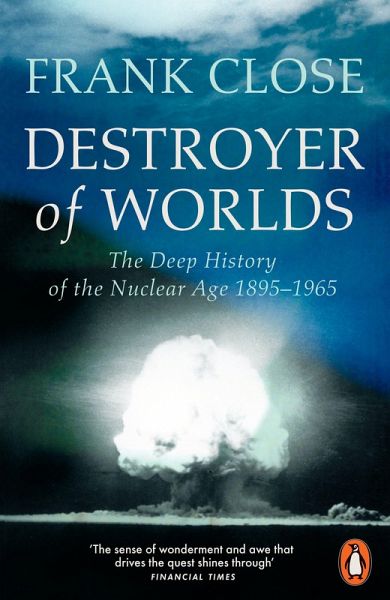
Henry Becquerel's accidental discovery, in Paris in 1896, of a faint smudge on a photographic plate sparked a chain of discoveries which would unleash the atomic age. Destroyer of Worlds is the story of how pursuit of this hidden source of nuclear power, which began innocently and collaboratively, was overwhelmed by the politics of the 1930s, and following devastation of Hiroshima and Nagasaki opened the way to a still more terrible possibility: a thermonuclear bomb, the so-called "backyard weapon", that could destroy all life on earth - from anywhere. Spanning decades and continents, the story moves from Becquerel to Ernest Rutherford, Enrico Fermi, Otto Hahn, Lise Meitner and the Joliot-Curies, and on to the appearance of Robert Oppenheimer before climaxing with increasingly horrifying developments in the USA and USSR. It re-evaluates the important role played by three remarkable women - Lise Meitner, Ida Noddack and Irene Curie - and provides new insights into the work of Ettore Majorana, who mysteriously disappeared in 1938. This is the remarkable story of how knowledge is often advanced by personal convictions and relationships, an indeed by chance.