
Andere Kunden interessierten sich auch für
 Maternities203,99 €
 Coastal Erosion and Impacts41,99 €
") Urban development and risk on the Somone-Mbour coast (Senegal)27,99 €
Urban development and risk on the Somone-Mbour coast (Senegal)27,99 € The role of Geography in Regional Planning53,99 €
 Mining and spatial dynamics in south-eastern Senegal43,99 €
 Health risk and adaptation to climate change in Senegal29,99 €
 The Determinants of micro-enterprises in Debremarkos Town, Ethiopia41,99 €






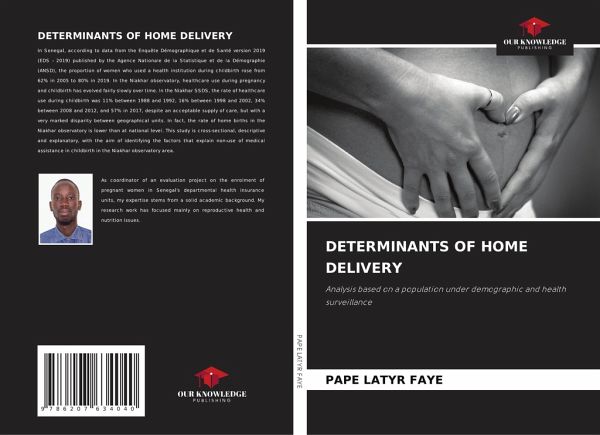
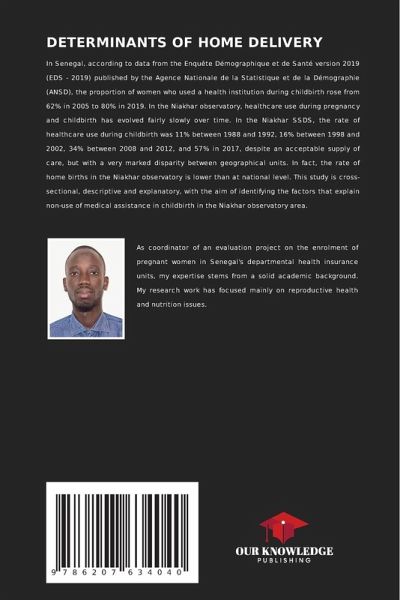
In Senegal, according to data from the Enquête Démographique et de Santé version 2019 (EDS - 2019) published by the Agence Nationale de la Statistique et de la Démographie (ANSD), the proportion of women who used a health institution during childbirth rose from 62% in 2005 to 80% in 2019. In the Niakhar observatory, healthcare use during pregnancy and childbirth has evolved fairly slowly over time. In the Niakhar SSDS, the rate of healthcare use during childbirth was 11% between 1988 and 1992, 16% between 1998 and 2002, 34% between 2008 and 2012, and 57% in 2017, despite an acceptable supply of care, but with a very marked disparity between geographical units. In fact, the rate of home births in the Niakhar observatory is lower than at national level. This study is cross-sectional, descriptive and explanatory, with the aim of identifying the factors that explain non-use of medical assistance in childbirth in the Niakhar observatory area.