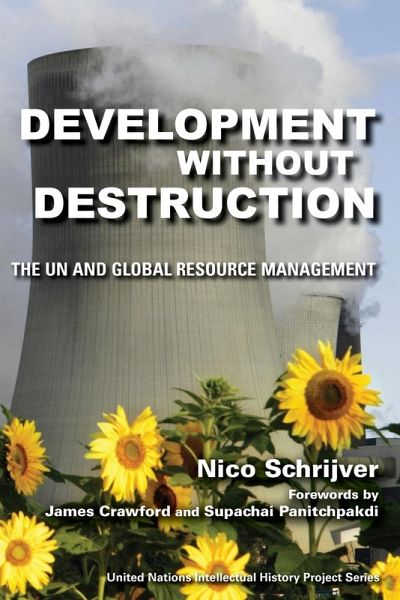
Since 1945, the UN has been actively engaged in conceptualizing strategies for both economic development and a sustainable environment. From a broad historical perspective, Development without Destruction sketches the role played by organizations and individuals in the UN system in developing and consolidating principles of international law and international governance with respect to natural resource management. Nico Schrijver highlights the UN's efforts to generate and implement strategies to resolve tensions between economic development and environmental protection, conservation and…mehr
Since 1945, the UN has been actively engaged in conceptualizing strategies for both economic development and a sustainable environment. From a broad historical perspective, Development without Destruction sketches the role played by organizations and individuals in the UN system in developing and consolidating principles of international law and international governance with respect to natural resource management. Nico Schrijver highlights the UN's efforts to generate and implement strategies to resolve tensions between economic development and environmental protection, conservation and exploitation, sovereignty and internationalism, and armed conflict and peaceful access to natural resources. Schrijver's thorough analysis is an indispensable guide to management of the critical environmental issues on today's global agenda.
Nico Schrijver holds the Chair of International Law and is Academic Director of the Grotius Centre for International Legal Studies at Leiden University. He is author of The Evolution of Sustainable Development in International Law: Inception, Meaning, and Status and Sovereignty over Natural Resources: Balancing Rights and Duties.
Inhaltsangabe
List of Figures and Tables Series Editors' Foreword / Louis Emmerij, Richard Jolly, and Thomas G. Weiss Foreword / James Crawford Foreword / Supachai Panitchpakdi Acknowledgments List of Abbreviations Introduction: Concepts and Principles 1. Historical Background: Formative Phases of International Organization during the Pre-UN Period 2. UN Involvement with Natural Resource Management at the National and Transboundary Levels 3. Management of the Global Commons 4. The International Architecture for Environmental Governance and Global Resource Management 5. Natural Resources and Armed Conflict 6. The Role of the International Court of Justice in the Settlement of Natural Resource Disputes 7. The UN's Conceptual Contribution: Conclusions and Challenges Notes Index About the Author About the United Nations Intellectual History Project
Es gelten unsere Allgemeinen Geschäftsbedingungen: www.buecher.de/agb
Impressum
www.buecher.de ist ein Internetauftritt der buecher.de internetstores GmbH
Geschäftsführung: Monica Sawhney | Roland Kölbl | Günter Hilger
Sitz der Gesellschaft: Batheyer Straße 115 - 117, 58099 Hagen
Postanschrift: Bürgermeister-Wegele-Str. 12, 86167 Augsburg
Amtsgericht Hagen HRB 13257
Steuernummer: 321/5800/1497
USt-IdNr: DE450055826