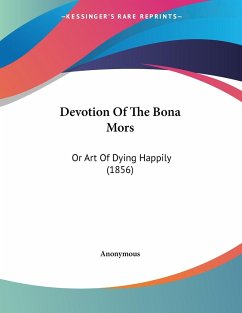
""Devotion of the Bona Mors: Or Art of Dying Happily"" is a religious book that was published in 1856 anonymously. The book is focused on the concept of a ""good death"" or a peaceful and happy passing. It is written from a Christian perspective and is aimed at helping readers prepare for death by living a virtuous life and maintaining a strong faith in God. The book contains a variety of prayers, meditations, and reflections on death, as well as advice on how to live a good life in preparation for the afterlife. It also includes stories of saints and other holy figures who faced death with…mehr
""Devotion of the Bona Mors: Or Art of Dying Happily"" is a religious book that was published in 1856 anonymously. The book is focused on the concept of a ""good death"" or a peaceful and happy passing. It is written from a Christian perspective and is aimed at helping readers prepare for death by living a virtuous life and maintaining a strong faith in God. The book contains a variety of prayers, meditations, and reflections on death, as well as advice on how to live a good life in preparation for the afterlife. It also includes stories of saints and other holy figures who faced death with courage and faith. Overall, ""Devotion of the Bona Mors"" is a guidebook for those seeking a peaceful and happy death, and provides comfort and inspiration for those facing the end of their lives.This scarce antiquarian book is a facsimile reprint of the old original and may contain some imperfections such as library marks and notations. Because we believe this work is culturally important, we have made it available as part of our commitment for protecting, preserving, and promoting the world's literature in affordable, high quality, modern editions, that are true to their original work.
The author of The Mabinogion is unknown, as the stories were passed down through Welsh oral tradition before being recorded in medieval manuscripts. They were later preserved in the White Book of Rhydderch and the Red Book of Hergest, two 14th-century texts. Though the scribes remain unnamed, their work safeguarded Wales's rich mythological heritage.These tales draw from ancient Celtic mythology, heroic sagas, and supernatural folklore. They reflect the cultural and political landscape of early Wales, blending history with legend. While the original storytellers are lost to time, their influence endures.In the 19th century, Lady Charlotte Guest translated and popularized The Mabinogion, introducing it to a wider English-speaking audience. Her work helped establish the text as a foundational piece of medieval literature and revived interest in Welsh mythology. Thanks to her efforts and the nameless scribes before her, The Mabinogion continues to captivate readers and scholars alike, preserving the voice of a lost era.
Es gelten unsere Allgemeinen Geschäftsbedingungen: www.buecher.de/agb
Impressum
www.buecher.de ist ein Internetauftritt der buecher.de internetstores GmbH
Geschäftsführung: Monica Sawhney | Roland Kölbl | Günter Hilger
Sitz der Gesellschaft: Batheyer Straße 115 - 117, 58099 Hagen
Postanschrift: Bürgermeister-Wegele-Str. 12, 86167 Augsburg
Amtsgericht Hagen HRB 13257
Steuernummer: 321/5800/1497
USt-IdNr: DE450055826