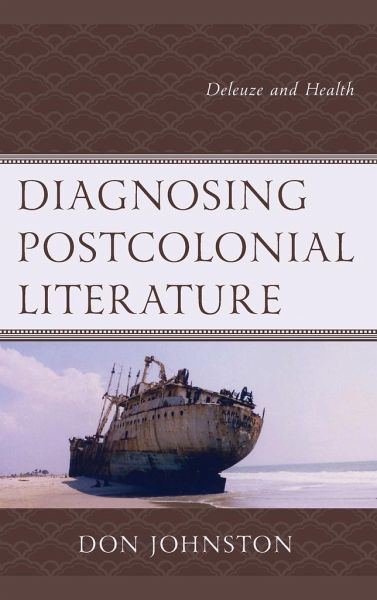
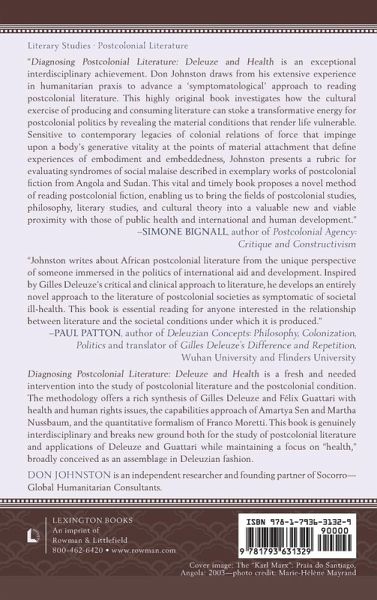
Diagnosing Postcolonial Literature is a fresh and needed intervention into the study of postcolonial literature and the postcolonial condition. Deleuze's notion that literature is an enterprise of health, and that great authors consequently are diagnosticians of their culture, can be applied to postcolonial literature. The methodology, however, goes beyond the Deleuzian approach and offers a rich synthesis of Deleuze and Guattari with a range of different frameworks including health and human rights issues, the capabilities approach of Sen and Nussbaum, and the quantitative formalism of…mehr
Diagnosing Postcolonial Literature is a fresh and needed intervention into the study of postcolonial literature and the postcolonial condition. Deleuze's notion that literature is an enterprise of health, and that great authors consequently are diagnosticians of their culture, can be applied to postcolonial literature. The methodology, however, goes beyond the Deleuzian approach and offers a rich synthesis of Deleuze and Guattari with a range of different frameworks including health and human rights issues, the capabilities approach of Sen and Nussbaum, and the quantitative formalism of Moretti. This book majorly seeks to combine the study of postcolonial literature (a field in which Deleuze and Guattari are often used) with social sciences and quantitative methods. The work is genuinely interdisciplinary and breaks new ground both for the study of postcolonial literature and applications of Deleuze and Guattari. It does this while maintaining a focus on 'health', broadly conceived in as an assemblage, in Deleuzian fashion.
I was born in East Texas a long time ago and grew up with a sister and a brother. Upon completing high school, I joined the U.S. Air Force and served three years as a jungle survival instructor in Panama. Following my military service, I enrolled in Stephen F. Austin State University and got married. After getting my degree in biology and chemistry, we moved to Houston where our only child, a son, was born.During the early years of my career, I wrote numerous technical articles and reports but no fiction until recently. Upon retirement, I became interested in writing science fiction. My first sci-fi novel, The Dar Lumbre Chronicles, was published in 2018. It took me about two years to write The Alamogordo Connection. At that rate, you can look for the third one, The Photosynthesis Gene in 2022.My wife of 53 years died of cancer in 2014, leaving me the patriarch of a small family-a son, a daughter-in-law, three grandchildren, and two great grandchildren. My family is my pride and joy.I have been a member of Sugar Land Baptist Church for over 20 years and have led Bible study classes throughout that time.
Inhaltsangabe
Chapter 1: Postcolonial Theory's Heedlessness to Health, "D"evelopment's Disregard for Postcolonialism Chapter 2: Elaborating a Postcolonial Symptomatology Chapter 3: Those Excluded by the City: Pepetela and Angola's "Savage Capitalism" Chapter 4: Becoming-witness: the Conflagration of the Arab Community and the Sudanese Arab writer, Tayeb Salih Chapter 5: Conclusion Appendix
Chapter 1: Postcolonial Theory's Heedlessness to Health, "D"evelopment's Disregard for Postcolonialism Chapter 2: Elaborating a Postcolonial Symptomatology Chapter 3: Those Excluded by the City: Pepetela and Angola's "Savage Capitalism" Chapter 4: Becoming-witness: the Conflagration of the Arab Community and the Sudanese Arab writer, Tayeb Salih Chapter 5: Conclusion Appendix
Es gelten unsere Allgemeinen Geschäftsbedingungen: www.buecher.de/agb
Impressum
www.buecher.de ist ein Internetauftritt der buecher.de internetstores GmbH
Geschäftsführung: Monica Sawhney | Roland Kölbl | Günter Hilger
Sitz der Gesellschaft: Batheyer Straße 115 - 117, 58099 Hagen
Postanschrift: Bürgermeister-Wegele-Str. 12, 86167 Augsburg
Amtsgericht Hagen HRB 13257
Steuernummer: 321/5800/1497
USt-IdNr: DE450055826