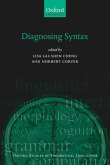
Diagnosis is an essential part of scientific research. It refers to the process of identifying a phenomenon, property, or condition on the basis of certain signs and by the use of various diagnostic procedures. This book is the first ever to consider the use of diagnostics in syntactic research and focuses on the five core domains of natural language syntax - ellipsis, agreement, anaphora, phrasal movement, and head movement. Each empirical domain is considered in turn from the perspectives of syntax, syntax at the interfaces, neuropsycholinguistics, and language diversity. Drawing on the…mehr
Diagnosis is an essential part of scientific research. It refers to the process of identifying a phenomenon, property, or condition on the basis of certain signs and by the use of various diagnostic procedures. This book is the first ever to consider the use of diagnostics in syntactic research and focuses on the five core domains of natural language syntax - ellipsis, agreement, anaphora, phrasal movement, and head movement. Each empirical domain is considered in turn from the perspectives of syntax, syntax at the interfaces, neuropsycholinguistics, and language diversity. Drawing on the expertise of 2 leading scholars and their empirically rich data, the book presents current thoughts on, and practical answers to, the question: What are the diagnostic signs, techniques and procedures that can be used to analyse natural language syntax? It will interest linguists, including formalists, typologists, psycholinguists and neurolinguists.
Lisa Lai-Shen Cheng is Chair Professor of Linguistics at Leiden University. She received her PhD in Linguistics from MIT in 1991. Her main research interests include comparative syntax (both micro- and macro-comparation), syntax-semantics interface and syntax-phonology interface. Some recent research topics include verb doubling, free choice items and prosodic domains. She has published in Linguistic Inquiry, The Linguistic Review, Syntax, Journal of East Asian Linguistics, Journal of African Language and Linguistics, Natural Language Semantics, and Journal of Semantics. Norbert Corver is Professor of Dutch Linguistics at Utrecht University. He received his PhD in Linguistics from Tilburg University in 1990. His main research interests are Dutch syntax, micro- and macro-comparative syntax, the study of syntax at the interface with information structure and affect. Some recent research topics include predicate displacement, the internal syntax of adjective phrases, NP-ellipsis, the syntax of interjections, exclamatives and curse expressions. He has published in Natural Language and Linguistic Theory, Linguistic Inquiry, The Linguistic Review, Lingua, Linguistics, and The Journal of Comparative Germanic Linguistics.
Inhaltsangabe
* 1: Lisa Lai-Shen Cheng and Norbert Corver: Syntactic Diagnostics in the Study of Human Language * Part I: Head Movement * 2: Christer Platzack: Head Movement as a Phonological Operation * 3: Heidi Harley: Getting Morphemes in Order: affixation and head movement * 4: Naama Friedmann: Verb Movement to C: from agrammatic aphasias to syntactic analysis * 5: Jochen Zeller: In Defence of Head Movement: evidence from Bantu * 6: Heidi Harley: Diagnosing Head Movement * Part II: Phrasal Movement * 7: David Pesetsky: Phrasal Movement and its DIscontents: diseases and diagnoses * 8: Winfried Lechner: Diagnosing Covert Movement: the Duke of York reconstruction * 9: Hamida Demirdache: Arguments for LD Movement in LD Questions in Child Language * 10: Maria Polinsky and Eric Potsdam: Diagnosing Covert A-movement * 11: Winfried Lechner: Diagnosing XP Movement * Part III: Agreement * 12: Sandra Chung: The Syntactic Relations Behind Agreement * 13: Ora Matushansky: Gender Confusion * 14: Maria Teresa Guasti: Agreement in the Production of Subject and Object wh-questions * 15: Jamal Ouhalla: Agreement Unified: Arabic * 16: Maria Teresa Guasti and Ora Matushansky: Diagnosing Agreement * Part IV: Anaphora * 17: Martin Everaert and Elena Anagnostopoulou: Identifying Anaphoric Dependencies * 18: Chris Tancredi: Condition B * 19: Sergey Avrutin and Sergio Baauw: A Processing View on Agrammatism * 20: Norvin Richards: Tagalog Anaphora * 21: martin Everaert: Diagnosing Anaphora * Part V: Ellipsis * 22: Jason Merchant: Polarity Item Under Ellipsis * 23: Susanne Winkler: Syntactic Diagnostics for Extraction of Focus From Ellipsis Site * 24: Lyn Frazier: A Recycling Approach to Processing Ellipsis * 25: Jeroen van Craenenbroeck and Anikó Lipták: What Sluicing Can do, What it Can't, and in Which Language: on the cross-linguistic syntax of ellipsis * 26: Jason Merchant: Diagnosing Ellipsis
* 1: Lisa Lai-Shen Cheng and Norbert Corver: Syntactic Diagnostics in the Study of Human Language * Part I: Head Movement * 2: Christer Platzack: Head Movement as a Phonological Operation * 3: Heidi Harley: Getting Morphemes in Order: affixation and head movement * 4: Naama Friedmann: Verb Movement to C: from agrammatic aphasias to syntactic analysis * 5: Jochen Zeller: In Defence of Head Movement: evidence from Bantu * 6: Heidi Harley: Diagnosing Head Movement * Part II: Phrasal Movement * 7: David Pesetsky: Phrasal Movement and its DIscontents: diseases and diagnoses * 8: Winfried Lechner: Diagnosing Covert Movement: the Duke of York reconstruction * 9: Hamida Demirdache: Arguments for LD Movement in LD Questions in Child Language * 10: Maria Polinsky and Eric Potsdam: Diagnosing Covert A-movement * 11: Winfried Lechner: Diagnosing XP Movement * Part III: Agreement * 12: Sandra Chung: The Syntactic Relations Behind Agreement * 13: Ora Matushansky: Gender Confusion * 14: Maria Teresa Guasti: Agreement in the Production of Subject and Object wh-questions * 15: Jamal Ouhalla: Agreement Unified: Arabic * 16: Maria Teresa Guasti and Ora Matushansky: Diagnosing Agreement * Part IV: Anaphora * 17: Martin Everaert and Elena Anagnostopoulou: Identifying Anaphoric Dependencies * 18: Chris Tancredi: Condition B * 19: Sergey Avrutin and Sergio Baauw: A Processing View on Agrammatism * 20: Norvin Richards: Tagalog Anaphora * 21: martin Everaert: Diagnosing Anaphora * Part V: Ellipsis * 22: Jason Merchant: Polarity Item Under Ellipsis * 23: Susanne Winkler: Syntactic Diagnostics for Extraction of Focus From Ellipsis Site * 24: Lyn Frazier: A Recycling Approach to Processing Ellipsis * 25: Jeroen van Craenenbroeck and Anikó Lipták: What Sluicing Can do, What it Can't, and in Which Language: on the cross-linguistic syntax of ellipsis * 26: Jason Merchant: Diagnosing Ellipsis
Es gelten unsere Allgemeinen Geschäftsbedingungen: www.buecher.de/agb
Impressum
www.buecher.de ist ein Internetauftritt der buecher.de internetstores GmbH
Geschäftsführung: Monica Sawhney | Roland Kölbl | Günter Hilger
Sitz der Gesellschaft: Batheyer Straße 115 - 117, 58099 Hagen
Postanschrift: Bürgermeister-Wegele-Str. 12, 86167 Augsburg
Amtsgericht Hagen HRB 13257
Steuernummer: 321/5800/1497
USt-IdNr: DE450055826