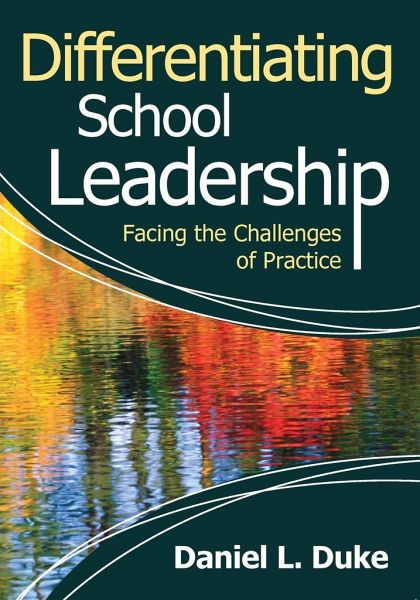
Diagnose your school's critical challenges and apply specific differentiated leadership strategies for improvement! Whether yours is an urban or a rural school, every setting faces unique types of challenges requiring an appropriate and differentiated response. This book introduces the qualities of differentiated leadership and stresses the importance of understanding that different schools can face very distinct sets of challenges. The author provides principals with an overview of "organizational diagnostics" with guidelines for identifying critical issues and demonstrates how to apply…mehr
Diagnose your school's critical challenges and apply specific differentiated leadership strategies for improvement! Whether yours is an urban or a rural school, every setting faces unique types of challenges requiring an appropriate and differentiated response. This book introduces the qualities of differentiated leadership and stresses the importance of understanding that different schools can face very distinct sets of challenges. The author provides principals with an overview of "organizational diagnostics" with guidelines for identifying critical issues and demonstrates how to apply differentiated leadership to four high-level priorities: Preventing school decline Turning around a low-performing school Sustaining improvements Designing a new school
After teaching high school social studies and serving as a secondary school administrator, Daniel L. Duke embarked on a career in higher education. For over three decades he has taught courses on educational leadership, organizational change, and school reform as well as conducted research on various aspects of public schools. After serving on the faculties of Lewis and Clark College and Stanford University, he came to the University of Virginia as chair of Educational Leadership and Policy Studies. Duke founded and directed the Thomas Jefferson Center for Educational Design and helped establish the Darden-Curry Partnership for Leaders in Education (PLE), a unique enterprise involving the Curry School of Education and the Darden Graduate School of Business Administration. He serves as research director for the PLE. A prolific writer, Duke has authored or co-authored 27 books and several hundred scholarly articles, monographs, chapters, and reports. His most recent books include The Challenges of Educational Change (2004), Education Empire: The Evolution of an Excellent Suburban School System (2005), Teachers' Guide to School Turnarounds (2007), and The Little School System That Could: Transforming a City School District (2008). A highly regarded consultant, Duke has worked with over 150 school systems, state agencies, foundations, and governments across the United States and abroad. He has served as president of the University Council for Educational Administration and was chosen as Professor of the Year at the Curry School of Education.
Inhaltsangabe
Acknowledgments About the Author Introduction Part I. The Challenge of School Decline 1. Recognizing the Potential for School Decline A School on the Brink Detecting Vulnerabilities The Impact of Inadequate Funding The Impact of a Weak Principal The Impact of a Change in School Culture Meeting the Challenge of School Decline Key Lessons and Next Steps 2. Leadership to Prevent School Decline Leading Schools That Face Demographic Changes The Challenges of Changing Demographics School Leadership in the Face of Demographic Change Key Lessons and Next Steps Part II. The Challenge of School Turnaround 3. Identifying the Characteristics of Low-Performing Schools A School in Need of Turning Around Analyzing the Causes of Low Performance Diagnosing School-Based Causes Meeting the Challenge of School Turnaround Key Lessons and Next Steps 4. Leadership to Turn Around a Low-Performing School Targeting Key Conditions School Turnaround Leadership Key Lessons and Next Steps Part III. The Challenge of Sustaining School Improvement 5. Reversing School Failure Is Only the First Step A Promising Start at Stuart High School Determining the Unfinished Agenda Meeting the Challenge of Sustained Improvement Key Lessons and Next Steps 6. Leadership to Sustain School Improvement Building Capacity for Sustained Success The Challenges of Sustained School Improvement Leadership for the Long Haul Key Lessons and Next Steps Part IV. The Challenge of Creating a New School 7. Leadership for Students Who Need a Different Learning Environment Leading by Design Meeting the Challenge of Creating a New School Key Lessons and Next Steps Part V. Leadership Lessons 8. Why School Leaders Fail Self-Inflicted Problems The Greatest Mistake of All 9. The Implications of Differentiating Leadership Some Practical Consequences Last Word References Index
Acknowledgments About the Author Introduction Part I. The Challenge of School Decline 1. Recognizing the Potential for School Decline A School on the Brink Detecting Vulnerabilities The Impact of Inadequate Funding The Impact of a Weak Principal The Impact of a Change in School Culture Meeting the Challenge of School Decline Key Lessons and Next Steps 2. Leadership to Prevent School Decline Leading Schools That Face Demographic Changes The Challenges of Changing Demographics School Leadership in the Face of Demographic Change Key Lessons and Next Steps Part II. The Challenge of School Turnaround 3. Identifying the Characteristics of Low-Performing Schools A School in Need of Turning Around Analyzing the Causes of Low Performance Diagnosing School-Based Causes Meeting the Challenge of School Turnaround Key Lessons and Next Steps 4. Leadership to Turn Around a Low-Performing School Targeting Key Conditions School Turnaround Leadership Key Lessons and Next Steps Part III. The Challenge of Sustaining School Improvement 5. Reversing School Failure Is Only the First Step A Promising Start at Stuart High School Determining the Unfinished Agenda Meeting the Challenge of Sustained Improvement Key Lessons and Next Steps 6. Leadership to Sustain School Improvement Building Capacity for Sustained Success The Challenges of Sustained School Improvement Leadership for the Long Haul Key Lessons and Next Steps Part IV. The Challenge of Creating a New School 7. Leadership for Students Who Need a Different Learning Environment Leading by Design Meeting the Challenge of Creating a New School Key Lessons and Next Steps Part V. Leadership Lessons 8. Why School Leaders Fail Self-Inflicted Problems The Greatest Mistake of All 9. The Implications of Differentiating Leadership Some Practical Consequences Last Word References Index
Es gelten unsere Allgemeinen Geschäftsbedingungen: www.buecher.de/agb
Impressum
www.buecher.de ist ein Internetauftritt der buecher.de internetstores GmbH
Geschäftsführung: Monica Sawhney | Roland Kölbl | Günter Hilger
Sitz der Gesellschaft: Batheyer Straße 115 - 117, 58099 Hagen
Postanschrift: Bürgermeister-Wegele-Str. 12, 86167 Augsburg
Amtsgericht Hagen HRB 13257
Steuernummer: 321/5800/1497
USt-IdNr: DE450055826