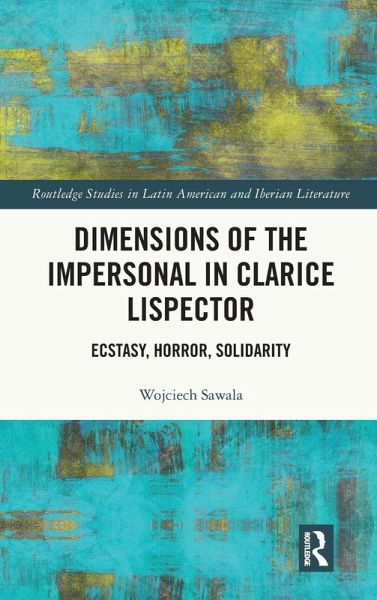
This book explores the fictional work of Clarice Lispector (1920-1977), the eminent twentieth-century Brazilian writer. It employs the theoretical framework of "affirmative biopolitics" by Roberto Esposito, engaging with Michel Foucault and Giorgio Agamben, alongside voices like Mircea Eliade, Anthony Giddens, and Agata Bielik-Robson. The focus is on rethinking and valuing "impersonality," crucial for understanding the anthropological, metaphysical, ethical, and political implications in Lispector's works. The main thesis posits that Lispector's writings, from journalistic chronicles to…mehr
This book explores the fictional work of Clarice Lispector (1920-1977), the eminent twentieth-century Brazilian writer. It employs the theoretical framework of "affirmative biopolitics" by Roberto Esposito, engaging with Michel Foucault and Giorgio Agamben, alongside voices like Mircea Eliade, Anthony Giddens, and Agata Bielik-Robson. The focus is on rethinking and valuing "impersonality," crucial for understanding the anthropological, metaphysical, ethical, and political implications in Lispector's works. The main thesis posits that Lispector's writings, from journalistic chronicles to significant books like The Passion According to G.H., present a complex anthropological vision marked by an ontological and ethical "deadlock" between personality and impersonality. This vision suggests that humans are trapped in a personal mode of existence, separated from their ontological essence, leading to a metaphysical guilt. The book analyzes this deadlock both in individual and communal-political contexts, highlighting the cryptotheological dimension in Lispector's mystical and messianic themes rooted in Jewish tradition.
Produktdetails
Produktdetails
Routledge Studies in Latin American and Iberian Literature
Wojciech Sawala is an assistant professor in the Department of Portuguese at Adam Mickiewicz University of Poznan, Poland. Comparatist and Latin Americanist, he specializes in the continent's twentieth-century narrative classics, including Borges, Cortázar, Lispector, and Guimarães Rosa. His research interests include biopolitics, postsecularism and Jewish messianism.
Inhaltsangabe
Acknowledgements Introduction Chapter 1. Constructing/Dismantling Personhood Humanity as a Dispositif "Human Setup": On the History of the Notion of a Person Persona as Human's Ontological Status Beyond the Dispositif of a Person: What Remains Ethics of Impersonality Chapter 2. Depersonalizations: Modernism and Jewish Tradition Modernist Depersonalizations Fernando Pessoa: Depersonalization and Abulia Hermann Hesse: Through Multiplicity Toward Unity Impersonality in Brazilian Modernism Clarice Lispector: A Writer, a Mystic, a Messianist Chapter 3. Dialectics of Personhood: Infancy and Puberty Telephone as a Synecdoche of the Dispositif A Person as a Dispositif: Humanization as Banishment from Being Human Life as a Dialectic of Personalization and Depersonalization Fetal and Infant Life as an Impersonal State Domestication of Child, Animal, and God Maturing as the Emergence of a Person from an Impersonal Background Chapter 4. Crisis of Personhood: Horror and Ecstasy Home and Ontological Security The Vegetal Space of Impersonality Freedom and Beauty The Horror of Impersonality: Lispector and the "Heart of Darkness" The Ascetic-Mystical Experience: From "the Self" Toward Nothingness Layers and Seduction Biological Life as an Object of Disgust Chapter 5. Impersonalist Ethics: Toward Solidarity with the Bare Life The Political Dimension of the Bare Life Encounter with the Cockroach: Approaching the Bare Life Literary Study of Conditions for "Affirmative Biopolitics" Messianic Coda: "We shall be inhuman..." Bibliography Index
Es gelten unsere Allgemeinen Geschäftsbedingungen: www.buecher.de/agb
Impressum
www.buecher.de ist ein Internetauftritt der buecher.de internetstores GmbH
Geschäftsführung: Monica Sawhney | Roland Kölbl | Günter Hilger
Sitz der Gesellschaft: Batheyer Straße 115 - 117, 58099 Hagen
Postanschrift: Bürgermeister-Wegele-Str. 12, 86167 Augsburg
Amtsgericht Hagen HRB 13257
Steuernummer: 321/5800/1497
USt-IdNr: DE450055826