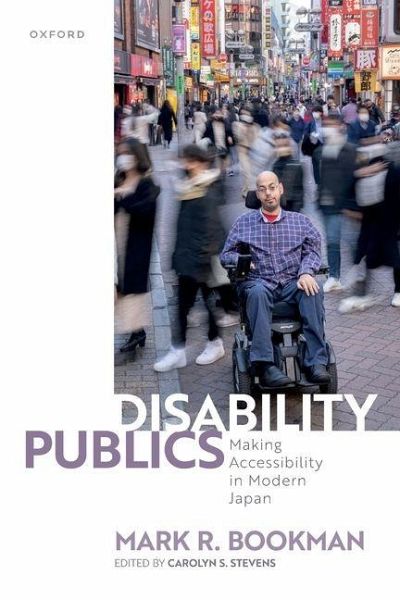
Over the last 150 years, activists and policymakers in Japan have tried to improve access for disabled persons, but these attempts have frequently excluded as many impaired individuals as they have empowered. Why and how have stakeholders pursued these accessibility projects for different demographics in modern Japan?
Over the last 150 years, activists and policymakers in Japan have tried to improve access for disabled persons, but these attempts have frequently excluded as many impaired individuals as they have empowered. Why and how have stakeholders pursued these accessibility projects for different demographics in modern Japan?
Before his untimely passing in 2022, Mark R. Bookman was a Postdoctoral Fellow at Tokyo College, the University of Tokyo. His research examines the history of disability policy and connected social movements in Japanese and global contexts. Mark held PhD and MA degrees from the University of Pennsylvania as well as a BA from Villanova University. Mark's scholarship on disability inclusion can be found in peer-reviewed journals such as Japan Focus: The Asia-Pacific Journal and public-facing media outlets like the Japan Times and Japan Today. Outside of the academy, Mark also worked as an accessibility consultant, working with government agencies and corporate entities in Japan, the United States, and Canada, as well as the International Paralympic Committee and United Nations, on projects related to inclusive education, equitable environments, and disaster risk management for diverse demographics of disabled people. For additional author information, see www.bookmanresearch.com Carolyn S. Stevens is an anthropologist of contemporary Japan with degrees from Harvard College and Columbia University. After serving at the University of Melbourne and Monash University for thirty years, she is currently Emeritus Professor of Japanese Studies at Monash University, Australia. Her research to date has focused on social problems in Japan, disability studies and music/sensory studies. Her recent monographs include Disability in Japan (2013), and the coauthored Sounding Out Japan: A Sensory Ethnographic Tour (2021). She is currently Editor-in-Chief of the interdisciplinary journal Japanese Studies, a Routledge imprint.
Inhaltsangabe
Introduction: Japanese Disability Studies is for Everyone Part I. Defining Disability 1: Bodily Privilege in the Prewar Period (1868-1937) 2: Wartime Welfare and Postwar Policymaking (1937-1957) Part II. Expansion and Exclusion 3: Economic Growth and the Rise of Residential Institutions (1957-1970) 4: Deinstitutionalization and Experiments in Integration (1970-1981) Part III. Community Life 5: Independent Living and Universal Design (1981-2006) 6: Implementation Issues and Antidiscrimination Laws (2006-2014) 7: Paralympic Possibilities and Inclusion Projects (2014-2021) Conclusion / Epilogue: Breaking Down Barriers-From Analysis to Praxis
Introduction: Japanese Disability Studies is for Everyone Part I. Defining Disability 1: Bodily Privilege in the Prewar Period (1868-1937) 2: Wartime Welfare and Postwar Policymaking (1937-1957) Part II. Expansion and Exclusion 3: Economic Growth and the Rise of Residential Institutions (1957-1970) 4: Deinstitutionalization and Experiments in Integration (1970-1981) Part III. Community Life 5: Independent Living and Universal Design (1981-2006) 6: Implementation Issues and Antidiscrimination Laws (2006-2014) 7: Paralympic Possibilities and Inclusion Projects (2014-2021) Conclusion / Epilogue: Breaking Down Barriers-From Analysis to Praxis
Es gelten unsere Allgemeinen Geschäftsbedingungen: www.buecher.de/agb
Impressum
www.buecher.de ist ein Internetauftritt der buecher.de internetstores GmbH
Geschäftsführung: Monica Sawhney | Roland Kölbl | Günter Hilger
Sitz der Gesellschaft: Batheyer Straße 115 - 117, 58099 Hagen
Postanschrift: Bürgermeister-Wegele-Str. 12, 86167 Augsburg
Amtsgericht Hagen HRB 13257
Steuernummer: 321/5800/1497
USt-IdNr: DE450055826