
Andere Kunden interessierten sich auch für
 Community Carsharing and the Social-Ecological Mobility Transition40,99 €
 Rural Planning Futures38,99 €
 DISASTER MANAGEMENT SYSTEM53,99 €
 Walking, Landscape and Environment40,99 €
 Bike Share35,99 €
 Insurgent Public Space179,99 €
 Introduction to Design Psychology137,99 €





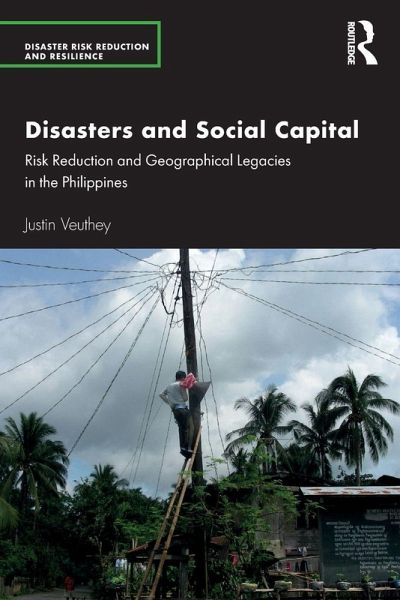
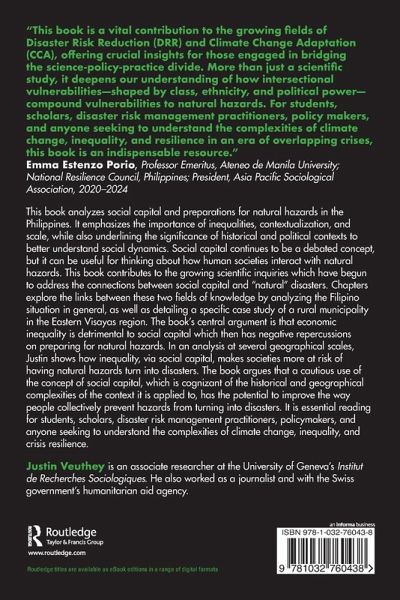
This book analyzes social capital and preparations for natural hazards in the Philippines. It emphasizes the importance of inequalities, contextualization, and scale, while also underlining the significance of historical and political contexts to better understand social dynamics. Social capital continues to be a debated concept, but it can be useful for thinking about how human societies interact with natural hazards. This book contributes to the growing scientific inquiries which have begun to address the connections between social capital and "natural" disasters. Chapters explore the links between these two fields of knowledge by analyzing the Filipino situation in general, as well as detailing a specific case study of a rural municipality in the Eastern Visayas region. The book's central argument is that economic inequality is detrimental to social capital which then has negative repercussions on preparing for natural hazards. In an analysis at several geographical scales, Justin shows how inequality, via social capital, makes societies more at risk of having natural hazards turn into disasters. The book argues that a cautious use of the concept of social capital, which is cognizant of the historical and geographical complexities of the context it is applied to, has the potential to improve the way people collectively prevent hazards from turning into disasters. It is essential reading for students, scholars, disaster risk management practitioners, policymakers, and anyone seeking to understand the complexities of climate change, inequality, and crisis resilience.