
Andere Kunden interessierten sich auch für
 A Reference Grammar of Kunuz Nubian52,99 €
 Efik words in generative grammar52,99 €
 TEACHING A FOREIGN LANGUAGE: A STUDY OF TPRS32,99 €
 Translation in Second Language Writing32,99 €
 The Critical Reception of Edward Said's Orientalism in the Arab World32,99 €
 Dystopian Writing in the Twentieth Century32,99 €
 Sherlock Holmes and the Failure of Masculine Values39,99 €






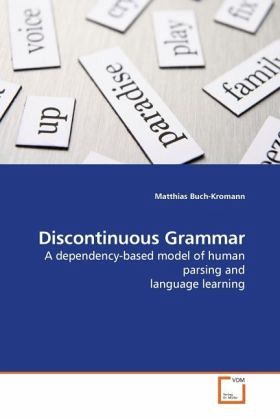
This book presents a new model of human language,
human parsing, and human language learning. It
provides a detailed
formal account of a
wide range of linguistic phenomena, including
discontinuous word
order, secondary dependencies, parasitic gaps,
elliptic coordinations,
punctuation, and important aspects of morphology and
discourse. The
book argues for a probabilistic model of language,
and proposes a
psycholinguistically motivated non-projective
dependency parsing
algorithm that can take advantage of the
probabilistic model.
The book falls within the tradition of dependency
grammar, but
differs from dependency theories such as Word
Grammar, Functional Generative Description, and
Meaning Text Theory by building on a purely
probabilistic conception of human language,
and by providing a unified account of computational
linguistics, psycholinguistics, and linguistics.
The
theory has been used as the basis for the 100,000
word Danish
Dependency Treebank and the Copenhagen Dependency
Treebank for
Danish-English.
The book is targeted towards researchers and students
working within
computational linguistics, psycholinguistics, and
linguistics.
human parsing, and human language learning. It
provides a detailed
formal account of a
wide range of linguistic phenomena, including
discontinuous word
order, secondary dependencies, parasitic gaps,
elliptic coordinations,
punctuation, and important aspects of morphology and
discourse. The
book argues for a probabilistic model of language,
and proposes a
psycholinguistically motivated non-projective
dependency parsing
algorithm that can take advantage of the
probabilistic model.
The book falls within the tradition of dependency
grammar, but
differs from dependency theories such as Word
Grammar, Functional Generative Description, and
Meaning Text Theory by building on a purely
probabilistic conception of human language,
and by providing a unified account of computational
linguistics, psycholinguistics, and linguistics.
The
theory has been used as the basis for the 100,000
word Danish
Dependency Treebank and the Copenhagen Dependency
Treebank for
Danish-English.
The book is targeted towards researchers and students
working within
computational linguistics, psycholinguistics, and
linguistics.