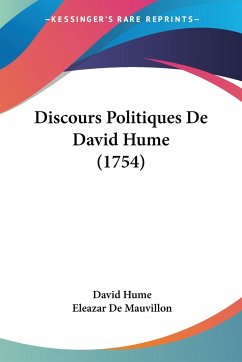
Discours Politiques De David Hume (1754) is a book written by the Scottish philosopher David Hume. The book is a collection of Hume's political essays, which were originally published in the mid-18th century. The essays cover a wide range of topics, including the principles of government, the nature of political power, and the role of religion in society. Hume's writing is characterized by a clear and concise style, and his arguments are based on careful observation and analysis of human behavior. The book is an important contribution to the field of political philosophy and remains relevant…mehr
Discours Politiques De David Hume (1754) is a book written by the Scottish philosopher David Hume. The book is a collection of Hume's political essays, which were originally published in the mid-18th century. The essays cover a wide range of topics, including the principles of government, the nature of political power, and the role of religion in society. Hume's writing is characterized by a clear and concise style, and his arguments are based on careful observation and analysis of human behavior. The book is an important contribution to the field of political philosophy and remains relevant to contemporary debates about the nature of democracy, the role of government, and the relationship between religion and politics.This scarce antiquarian book is a facsimile reprint of the old original and may contain some imperfections such as library marks and notations. Because we believe this work is culturally important, we have made it available as part of our commitment for protecting, preserving, and promoting the world's literature in affordable, high quality, modern editions, that are true to their original work.
David Hume (7 May 1711 NS - 25 August 1776) was a Scottish Enlightenment philosopher, student of history, economist, librarian, and writer. He is most popular for his profoundly persuasive philosophical empiricism, skepticism, and naturalism. argued against the presence of intrinsic thoughts, positing that all human information derives solely from experience. He studied philosophy at the College of Edinburgh at an abnormally early age of 12 or 13. Hume never wedded and resided partly at his Berwickshire home in Chirnside, which had a place with his family beginning around 1604. Hume's doctor determined him to have the "Sickness of the Learned" after he created scurvy and different maladies. He was secretary to General James St Clair, who was an emissary to Turin and Vienna. Hume wrote A Treatise of Human Nature in 1738 and The History of England in 1754. In 1745, during the Jacobite risings, Hume mentored the Marquess of Annandale (1720-92), an engagement that finished in confusion. He is viewed as one of the main philosophers to write in English. The David Hume Tower, a University of Edinburgh building, was renamed in a protest over his writing on race.
Es gelten unsere Allgemeinen Geschäftsbedingungen: www.buecher.de/agb
Impressum
www.buecher.de ist ein Internetauftritt der buecher.de internetstores GmbH
Geschäftsführung: Monica Sawhney | Roland Kölbl | Günter Hilger
Sitz der Gesellschaft: Batheyer Straße 115 - 117, 58099 Hagen
Postanschrift: Bürgermeister-Wegele-Str. 12, 86167 Augsburg
Amtsgericht Hagen HRB 13257
Steuernummer: 321/5800/1497
USt-IdNr: DE450055826