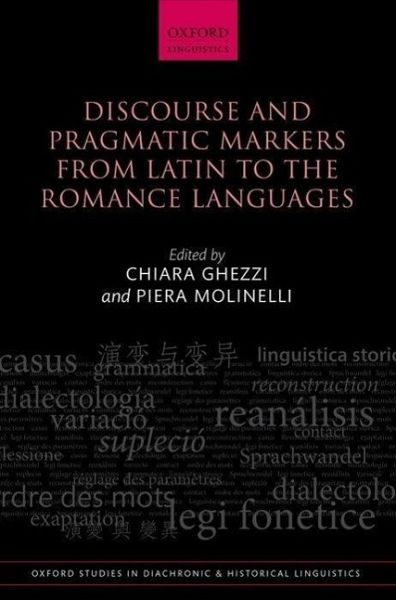
This book examines the historical development of discourse and pragmatic markers across the Romance languages. These markers serve to indicate the organization of the discourse, the speaker's relationship with the interlocutor, and the speaker's stance with regard to the information expressed. Their relevance is in assisting interpretation, despite the fact that they have little or no propositional content. In this book, distinguished scholars from different theoretical backgrounds analyse the different classes of discourse and pragmatic markers found in Latin and the Romance languages and…mehr
This book examines the historical development of discourse and pragmatic markers across the Romance languages. These markers serve to indicate the organization of the discourse, the speaker's relationship with the interlocutor, and the speaker's stance with regard to the information expressed. Their relevance is in assisting interpretation, despite the fact that they have little or no propositional content. In this book, distinguished scholars from different theoretical backgrounds analyse the different classes of discourse and pragmatic markers found in Latin and the Romance languages and explore both their diachronic development and their synchronic properties. Following an introduction and overview of the development of these markers, the book is divided into two parts: the first part investigates pragmatic markers developed from verbs, such as Latin quaeso, Romanian ma rog, and Spanish o sea; the second looks at adverbs as discourse markers, such as French deja and Italian gia, Romanian atunci and Portuguese alias. Chapters address a variety of theoretical issues such as the cyclic nature of functional developments, the nature of grammaticalization and pragmaticalization, semantic change, and the emergence of new pragmatic values. The arguments presented also have consequences for any analysis of the interfaces between grammar, discourse, and interaction.
Chiara Ghezzi is a researcher at the University of Bergamo, where she was previously Adjunct Lecturer in Sociolinguistics and Didactics of the Italian Language. She received her PhD from the University of Pavia with a dissertation entitled 'Vagueness Markers in Contemporary Italian: Intergenerational Variation and Pragmatic Change'. Her research interests include historical pragmatics, the history of old Italian, grammaticalization theory, sociolinguistic variation in contemporary Italian, and discourse and pragmatic markers. Her publications include three articles in Linguistica e Filologia. Piera Molinelli is Professor of General Linguistics at the University of Bergamo. She coordinates several Italian national research groups and has organized national and international conferences. Her areas of research include diachronic and historical linguistics, the history of Latin and old Italian, discourse and pragmatic markers, grammaticalization, language contact, and multilingualism. She is the author of Fenomeni della negazione dal latino all'italiano (La Nuova Italia 1988), along with a number of journal articles, and is co-editor of Ars linguistica (Bulzoni 1998), Comunicare nella torre di Babele. Repertori plurilingui in Italia oggi (Carocci 2001), Synchrony and Diachrony: A dynamic interface (Benjamins 2013), and Plurilinguismo e diglossia nella Tarda Antichità e nel Medioevo (SISMEL Il Galluzzo 2013).
Inhaltsangabe
* 1: Chiara Ghezzi and Piera Molinelli: Discourse and pragmatic markers from Latin to the Romance languages: New insights * 2: Chiara Ghezzi: The development of discourse and pragmatic markers * 1 VERBS AS PRAGMATIC MARKERS * 3: Maria Iliescu: Call markers in French, Italian, and Romanian * 4: Adriana Costachescu: On disagreement markers in French and Romanian dialogue * 5: Chiara Ghezzi and Piera Molinelli: Deverbal pragmatic markers from Latin to Italian (Lat. quaeso and It. prego): The cyclic nature of functional developments * 6: Michaela Livescu: Ma rog: A pragmatic marker in Romanian * 7: Salvador Pons Borderia: Paths of grammaticalization in Spanish o sea * 2 ADVERBS AS DISCOURSE MARKERS * 8: Maj-Britt Mosegaard Hansen: Cyclicity in semantic/pragmatic change: The medieval particle ja between Latin iam and Modern French deja * 9: Chiara Fedriani and Emanuele Miola: French deja, Piedmontese Italian gia: A case of contact-induced pragmaticalization * 10: Mario Squartini: The pragmaticalization of 'already' in Romance: from discourse grammar to illocution * 11: Ana Cristina Macario Lopes: Alias: A contribution to the study of a Portuguese discourse marker * 12: Mihaela Popescu: Romanian 'atunci' and French 'alors': Functional and discourse properties * 13: Corinne Rossari: How does a concessive value emerge? * Conclusion
* 1: Chiara Ghezzi and Piera Molinelli: Discourse and pragmatic markers from Latin to the Romance languages: New insights * 2: Chiara Ghezzi: The development of discourse and pragmatic markers * 1 VERBS AS PRAGMATIC MARKERS * 3: Maria Iliescu: Call markers in French, Italian, and Romanian * 4: Adriana Costachescu: On disagreement markers in French and Romanian dialogue * 5: Chiara Ghezzi and Piera Molinelli: Deverbal pragmatic markers from Latin to Italian (Lat. quaeso and It. prego): The cyclic nature of functional developments * 6: Michaela Livescu: Ma rog: A pragmatic marker in Romanian * 7: Salvador Pons Borderia: Paths of grammaticalization in Spanish o sea * 2 ADVERBS AS DISCOURSE MARKERS * 8: Maj-Britt Mosegaard Hansen: Cyclicity in semantic/pragmatic change: The medieval particle ja between Latin iam and Modern French deja * 9: Chiara Fedriani and Emanuele Miola: French deja, Piedmontese Italian gia: A case of contact-induced pragmaticalization * 10: Mario Squartini: The pragmaticalization of 'already' in Romance: from discourse grammar to illocution * 11: Ana Cristina Macario Lopes: Alias: A contribution to the study of a Portuguese discourse marker * 12: Mihaela Popescu: Romanian 'atunci' and French 'alors': Functional and discourse properties * 13: Corinne Rossari: How does a concessive value emerge? * Conclusion
Es gelten unsere Allgemeinen Geschäftsbedingungen: www.buecher.de/agb
Impressum
www.buecher.de ist ein Internetauftritt der buecher.de internetstores GmbH
Geschäftsführung: Monica Sawhney | Roland Kölbl | Günter Hilger
Sitz der Gesellschaft: Batheyer Straße 115 - 117, 58099 Hagen
Postanschrift: Bürgermeister-Wegele-Str. 12, 86167 Augsburg
Amtsgericht Hagen HRB 13257
Steuernummer: 321/5800/1497
USt-IdNr: DE450055826