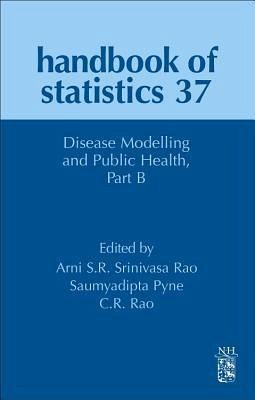
Handbook of Statistics: Disease Modelling and Public Health, Part B, Volume 37 addresses new challenges in existing and emerging diseases. As a two part volume, this title covers an extensive range of techniques in the field, with this book including chapters on Reaction diffusion equations and their application on bacterial communication, Spike and slab methods in disease modeling, Mathematical modeling of mass screening and parameter estimation, Individual-based and agent-based models for infectious disease transmission and evolution: an overview, and a section on Visual Clustering of Static…mehr
Handbook of Statistics: Disease Modelling and Public Health, Part B, Volume 37 addresses new challenges in existing and emerging diseases. As a two part volume, this title covers an extensive range of techniques in the field, with this book including chapters on Reaction diffusion equations and their application on bacterial communication, Spike and slab methods in disease modeling, Mathematical modeling of mass screening and parameter estimation, Individual-based and agent-based models for infectious disease transmission and evolution: an overview, and a section on Visual Clustering of Static and Dynamic High Dimensional Data.
This volume covers the lack of availability of complete data relating to disease symptoms and disease epidemiology, one of the biggest challenges facing vaccine developers, public health planners, epidemiologists and health sector researchers.
Arni S.R. Srinivasa Rao works in pure mathematics, applied mathematics, probability, artificial
intelligence and applications in medicine. He had edited these handbooks jointly with renowned statistician Dr. C. R. Rao. He is a Professor at the Medical College of Georgia,
Augusta University, U.S.A., and the Director of the Laboratory for Theory and Mathematical
Modeling housed within the Division of Infectious Diseases, Medical College of Georgia, Augusta,
U.S.A. Previously, Dr. Rao conducted research and/or taught at the Mathematical Institute, University of Oxford (2003, 2005-07), Indian Statistical Institute (1998-2002, 2006-2012), Indian Institute of Science (2002-04), University of Guelph (2004-06). Until 2012, Dr. Rao held a permanent faculty position at the Indian Statistical Institute. He has won the Heiwa-Nakajima Award (Japan) and Fast Track Young Scientists Fellowship in Mathematical Sciences (DST, New Delhi). Dr. Rao also proved a major theorem in stationary population models, such as, Rao's Partition Theorem in
Populations, Rao-Carey Theorem in stationary populations, and developed mathematical
modeling-based policies for the spread of diseases like HIV, H5N1, COVID-19, etc. He developed
a new set of network models for understanding avian pathogen biology on grid graphs (these were
called chicken walk models), AI Models for COVID-19, and received wide coverage in the science
media. Dr. Rao is an elected Fellow of ISMMACS (Indian Society for Mathematical Modeling and
Computer Simulation), and ISPS (Indian Society for Probability and Statistics). He developed
concepts such as "Exact Deep Learning Machines?, and "Multilevel Contours within a bundle of Complex Number Planes?.
Inhaltsangabe
Section VI : Statistical Methodologies 1. Imputation of Area-Level Covariates by Registry Linking J.S. Rao and Jie Fan 2. Asymptotic Approaches to Discovering Cancer Genomic Signatures Maciej Pietrzak and Grzegorz A. Rempala 3. Emerging Statistical Methodologies in the Field of Microbiome Studies Siddhartha Mandal
Section VII : Advanced Mathematical Methods 4. Reaction-Diffusion Equations and Their Application on Bacterial Communication Christina Kuttler 5. Hepatitis C Virus (HCV) Treatment as Prevention: Epidemic and Cost-Effectiveness Modeling Natasha K. Martin and Lara K. Marquez 6. Mathematical Modeling of Mass Screening and Parameter Estimation Masayuki Kakehashi and Miwako Tsunematsu 7. Inferring Patterns, Dynamics, and Model-Based Metrics of Epidemiological Risks of Neglected Tropical Diseases Anuj Mubayi 8. Theory and Modeling for Time Required to Vaccinate a Population in an Epidemic Taejin Lee, Kurien Thomas and Arni S.R. Srinivasa Rao
Section VIII : Public Health and Epidemic Data Modeling 9. Frailty Models in Public Health David D. Hanagal 10. Structural Nested Mean Models and History-Adjusted Marginal Structural Models for Time-Varying Effect Modification: An Application to Dental Data Murthy N. Mittinty 11. Conditional Growth Models: An Exposition and Some Extensions Clive Osmond and Caroline H.D. Fall 12. Parametric Model to Predict H1N1 Influenza in Vellore District, Tamil Nadu, India Daphne Lopez and Gunasekaran Manogaran 13. Public Health Eye Care: Modeling Techniques to Translate Evidence Into Effective Action Gudlavalleti V.S. Murthy and Neena S. John 14. Individual-Based Models for Public Health Benjamin Roche and Raphaël Duboz
Section VI : Statistical Methodologies 1. Imputation of Area-Level Covariates by Registry Linking J.S. Rao and Jie Fan 2. Asymptotic Approaches to Discovering Cancer Genomic Signatures Maciej Pietrzak and Grzegorz A. Rempala 3. Emerging Statistical Methodologies in the Field of Microbiome Studies Siddhartha Mandal
Section VII : Advanced Mathematical Methods 4. Reaction-Diffusion Equations and Their Application on Bacterial Communication Christina Kuttler 5. Hepatitis C Virus (HCV) Treatment as Prevention: Epidemic and Cost-Effectiveness Modeling Natasha K. Martin and Lara K. Marquez 6. Mathematical Modeling of Mass Screening and Parameter Estimation Masayuki Kakehashi and Miwako Tsunematsu 7. Inferring Patterns, Dynamics, and Model-Based Metrics of Epidemiological Risks of Neglected Tropical Diseases Anuj Mubayi 8. Theory and Modeling for Time Required to Vaccinate a Population in an Epidemic Taejin Lee, Kurien Thomas and Arni S.R. Srinivasa Rao
Section VIII : Public Health and Epidemic Data Modeling 9. Frailty Models in Public Health David D. Hanagal 10. Structural Nested Mean Models and History-Adjusted Marginal Structural Models for Time-Varying Effect Modification: An Application to Dental Data Murthy N. Mittinty 11. Conditional Growth Models: An Exposition and Some Extensions Clive Osmond and Caroline H.D. Fall 12. Parametric Model to Predict H1N1 Influenza in Vellore District, Tamil Nadu, India Daphne Lopez and Gunasekaran Manogaran 13. Public Health Eye Care: Modeling Techniques to Translate Evidence Into Effective Action Gudlavalleti V.S. Murthy and Neena S. John 14. Individual-Based Models for Public Health Benjamin Roche and Raphaël Duboz
Es gelten unsere Allgemeinen Geschäftsbedingungen: www.buecher.de/agb
Impressum
www.buecher.de ist ein Internetauftritt der buecher.de internetstores GmbH
Geschäftsführung: Monica Sawhney | Roland Kölbl | Günter Hilger
Sitz der Gesellschaft: Batheyer Straße 115 - 117, 58099 Hagen
Postanschrift: Bürgermeister-Wegele-Str. 12, 86167 Augsburg
Amtsgericht Hagen HRB 13257
Steuernummer: 321/5800/1497
USt-IdNr: DE450055826