For the distance training provider, today's amazing array of advanced communications technologies poses many exciting possibilities. But it also makes for a daunting challenge. How can you employ these technologies-each with its inherent strengths and limitations-to implement the most effective distance and distributed learning? And how can you use them to best meet your organization's strategic goals? Through the use of sixteen lively case studies, Distance Training shows readers the innovative ways in which organizations have used various communications technologies to maximize employee…mehr
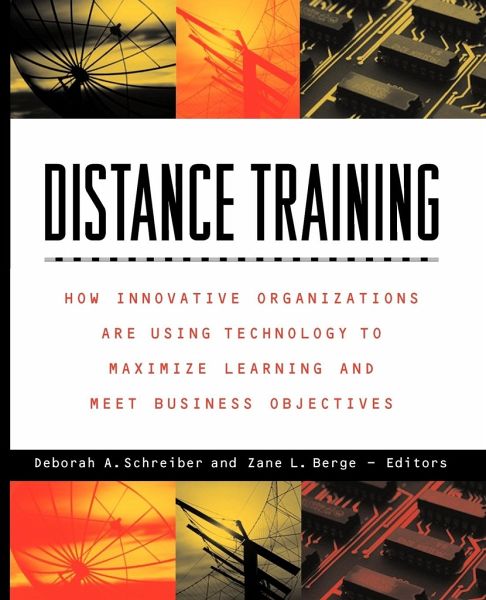
For the distance training provider, today's amazing array of advanced communications technologies poses many exciting possibilities. But it also makes for a daunting challenge. How can you employ these technologies-each with its inherent strengths and limitations-to implement the most effective distance and distributed learning? And how can you use them to best meet your organization's strategic goals? Through the use of sixteen lively case studies, Distance Training shows readers the innovative ways in which organizations have used various communications technologies to maximize employee learning and meet business objectives. Each study illustrates distance-training applications ranging from the dissemination of information to building skills in critical thinking and problem solving, to changing attitudes, and to shaping organizational culture. Taken from corporations, nonprofits, and government agencies, these studies also show how providers managed to overcome the many organizational and technical obstacles that stood between them and the successful realization of their learning events, programs, and designs. Readers will benefit from the best practices embedded in each case study, which are summarized at the end of the book. They will also gain from the set of guiding principles that provides a framework for discussing distance learning in organizations-principles that represent systems engineering strategies for the design, development, and implementation of distance training processes. Including a history of distance training and in-depth advice on instructional design, policy issues, organizational restructuring, and technical and electronic systems development, Distance Training gives practitioners and aspirants to the field a concrete, real-world look at how state-of-the-art distance learning can actually be achieved.
DEBORAH A. SCHREIBER is founder and president of D.A. Schreiber, Inc., a distance learning consulting group that specializes in the corporate application of distance training. She also serves on the faculty of the University of Maryland Baltimore County in the Instructional Systems Development and Technology Graduate Program. ZANE L. BERGE is director of training systems in the Instructional Systems Development and Technology Graduate Program at UMBC. He has edited seven books, written numerous articles, and conducts workshops and presentations on distance teaching and learning.
Inhaltsangabe
Introduction. Organizational Technology and Its Impact on Distance Training (D.Schreiber). Conceptual Frameworks in Distance Training and Education (Z.Berge). Instructional Design of Distance Training (D. Screiber). DISTRIBUTING INFORMATION AND INCREASING KNOWLEDGE. Building Customer Relations: Web-Based Training for the HomeImprovement Industry. Increasing Employee Knowledge and Understanding of OperationalSystems: Integrating Multiple Technologies at NYNEX (B.Howard). Disseminating Time-Sensitive Information: Using InteractiveDistance Learning to Deliver Training and Education in the AmericanRed Cross Biomedical Services (L. Klueter & E. Kalweit). Disseminating Time- and Regualtion-Sensitive Information: OnlineTraining Seminars at Mortgage Bankers Association of America (T.Monahan). Graduate Programs at a Distance: A Partnership Between theCalifornia Department of Rehabilitation and San Diego StateUniversity (M. Warn, et al.). BUILDING SKILLS (TECHNICAL AND CRITICAL THINKING). Reskilling Employees for Competitve Advantage: Reinventing Learningat Unisys Corporation. Delivering Technical Training to Advance Mechanical Skills:Interactive Video Teletraining in the Federal AviationAdministration (L. Payneand & H. Payne). Delivering Clinical- Based Training in a Public Health Setting (J.Place, et al.). Skills-Based Distance Training for a Global Environment: Malaysia'sVirtual University (M. Ress & P. Sonberg). The Value of Building Skills with Online Technology: OnlineTraining Costs and Evaluation at the Texas Natural ResourceConservation Commission (S. Walker). Building Intranet Courseware Using Multidisciplinary Teams: TheStory of Quantum Solutions, Inc. and Colombia/ HCA Healthcare Corporation (A. Yakimivicz). CHANGING ATTITUDES AND ENHANCING MOTIVATION. Eliciting Community Beliefs and Changing Attitudes ThroughEducation: Innovative Distance Learning at the Colombus Center (R.Bento, et al.). Measuring attitudes to Assess Trainig: The Interactive DistanceLearning Group Looks at Learning and Transfer from SatelliteTraining (J. Dessinger, et al.). Unanticipated Attitudianl Cahnge: The Progression Toward Self-Directed Distance Training at H.B. Zachry (L. Dooley, etal.). Utilizing Telelearning as a Strategic Media Choice to EnhanceExecutive Development and Affect Organizational Perspective: TheU.S. Navy's Bureau of Medicine and Surgery (BUMED) (J. Suchan &A. Crawford). Conclusion. Best Practices of Distance Training (D. Schreiber).
Es gelten unsere Allgemeinen Geschäftsbedingungen: www.buecher.de/agb
Impressum
www.buecher.de ist ein Internetauftritt der buecher.de internetstores GmbH
Geschäftsführung: Monica Sawhney | Roland Kölbl | Günter Hilger
Sitz der Gesellschaft: Batheyer Straße 115 - 117, 58099 Hagen
Postanschrift: Bürgermeister-Wegele-Str. 12, 86167 Augsburg
Amtsgericht Hagen HRB 13257
Steuernummer: 321/5800/1497
USt-IdNr: DE450055826