This brief provides readers a complete and self-contained resource for information about DDoS attacks and how to defend against them. It presents the latest developments in this increasingly crucial field along with background context and survey material. The book also supplies an overview of DDoS attack issues, DDoS attack detection methods, DDoS attack source traceback, and details on how hackers organize DDoS attacks. The author concludes with future directions of the field, including the impact of DDoS attacks on cloud computing and cloud technology. The concise yet comprehensive nature of…mehr
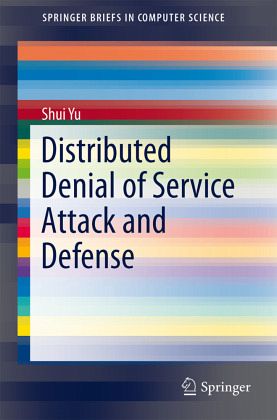
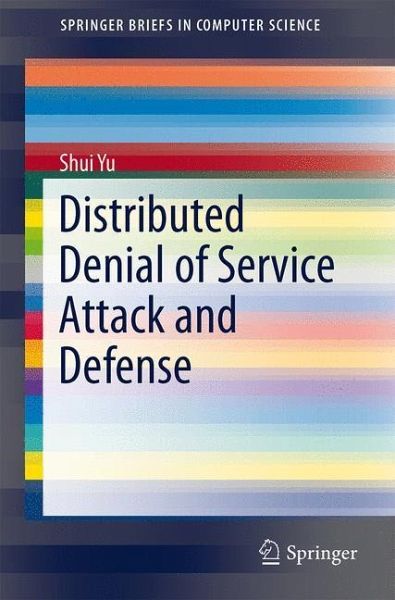
This brief provides readers a complete and self-contained resource for information about DDoS attacks and how to defend against them. It presents the latest developments in this increasingly crucial field along with background context and survey material. The book also supplies an overview of DDoS attack issues, DDoS attack detection methods, DDoS attack source traceback, and details on how hackers organize DDoS attacks. The author concludes with future directions of the field, including the impact of DDoS attacks on cloud computing and cloud technology. The concise yet comprehensive nature of this brief makes it an ideal reference for researchers and professionals studying DDoS attacks. It is also a useful resource for graduate students interested in cyberterrorism and networking.
Ting Wang received his Ph.D. degree in Computer Science and Engineering from Hong Kong University of Science and Technology, Hong Kong, China, in 2015. He is currently an associate professor with the Shanghai Key Laboratory of Trustworthy Computing, Software Engineering Institute, East China Normal University (ECNU), Shanghai, China. Prior to joining ECNU in 2020, he worked at the Bell Labs as a research scientist from 2015 to 2016, and at Huawei as a senior engineer from 2016 to 2020. He is currently an associate editor of IEEE Access, the editor-in-chief of IITCIB, and a technical committee member of Computer Communications, Elsevier. His research interests include SDN/NFV, data center networking, machine learning, AI-assisted intelligent networking, Internet of Things, and cloud/edge computing. Bo Li received his Bachelor degree from the Information Engineering School, Hangzhou Dianzi University. He is currently pursuing his Master degree at Software Engineering Institute, East China Normal University, Shanghai, China. His research interests include data center networks, cloud computing, and machine learning systems. Mingsong Chen received the B.S. and M.E. degrees from Department of Computer Science and Technology, Nanjing University, Nanjing, China, in 2003 and 2006 respectively, and the Ph.D. degree in Computer Engineering from the University of Florida, Gainesville, in 2010. He is currently a Professor with the Software Engineering Institute at East China Normal University. His research interests are in the area of cloud computing, design automation of cyber-physical systems, parallel and distributed systems, and formal verification techniques. Currently he serves as the director of MoE Engineering Research Center of Software/Hardware Codesign Technology and Application, and the vice director of technical committee of embedded systems of China Computer Federation (CCF). He is an Associate Editor of IET Computers \& Digital Techniques, and Journal of Circuits, Systems and Computers. Shui Yu is a full Professor of School of Computer Science, University of Technology Sydney, Australia. Dr. Yu's research interest includes Security and Privacy, Networking, Big Data, and Mathematical Modelling. He has published two monographs and edited two books, more than 200 technical papers, including top journals and top conferences, such as IEEE TPDS, TC, TIFS, TMC, TKDE, TETC, ToN, and INFOCOM. Dr Yu initiated the research field of networking for big data in 2013. His h-index is 33. Dr Yu actively serves his research communities in various roles. He is currently serving the editorial boards of IEEE Communications Surveys and Tutorials, IEEE Communications Magazine, IEEE Internet of Things Journal, IEEE Communications Letters, IEEE Access, and IEEE Transactions on Computational Social Systems. He has served many international conferences as a member of organizing committee, such aspublication chair for IEEE Globecom 2015, IEEE INFOCOM 2016 and 2017, TPC chair for IEEE BigDataService 2015, and general chair for ACSW 2017. Dr Yu is a final voting member for a few NSF China programs in 2017. He is a Senior Member of IEEE, a member of AAAS and ACM, the Vice Chair of Technical Committee on Big Data of IEEE Communication Society, and a Distinguished Lecturer of IEEE Communication Society.
Inhaltsangabe
An Overview of DDoS Attacks.- Malicious Networks for DDoS Attacks.- DDoS Attack Detection.- Attack Source Traceback.- DDoS Attack and Defence in Cloud.- Future Work.
An Overview of DDoS Attacks.- Malicious Networks for DDoS Attacks.- DDoS Attack Detection.- Attack Source Traceback.- DDoS Attack and Defence in Cloud.- Future Work.
Es gelten unsere Allgemeinen Geschäftsbedingungen: www.buecher.de/agb
Impressum
www.buecher.de ist ein Internetauftritt der buecher.de internetstores GmbH
Geschäftsführung: Monica Sawhney | Roland Kölbl | Günter Hilger
Sitz der Gesellschaft: Batheyer Straße 115 - 117, 58099 Hagen
Postanschrift: Bürgermeister-Wegele-Str. 12, 86167 Augsburg
Amtsgericht Hagen HRB 13257
Steuernummer: 321/5800/1497
USt-IdNr: DE450055826