
Andere Kunden interessierten sich auch für
 Emerging Conceptions of Work, Management and the Labor Market151,99 €
 Implementing POP-Leading, Structuring, and Managing a Problem-Oriented Police Agency25,99 €
 Events in social networks : a stochastic actor-oriented framework for dynamic event processes in social networks35,00 €
 Frameworks for Scientific and Technological Research oriented by Transdisciplinary Co-Production129,99 €
 Psychology-oriented Artificial Society Model20,99 €
 The socio-economic effect of SMEs, Barraganete Banana Case36,99 €
 Strategic Planning in Project-Oriented Industrial Companies Along15,99 €


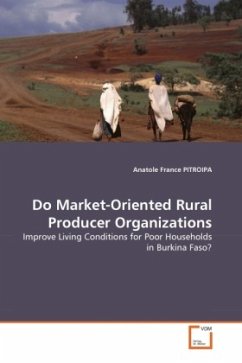
Based on the results of a survey conducted by the International Food Policy Research Institute (IFPRI) in 2003, this research assesses the impact of market-oriented RPOs (MOs) on the living conditions of small-scale farmers in the cotton producing areas of Burkina Faso. After controlling for a number of influences such as village size, household size, remittances, household education level, distance from market, household head gender, village accessibility during rainy season, existence of a local market, etc., the evaluation finds that RPO membership increases poor household living index by 17% and suggests that if funded and well managed, MOs are effective development tools that can benefit the largest number of Burkinabe people (90%) who live in rural areas and subsist on agriculture and agricultural-related activities.