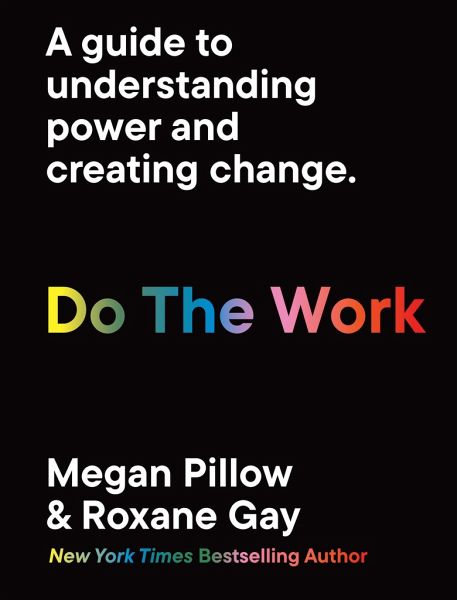
Confront your biases to change the world! Do The Work is a sharp workbook by educator Professor Roxane Gay and writer Dr. Megan Pillow, who discuss those with power and those without.
Confront your biases to change the world! Do The Work is a sharp workbook by educator Professor Roxane Gay and writer Dr. Megan Pillow, who discuss those with power and those without.
Roxane Gay is an American writer, editor, and professor. She is the New York Times best-selling author of Bad Feminist, a collection of pioneering essays and the memoir, Hunger as well as several other books. In April 2018, she was awarded a Guggenheim Fellowship for Creative Arts. She is a contributing opinion writer for The New York Times and also writes the Work Friend column. Her work can also be found in The Guardian, Virginia Quarterly Review, Harper's Bazaar, McSweeney's and many other publications. She holds an endowed professorship at Rutgers University and has also taught at Purdue and Yale. She is currently at work on film and television projects, and has launched her own publishing imprint, Roxane Gay Books. Megan Pillow is an American writer, editor, and scholar. She is project manager for Roxane Gay and co-editor of The Audacity, an innovative, integrity-driven newsletter inclusive of diverse voices. She holds an MFA and a PhD. Her work has appeared, among other places, in Electric Literature, Guernica, Triquarterly, and Gay Magazine and was featured in The Best American Mystery and Suspense 2022. Aurélia Durand is a French graphic artist. Her work, which includes the illustrations for the #1 New York Times bestseller This Book Is Anti-Racist , is a vivid celebration of diversity; she dedicates her artistic voice to matters involving representation. Aurélia represents Afro-descendants as joyful, proud, and empowered — a united community whose destinies are intertwined. These colorful personalities present the unified voice of a global community whose hopes, dreams, and desires envision an inclusive future for all. Her work has been featured in advertising campaigns, galleries, and editorial magazines; her clients include Nike, The New Yorker, Facebook, and more. Find her on Instagram: @4ur3lia.
Inhaltsangabe
Introduction
SECTION ONE: What is Power? Theories of power Interrogate/reflect
SECTION TWO: Who Gets to Have Power? Power and race Power, gender identity, and sexuality Power and ability/disability Power and money Power and politics Intersectionality: a brief primer Interrogate/reflect
SECTION THREE: What Affects a Person’s Power? Power and privilege In your community Interrogate/reflect
SECTION FOUR: What Can We Do About Power? Power in conflict Interrogate/reflect Practices toward self-awareness Interrogate/reflect
SECTION FIVE: How Can You Empower Others? Power and resistance Steps to empower Interrogate/reflect
SECTION ONE: What is Power? Theories of power Interrogate/reflect
SECTION TWO: Who Gets to Have Power? Power and race Power, gender identity, and sexuality Power and ability/disability Power and money Power and politics Intersectionality: a brief primer Interrogate/reflect
SECTION THREE: What Affects a Person’s Power? Power and privilege In your community Interrogate/reflect
SECTION FOUR: What Can We Do About Power? Power in conflict Interrogate/reflect Practices toward self-awareness Interrogate/reflect
SECTION FIVE: How Can You Empower Others? Power and resistance Steps to empower Interrogate/reflect