
Andere Kunden interessierten sich auch für
 Exploring Linguistic Standards in Non-Dominant Varieties of Pluricentric Languages- Explorando estándares lingüísticos en variedades no dominantes de lenguas pluricéntricas102,85 €
 La négation et ses emplois spéciaux en chinois mandarin93,20 €
 De-Hegemonizing Language Standards76,99 €
 Standards of Bibliographical Description85,99 €
 Distortions, norms and subtleties of the French language29,99 €
 Narrative of Double Consciousness in Contemporary Diasporic Writing53,99 €
 Double entendre36,99 €


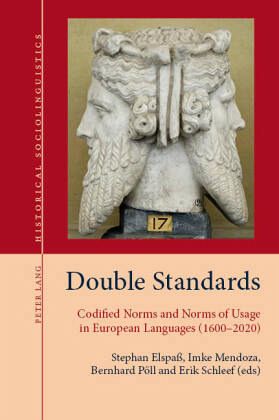
Standardisation is not a natural form of language change. The aim of such efforts is usually to create a largely uniform standard, often backed by a strong standard language ideology. However, standard languages are sometimes Janus-faced. Additional standard varieties emerge, leading to situations with «double standards» or even «multiple standards».
This volume brings together fifteen contributions on «double standards» in twelve languages - and various standard varieties thereof - from three language families, thus providing a novel comparative view on standardisation. Three main aspects of the «double standards» concept are identified: the descriptive vs prescriptive notion of standards, the coexistence of standard varieties in pluricentric or pluriareal settings, and the impact of the cohabitation of several standards in native or foreign language teaching.
This volume brings together fifteen contributions on «double standards» in twelve languages - and various standard varieties thereof - from three language families, thus providing a novel comparative view on standardisation. Three main aspects of the «double standards» concept are identified: the descriptive vs prescriptive notion of standards, the coexistence of standard varieties in pluricentric or pluriareal settings, and the impact of the cohabitation of several standards in native or foreign language teaching.