
Andere Kunden interessierten sich auch für
 Populist Discourse in Venezuela and the United States38,99 €
 Theorising Drones in Visual Culture98,99 €
 The Palgrave Handbook on Right-Wing Populism and Otherness in Global Perspective151,99 €
 Identity, Violence and Power19,99 €
 Contemporary Challenges to Identity Politics53,99 €
 Social Movements and Their Technologies53,99 €
 Neighbourhood Ecologies31,99 €

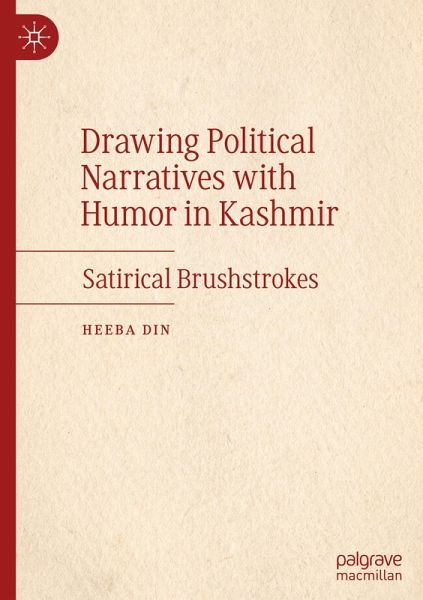
This book explores the remarkable ability of political cartoons in the region to craft and preserve an alternative narrative by employing the potent tool of political humor. Over the centuries, political humor, delivered through satire, caricature, ridicule, or irony, has been a powerful instrument for scrutinizing the establishment and unveiling the shortcomings and absurdities within society. In this book, the author delves into the meaning-generational structures utilized by political cartoons to amplify the underlying political-socio-cultural ideologies. It also investigates the pivotal role of political humor in shaping and defining the discourse in Kashmir. This book sheds light on the enduring impact of satire and caricature as instruments for not only commenting on contemporary issues but also for creating and sustaining a collective memory that reflects the complex sociopolitical dynamics that have characterized Kashmir throughout its history.
The book is methodologically robust in hermeneutic terms. Heeba is transparent about scope and source material, and she situates each argument within a defined reference period. ... For scholars, journalists, and archivists working on South Asian visual politics, this book is indispensable; it maps laugh lines onto power lines and provides the vocabulary necessary to trace how satire participates in the making and unmaking of public life. (Muhammad Nadeem, Kashmir Life, Vol. 17 (32), November, 2025)