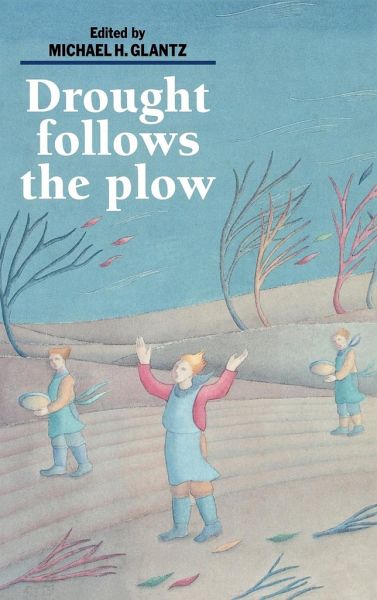
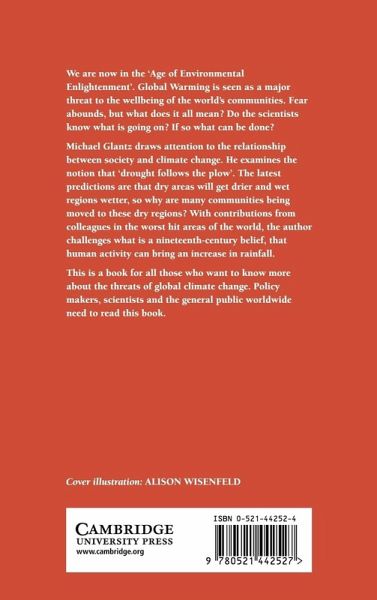
People around the globe are becoming increasingly aware that our use of the land has an effect on the environment in which we live. Global warming is seen as a major threat to the well-being of the world's communities. Fear abounds, but does anyone really know what is going on? Will human activity make things worse? In this 1994 book, the author examines the relationship between society and climate change. With contributions from colleagues in the worst hit areas of the world, the author shows how some patterns of land use can make the problems worse; increasing the risk of droughts and…mehr
People around the globe are becoming increasingly aware that our use of the land has an effect on the environment in which we live. Global warming is seen as a major threat to the well-being of the world's communities. Fear abounds, but does anyone really know what is going on? Will human activity make things worse? In this 1994 book, the author examines the relationship between society and climate change. With contributions from colleagues in the worst hit areas of the world, the author shows how some patterns of land use can make the problems worse; increasing the risk of droughts and associated food shortages. This book will help scientists and researchers assess our impact on the planet and consider our ability to respond to the consequences of future environmental change.
Michael H. Glantz was a Senior Scientist at the National Center for Atmospheric Research (NCAR), where he researched from 1974 to 2009. Since then, he has been the director of the University of Colorado's Consortium for Capacity Building (CCB). His research publications relate to understanding how extreme climate, water and weather affect societies and how societies affect climate. Since 1976, Glantz has conducted joint research in the former Soviet Union and in the Central Asian Republics on desertification and on the disappearing of the Aral Sea. In 2013 he was recognized by China as a pioneer in desertification studies. Glantz is a member of the Advisory Committee of the international Integrated Risk Governance Program, headquartered at Beijing Normal University. He has lectured on the Climate Affairs concept in several Chinese cities at universities and meteorological centers. He has numerous publications on climate, water and weather issues. Glantz and Professor Qian (BNU and executive director of the IRG) co-authored Usable Thoughts: Climate, Water and Weather in the 21st Century. His current multiyear research is "El Niño Ready Nations," supported by USAID/OFDA. Many Belt and Road countries are affected by El Niño's impacts. In 1990 he received the Global 500 Award of the UN Environment Program (UNEP) that recognizes people working in diverse ways to protect and enhance the planet's natural resources. Glantz received the 2009 Clinton Global Initiative and Rockefeller Foundation Commitment. He has a BS in Metallurgical Engineering (1961) and an MA (1963) and PhD (1970) in Political Science/ International Relations from the University of Pennsylvania.
Inhaltsangabe
Preface List of contributors Introduction Michael H. Glantz Part I. Drought, Desertification and Food Production: 1. Drought Michael H. Glantz 2. Desertification Michael H. Glantz 3. Food production: role of marginal lands Michael H. Glantz 4. Cultivating the dry margins Michael H. Glantz Part II. Case Studies and Conclusions: 5. The West African Sahel Michael H. Glantz 6. Somalia Jörg Janzen 7. The Brazilian Nordeste (Northeast) Antonio Magalhães and Pennie Magee 8. The dry regions of Kenya David Campbell 9. Australia R. Les Heathcote 10. Ethiopia James McCann 11. Northwest Africa Will Swearingen 12. The Virgin Lands scheme in the former Soviet Union Igor Zonn, Michael H. Glantz and Alvin Rubinstein 13. South Africa Coleen Vogel 14. Is the stork outrunning the plow? Michael H. Glantz Notes Index.
Preface List of contributors Introduction Michael H. Glantz Part I. Drought, Desertification and Food Production: 1. Drought Michael H. Glantz 2. Desertification Michael H. Glantz 3. Food production: role of marginal lands Michael H. Glantz 4. Cultivating the dry margins Michael H. Glantz Part II. Case Studies and Conclusions: 5. The West African Sahel Michael H. Glantz 6. Somalia Jörg Janzen 7. The Brazilian Nordeste (Northeast) Antonio Magalhães and Pennie Magee 8. The dry regions of Kenya David Campbell 9. Australia R. Les Heathcote 10. Ethiopia James McCann 11. Northwest Africa Will Swearingen 12. The Virgin Lands scheme in the former Soviet Union Igor Zonn, Michael H. Glantz and Alvin Rubinstein 13. South Africa Coleen Vogel 14. Is the stork outrunning the plow? Michael H. Glantz Notes Index.
Es gelten unsere Allgemeinen Geschäftsbedingungen: www.buecher.de/agb
Impressum
www.buecher.de ist ein Internetauftritt der buecher.de internetstores GmbH
Geschäftsführung: Monica Sawhney | Roland Kölbl | Günter Hilger
Sitz der Gesellschaft: Batheyer Straße 115 - 117, 58099 Hagen
Postanschrift: Bürgermeister-Wegele-Str. 12, 86167 Augsburg
Amtsgericht Hagen HRB 13257
Steuernummer: 321/5800/1497
USt-IdNr: DE450055826