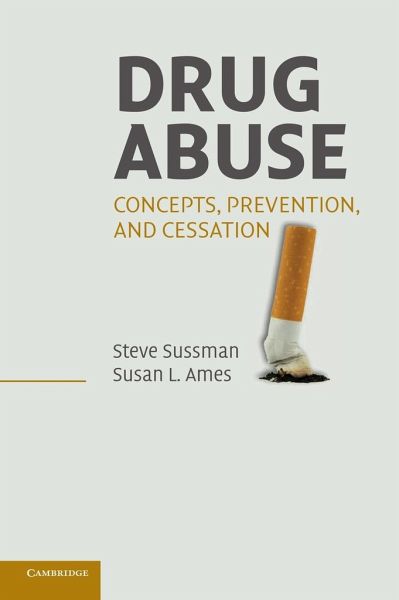
Drug Abuse: Concepts, Prevention, and Cessation serves as a comprehensive source of information on the topography of, causes of, and solutions to drug problems. The text covers conceptual issues regarding definitions of drug use, misuse, abuse, and dependence. Importantly, the text addresses a variety of theoretical bases currently applied to the development of prevention and cessation programs, specific program content from evidence-based programs, and program processes and modalities. Information regarding etiology, prevention, and cessation is neatly delineated into (a) neurobiological, (b)…mehr
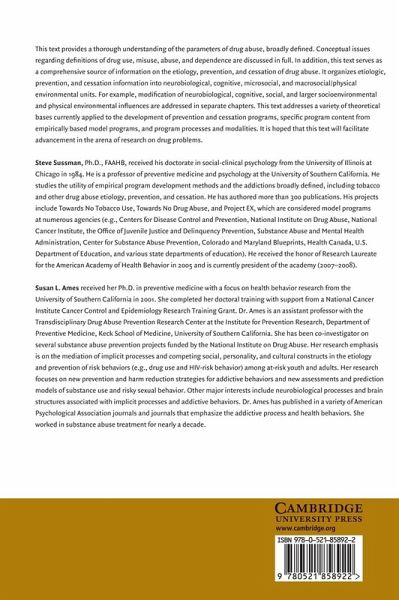
Drug Abuse: Concepts, Prevention, and Cessation serves as a comprehensive source of information on the topography of, causes of, and solutions to drug problems. The text covers conceptual issues regarding definitions of drug use, misuse, abuse, and dependence. Importantly, the text addresses a variety of theoretical bases currently applied to the development of prevention and cessation programs, specific program content from evidence-based programs, and program processes and modalities. Information regarding etiology, prevention, and cessation is neatly delineated into (a) neurobiological, (b) cognitive, (c) micro-social, and (d) macro-social/physical environmental units. The book is ideally suited as a primary source for students and professionals in chemical dependence programs, clinical and health psychology, public health, preventive medicine, nursing, sociology, and social work, among other fields, on the nature, causes, prevention, and cessation of the abuse of legal and illegal drugs.
Steve Sussman, Ph.D., FAAHB, received his doctorate in social-clinical psychology from the University of Illinois at Chicago in 1984. He is a Professor of Preventive Medicine and Psychology at the University of Southern California. He studies the utility of empirical program development methods and multiple addictions, including tobacco and drug abuse etiology, prevention, and cessation. He has over 300 publications. His Projects include Towards No Tobacco Use, Towards No Drug Abuse, and EX, which are considered model programs at numerous agencies (e.g., CDC, NIDA, NCI, OJJDP, SAMSHA, CSAP, Colorado and Maryland Blueprints, Health Canada, U.S. Department of Education, and various state departments of education). He received the honor of Research Laureate for the American Academy of Health Behavior in 2005 and is currently President there (2007-8).
Inhaltsangabe
Preface Part I. Concepts and Classes of Drugs: 1. Concepts of drug, drug use, misuse, and abuse 2. Further classifications relevant to substance abuse and dependence 3. Types of drugs, history of drug use and misuse, and costs of drug misuse Part II. Etiology: 4, Current multivariable models 5. Neurobiologically relevant 6. Cognitive processes 7. Social interaction and social groups 8. The large physical and social environment 9. Assessment Part III. Prevention: 10. Concepts of prevention 11. Neurobiologically relevant 12. Cognitive processes 13. Social interaction and social groups 14. The large social and physical environment Part IV. Cessation: 15. Concepts of cessation 16. Neurobiologically relevant 17. Cognitive processes 18. Social interaction and social groups 19. The large social and physical environment Part V. Conclusions and the Future: 20. Conclusions, recent, and future directions.
Preface Part I. Concepts and Classes of Drugs: 1. Concepts of drug, drug use, misuse, and abuse 2. Further classifications relevant to substance abuse and dependence 3. Types of drugs, history of drug use and misuse, and costs of drug misuse Part II. Etiology: 4, Current multivariable models 5. Neurobiologically relevant 6. Cognitive processes 7. Social interaction and social groups 8. The large physical and social environment 9. Assessment Part III. Prevention: 10. Concepts of prevention 11. Neurobiologically relevant 12. Cognitive processes 13. Social interaction and social groups 14. The large social and physical environment Part IV. Cessation: 15. Concepts of cessation 16. Neurobiologically relevant 17. Cognitive processes 18. Social interaction and social groups 19. The large social and physical environment Part V. Conclusions and the Future: 20. Conclusions, recent, and future directions.
Es gelten unsere Allgemeinen Geschäftsbedingungen: www.buecher.de/agb
Impressum
www.buecher.de ist ein Internetauftritt der buecher.de internetstores GmbH
Geschäftsführung: Monica Sawhney | Roland Kölbl | Günter Hilger
Sitz der Gesellschaft: Batheyer Straße 115 - 117, 58099 Hagen
Postanschrift: Bürgermeister-Wegele-Str. 12, 86167 Augsburg
Amtsgericht Hagen HRB 13257
Steuernummer: 321/5800/1497
USt-IdNr: DE450055826