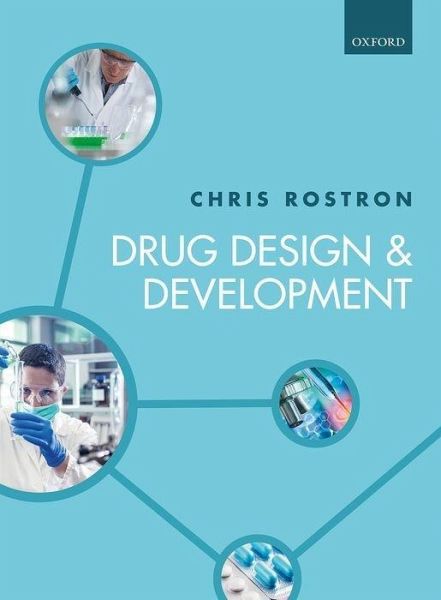
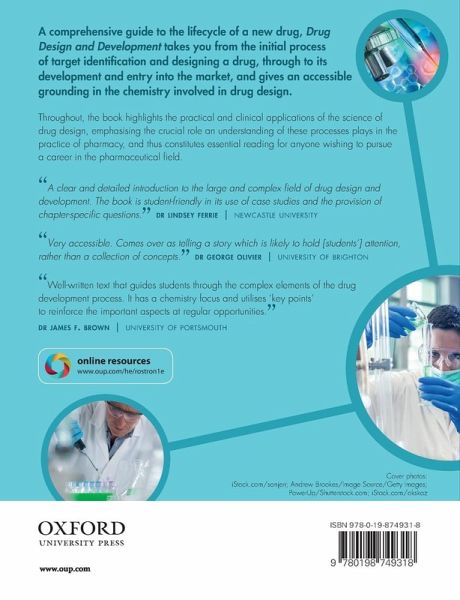
Drug Design and Development outlines the processes involved in the design and development of new drugs and emphasises the significance of these processes to the practice of pharmacy.
Drug Design and Development outlines the processes involved in the design and development of new drugs and emphasises the significance of these processes to the practice of pharmacy.
Dr Chris Rostron graduated in Pharmacy from Manchester University and completed a PhD in Medicinal Chemistry at Aston University. He gained Chartered Chemist status in 1975. After a period of post-doctoral research he was appointed as a lecturer in Medicinal Chemistry at Liverpool Polytechnic. He is now an Honorary Research Fellow in the School of Pharmacy and Biomolecular Sciences at Liverpool John Moores University. He was a member of the Academic Pharmacy Group Committee of the Royal Pharmaceutical Society of Great Britain and chairman for the past 5 years. He is currently chairman of the Academic Pharmacy Forum and deputy chair of the Education Expert Advisory Panel of the Royal Pharmaceutical Society. He is an external examiner in Medicinal Chemistry at a number of Schools of Pharmacy both in the UK and abroad. In 2008 he was awarded honorary membership of the Royal Pharmaceutical Society of Great Britain for services to Pharmacy education.
Inhaltsangabe
1: Introduction Part 1 Drug targets 2: Receptors and signal transduction 3: Enzymes as drug targets 4: Nucleic acids and protein synthesis as drug targets 5: Other drug targets Part 2 Origins of drug molecules 6: Sources of lead compounds 7: Drug synthesis 8: Optimisation of lead compounds 9: Computer-aided drug design 10: Combinatorial chemistry and high-throughput screening 11: Biotechnology and biopharmaceuticals Part 3 Biological aspects of drug development 12: Drug metabolism 13: Pharmacogenetics and pharmacogenomics 14: Toxicity testing Part 4 Preformulation studies 15: Solubility and drug development 16: Solid state characteristics 17: Drug stability Part 5 Clinical research 18: Clinical research and its regulation 19: Design and management of clinical trials
1: Introduction Part 1 Drug targets 2: Receptors and signal transduction 3: Enzymes as drug targets 4: Nucleic acids and protein synthesis as drug targets 5: Other drug targets Part 2 Origins of drug molecules 6: Sources of lead compounds 7: Drug synthesis 8: Optimisation of lead compounds 9: Computer-aided drug design 10: Combinatorial chemistry and high-throughput screening 11: Biotechnology and biopharmaceuticals Part 3 Biological aspects of drug development 12: Drug metabolism 13: Pharmacogenetics and pharmacogenomics 14: Toxicity testing Part 4 Preformulation studies 15: Solubility and drug development 16: Solid state characteristics 17: Drug stability Part 5 Clinical research 18: Clinical research and its regulation 19: Design and management of clinical trials
Es gelten unsere Allgemeinen Geschäftsbedingungen: www.buecher.de/agb
Impressum
www.buecher.de ist ein Internetauftritt der buecher.de internetstores GmbH
Geschäftsführung: Monica Sawhney | Roland Kölbl | Günter Hilger
Sitz der Gesellschaft: Batheyer Straße 115 - 117, 58099 Hagen
Postanschrift: Bürgermeister-Wegele-Str. 12, 86167 Augsburg
Amtsgericht Hagen HRB 13257
Steuernummer: 321/5800/1497
USt-IdNr: DE450055826