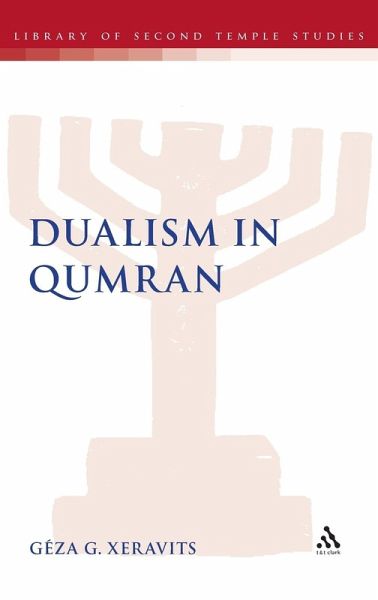
This is an assessment of dualistic thinking in the Qumran material written by leading contributors in the light of two decades of Qumran research. The importance of dualistic thinking within the Dead Sea Scrolls has always been emphasised in Qumran Studies . Nevertheless, in the last two decades the research on Qumran dualism seems to have been on the margins of scholarly interest. The main result of contemporary research in this area is support for the conviction that one cannot postulate compelling doctrines in the 'theology of Qumran' - the group did not want to develop a sophisticated…mehr
This is an assessment of dualistic thinking in the Qumran material written by leading contributors in the light of two decades of Qumran research. The importance of dualistic thinking within the Dead Sea Scrolls has always been emphasised in Qumran Studies . Nevertheless, in the last two decades the research on Qumran dualism seems to have been on the margins of scholarly interest. The main result of contemporary research in this area is support for the conviction that one cannot postulate compelling doctrines in the 'theology of Qumran' - the group did not want to develop a sophisticated doctrinal system; rather, they collected and mediated various aspects of the theology of their times. Since virtually all the Qumran material has been published, it is now apposite to evaluate several oft-debated topics of scholarly research. The theme of 'dualism in Qumran' is one such area in need of fresh investigation. The contributors of the present volume begin this work and open up new fields that might stimulate further reflection on the problem, assessing such issues as: the origin of Qumran's dualism; the literary growth of the passages in question; and the social/ideological setting of the dualistic passages within the Qumran Library. The Library of Second Temple Studies is a premier book series that offers cutting-edge work for a readership of scholars, teachers, postgraduate students and advanced undergraduates in the field of Second Temple studies. All the many and diverse aspects of Second Temple study are represented and promoted, including innovative work from historical perspectives, studies using social-scientific and literary theory, and developing theological, cultural and contextual approaches.
Normal 0 false false false MicrosoftInternetExplorer4 st1\: *{behavior: url(#ieooui) } ! /* Style Definitions */ p.MsoNormal, li.MsoNormal, div.MsoNormal {mso-style-parent: ""; margin:0cm; margin-bottom: .0001pt; mso-pagination: widow-orphan; font-size:12.0pt; font-family: "Times New Roman"; mso-fareast-font-family: "Times New Roman"; mso-ansi-language: HU; mso-fareast-language: HU;} @page Section1 {size:612.0pt 792.0pt; margin:72.0pt 90.0pt 72.0pt 90.0pt; mso-header-margin:36.0pt; mso-footer-margin:36.0pt; mso-paper-source:0;} div.Section1 {page: Section1;} > /* Style Definitions */ table.MsoNormalTable {mso-style-name: "Table Normal"; mso-tstyle-rowband-size:0; mso-tstyle-colband-size:0; mso-style-noshow: yes; mso-style-parent: ""; mso-padding-alt:0cm 5.4pt 0cm 5.4pt; mso-para-margin:0cm; mso-para-margin-bottom: .0001pt; mso-pagination: widow-orphan; font-size:10.0pt; font-family: "Times New Roman"; mso-ansi-language: #0400; mso-fareast-language: #0400; mso-bidi-language: #0400;} Geza G. Xeravits is professor and chair at the Department of Bible, Sapientia College of Theology, Budapest, Hungary. The main field of his research is early Jewish literature, especially the Dead Sea Scrolls, and the deuterocanonical books of the Old Testament.
Inhaltsangabe
Contents >Abbreviations >Contributors >Foreword >1. Introduction: Géza Xeravits >2. Dualism in the Qumran War Texts: Philip R. Davies >3. Looking for Sapiential Dualism at Qumran: Matthew Goff >4. Another Look at Dualism in Qumran Writings: Paul Heger >5. The Treatise on the Two Spirits and the Literary History of the Rule of the Community: Charlotte Hempel >6. Evil, Dualism and Community: Who/What Did the Yahad not want to be?: Jutta Leonhardt-Balzer >7. Light and Darkness in the Treatise on the Two Spirits (1QS III 13 - IV 26) and in 4Q186: Mladern Popovic >8. Dualism and Penitential Prayer in the Rule of the Community (1QS): Emmanuel O. Tukasi
Contents >Abbreviations >Contributors >Foreword >1. Introduction: Géza Xeravits >2. Dualism in the Qumran War Texts: Philip R. Davies >3. Looking for Sapiential Dualism at Qumran: Matthew Goff >4. Another Look at Dualism in Qumran Writings: Paul Heger >5. The Treatise on the Two Spirits and the Literary History of the Rule of the Community: Charlotte Hempel >6. Evil, Dualism and Community: Who/What Did the Yahad not want to be?: Jutta Leonhardt-Balzer >7. Light and Darkness in the Treatise on the Two Spirits (1QS III 13 - IV 26) and in 4Q186: Mladern Popovic >8. Dualism and Penitential Prayer in the Rule of the Community (1QS): Emmanuel O. Tukasi
Es gelten unsere Allgemeinen Geschäftsbedingungen: www.buecher.de/agb
Impressum
www.buecher.de ist ein Internetauftritt der buecher.de internetstores GmbH
Geschäftsführung: Monica Sawhney | Roland Kölbl | Günter Hilger
Sitz der Gesellschaft: Batheyer Straße 115 - 117, 58099 Hagen
Postanschrift: Bürgermeister-Wegele-Str. 12, 86167 Augsburg
Amtsgericht Hagen HRB 13257
Steuernummer: 321/5800/1497
USt-IdNr: DE450055826