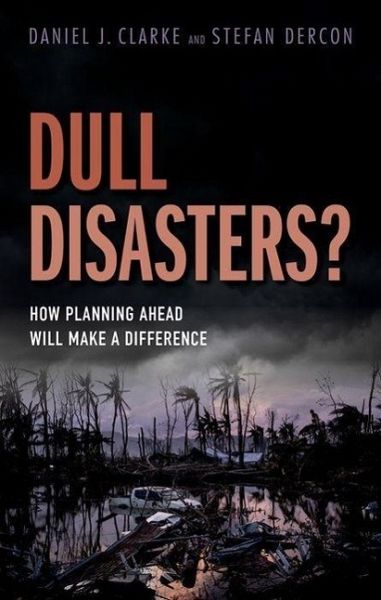
In recent years, typhoons have struck the Philippines and Vanuatu; earthquakes have rocked Haiti, Pakistan, and Nepal; floods have swept through Pakistan and Mozambique; droughts have hit Ethiopia, Kenya, and Somalia; and more. All led to loss of life and loss of livelihoods, and recovery will take years. One of the likely effects of climate change is to increase the likelihood of the type of extreme weather events that seems to cause these disasters. But do extreme events have to turn into disasters with huge loss of life and suffering?
In recent years, typhoons have struck the Philippines and Vanuatu; earthquakes have rocked Haiti, Pakistan, and Nepal; floods have swept through Pakistan and Mozambique; droughts have hit Ethiopia, Kenya, and Somalia; and more. All led to loss of life and loss of livelihoods, and recovery will take years. One of the likely effects of climate change is to increase the likelihood of the type of extreme weather events that seems to cause these disasters. But do extreme events have to turn into disasters with huge loss of life and suffering?
Daniel J. Clarke is an actuary and development economist who works as a Senior Insurance Specialist in the Disaster Risk Financing & Insurance Program, a joint program between the World Bank Group and the Global Facility for Disaster Reduction and Recovery. Over the last decade he has worked with more than twenty developing country governments to develop efficient, cost-effective solutions for enhanced financial protection against disasters. He has a first class degree from Cambridge University in Mathematics in Computer Science and a D.Phil. in Economics from the University of Oxford, and is a Fellow of the Institute of Actuaries. Stefan Dercon is Professor of Economic Policy at the University of Oxford, and a Professorial Fellow of Wolfson College. He is also Chief Economist of the UK Department for International Development. Previously he taught in Belgium and at the University of Addis Ababa. His interest is in applying microeconomics and statistics to problems of development. He has worked on risk and poverty, agriculture and rural institutions, political economy, childhood poverty, social and geographic mobility, micro-insurance, and measurement issues related to poverty and vulnerability.
Inhaltsangabe
1: Dealing with Disasters: It Should and Can Get Better 2: Defining the Problem: Begging Bowls and Benefactors 3: Bring in the Professionals 4: Planning for Disaster Recovery: Changing the Default Setting 5: Finance as the Glue 6: Moving Forward . . . Glossary Notes References
1: Dealing with Disasters: It Should and Can Get Better 2: Defining the Problem: Begging Bowls and Benefactors 3: Bring in the Professionals 4: Planning for Disaster Recovery: Changing the Default Setting 5: Finance as the Glue 6: Moving Forward . . . Glossary Notes References
Es gelten unsere Allgemeinen Geschäftsbedingungen: www.buecher.de/agb
Impressum
www.buecher.de ist ein Internetauftritt der buecher.de internetstores GmbH
Geschäftsführung: Monica Sawhney | Roland Kölbl | Günter Hilger
Sitz der Gesellschaft: Batheyer Straße 115 - 117, 58099 Hagen
Postanschrift: Bürgermeister-Wegele-Str. 12, 86167 Augsburg
Amtsgericht Hagen HRB 13257
Steuernummer: 321/5800/1497
USt-IdNr: DE450055826