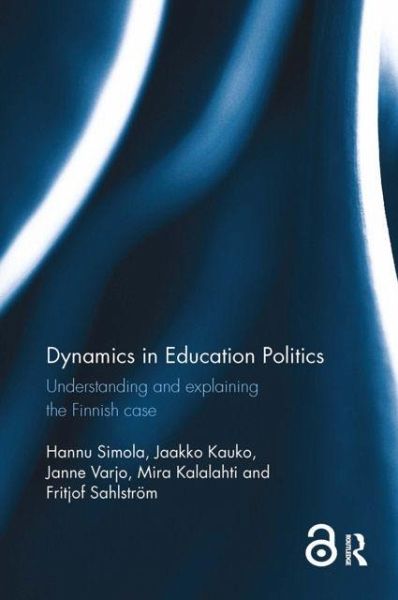
In the field of comparative education without a strong theory-driven approach it is hard to go beyond merely listing the similarities and differences that make it possible to create countless rankings, but reveals little about specific and shared developmental processes between education systems. This book introduces a new theoretical framework
In the field of comparative education without a strong theory-driven approach it is hard to go beyond merely listing the similarities and differences that make it possible to create countless rankings, but reveals little about specific and shared developmental processes between education systems. This book introduces a new theoretical framework
Hannu Simola, PhD, is Professor in Sociology and Politics of Education, at the Universities of Turku and Helsinki, Finland. His research interests are currently focused on socioanalysis of teacherhood, contextual analytics of educational innovations and local educational ethos. His recent book is The Finnish Education Mystery (Routledge 2015). Jaakko Kauko, PhD, MSocSc, is Associate Professor in Education at the School of Education, University of Tampere, Finland. His research is situated in the fields of politics of education and comparative education. He is interested in the questions of power, contingency, and complexity. Janne Varjo, PhD, is Lecturer at the Institute of Behavioural Sciences, and more particularly within the Research Unit focusing on the Sociology and Politics of Education, at the University of Helsinki. His research interests include sociology of education, history of education and administration, economy and planning of education. Mira Kalalahti, DrSocSc, MA, is Post-doctoral Researcher in the Research Unit Focusing on the Sociology and Politics of Education at the Department of Teacher Education, University of Helsinki, Finland. Her research interests involve sociology of education, especially questions concerning the equality of educational opportunities and educational transitions. Fritjof Sahlström, PhD, is Professor in Education at Åbo Akademi University, Finland. His research has focused on the organization of interaction in educational settings, on developing ways of documenting and analysing classroom interaction relying on conversation analysis, and on the relationships between interaction, participation and social reproduction.
Inhaltsangabe
Acknowledgements Introduction 1. Comparative Analytics in the Dynamics of Education Politics 1.1 Comparative education as a contested terrain 1.2 A proposal for a more systematic, flexible and vivid approach: CADEP 2. Orienting to the Finnish case 2.1 The history of political situations 2.2 The history of political possibilities 2.3 The history of politicking 3. Dynamics in Policymaking 3.1. Late but enduring structures reflecting a belief in schooling 3.2. Middle-class liberalist equity meets factory- and farmland-based equality 3.3 Equality enhanced by the recession and PISA 3.4. Conclusion: buffering and embedded egalitarianism 4. Dynamics in governance 4.1 From strict centralisation towards NPM and decentralisation 4.2 Punctuated trust 4.3 Non-materialised QAE 4.4 Conclusion: redistributing but punctuated trust 5. Dynamics in family educational strategies 5.1. Leaving the Peruskoulu monolith behind 5.2. Contradictory school choice 5.3. Local politicking for soft school choice 5.4. Conclusion: reliable but diverged parenthood 6. Dynamics in classroom cultures 6.1. From Herbart-Zillerian and social pedagogy to Peruskoulu didactics 6.2. Individualised Peruskoulu pedagogies since 1970 6.3. A hybrid of tradition and progress 6.4 Conclusion: consolidating but paternalistic progressivism 7. The dynamics of Finnish basic-education politics: from understanding to explanation
Acknowledgements Introduction 1. Comparative Analytics in the Dynamics of Education Politics 1.1 Comparative education as a contested terrain 1.2 A proposal for a more systematic, flexible and vivid approach: CADEP 2. Orienting to the Finnish case 2.1 The history of political situations 2.2 The history of political possibilities 2.3 The history of politicking 3. Dynamics in Policymaking 3.1. Late but enduring structures reflecting a belief in schooling 3.2. Middle-class liberalist equity meets factory- and farmland-based equality 3.3 Equality enhanced by the recession and PISA 3.4. Conclusion: buffering and embedded egalitarianism 4. Dynamics in governance 4.1 From strict centralisation towards NPM and decentralisation 4.2 Punctuated trust 4.3 Non-materialised QAE 4.4 Conclusion: redistributing but punctuated trust 5. Dynamics in family educational strategies 5.1. Leaving the Peruskoulu monolith behind 5.2. Contradictory school choice 5.3. Local politicking for soft school choice 5.4. Conclusion: reliable but diverged parenthood 6. Dynamics in classroom cultures 6.1. From Herbart-Zillerian and social pedagogy to Peruskoulu didactics 6.2. Individualised Peruskoulu pedagogies since 1970 6.3. A hybrid of tradition and progress 6.4 Conclusion: consolidating but paternalistic progressivism 7. The dynamics of Finnish basic-education politics: from understanding to explanation
Es gelten unsere Allgemeinen Geschäftsbedingungen: www.buecher.de/agb
Impressum
www.buecher.de ist ein Internetauftritt der buecher.de internetstores GmbH
Geschäftsführung: Monica Sawhney | Roland Kölbl | Günter Hilger
Sitz der Gesellschaft: Batheyer Straße 115 - 117, 58099 Hagen
Postanschrift: Bürgermeister-Wegele-Str. 12, 86167 Augsburg
Amtsgericht Hagen HRB 13257
Steuernummer: 321/5800/1497
USt-IdNr: DE450055826