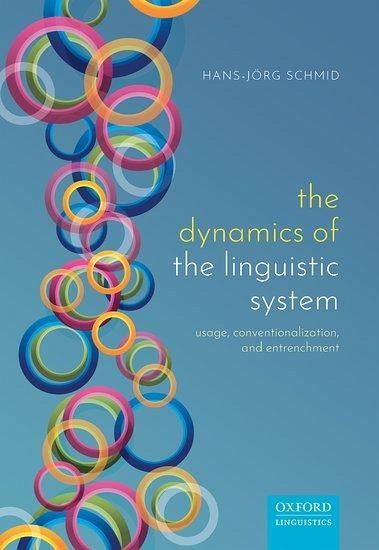
This volume outlines a model of language that can be characterized as functionalist, usage-based, dynamic, and complex-adaptive. The core idea is that linguistic structure is not stable and uniform, but continually refreshed by the interaction between three components: usage, the communicative activities of speakers; conventionalization, the social processes triggered by these activities and feeding back into them; and entrenchment, the individual cognitive processes that are also linked to these activities in a feedback loop. Hans-Jorg Schmid explains how this multiple feedback system works…mehr
This volume outlines a model of language that can be characterized as functionalist, usage-based, dynamic, and complex-adaptive. The core idea is that linguistic structure is not stable and uniform, but continually refreshed by the interaction between three components: usage, the communicative activities of speakers; conventionalization, the social processes triggered by these activities and feeding back into them; and entrenchment, the individual cognitive processes that are also linked to these activities in a feedback loop. Hans-Jorg Schmid explains how this multiple feedback system works by extending his Entrenchment-and-Conventionalization Model, showing how the linguistic system is created, sustained, and continually adapted by the ongoing interaction between usage, conventionalization, and entrenchment. Fulfilling the promise of usage-based accounts, the model explains how exactly usage is transformed into collective and individual grammar and how these two grammars in turn feed back into usage. The book is exceptionally broad in scope, with insights from a wide range of linguistic subdisciplines. It provides a coherent account of the role of multiple factors that influence language structure, variation, and change, including frequency, economy, identity, multilingualism, and language contact.
Hans-Jörg Schmid is Full Professor of English Linguistics at Ludwig Maximilians University, Munich. He has taught at Westfield College, London, and at the universities of Dresden, Bochum, and Bayreuth. His research has been devoted to a wide range of fields in linguistics including lexical semantics, grammar, cognitive linguistics, corpus linguistics, word-formation, pragmatics, sociolinguistics, and linguistic theory. His recent publications include English Morphology and Word-Formation (3rd edition; Erich Schmidt, 2016) and, as editor, Entrenchment and the Psychology of Language Learning: How We Reorganize and Adapt Linguistic Knowledge (APA/De Gruyter 2017), Cognitive Pragmatics: Handbooks of Pragmatics Volume 4 (De Gruyter 2012), and Constructions - Collocations - Patterns (with Thomas Herbst and Susen Faulhaber; De Gruyter 2014).
Inhaltsangabe
* Preface and acknowledgements * List of abbreviations * 1: Introduction * Part I: Usage and its potential to feed into conventionalization and entrenchment * 2: Usage events and utterance types * 3: Co-semiosis and other interpersonal activities * 4: Association and cognitive processing * 5: Forces affecting usage * 6: Summary of Part I * Part II: Conventionalization * 7: Understanding the process of conventionalization * 8: Usualization * 9: Diffusion * 10: Summary of Part II * Part III: Entrenchment * 11: Understanding the process of entrenchment * 12: The routinization of syntagmatic associations * 13: The routinization of symbolic associations * 14: The routinization of pragmatic associations * 15: Summary of part III: How the four types of associations cooperate and compete for routinization * Part IV: Synopsis: The EC-Model as a dynamic complex-adaptive system * 16: Summary of the EC-Model * 17: Persistence * 18: Variation * 19: Change * 20: Conclusion * References * Index
* Preface and acknowledgements * List of abbreviations * 1: Introduction * Part I: Usage and its potential to feed into conventionalization and entrenchment * 2: Usage events and utterance types * 3: Co-semiosis and other interpersonal activities * 4: Association and cognitive processing * 5: Forces affecting usage * 6: Summary of Part I * Part II: Conventionalization * 7: Understanding the process of conventionalization * 8: Usualization * 9: Diffusion * 10: Summary of Part II * Part III: Entrenchment * 11: Understanding the process of entrenchment * 12: The routinization of syntagmatic associations * 13: The routinization of symbolic associations * 14: The routinization of pragmatic associations * 15: Summary of part III: How the four types of associations cooperate and compete for routinization * Part IV: Synopsis: The EC-Model as a dynamic complex-adaptive system * 16: Summary of the EC-Model * 17: Persistence * 18: Variation * 19: Change * 20: Conclusion * References * Index
Es gelten unsere Allgemeinen Geschäftsbedingungen: www.buecher.de/agb
Impressum
www.buecher.de ist ein Internetauftritt der buecher.de internetstores GmbH
Geschäftsführung: Monica Sawhney | Roland Kölbl | Günter Hilger
Sitz der Gesellschaft: Batheyer Straße 115 - 117, 58099 Hagen
Postanschrift: Bürgermeister-Wegele-Str. 12, 86167 Augsburg
Amtsgericht Hagen HRB 13257
Steuernummer: 321/5800/1497
USt-IdNr: DE450055826