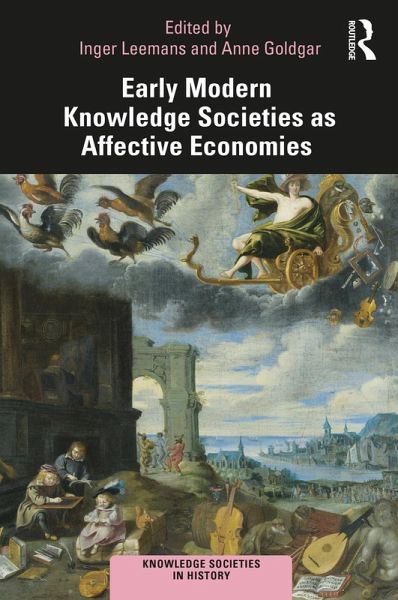
This book researches the development of knowledge economies in Early Modern Europe. Starting with the Southern and Northern Netherlands as important early hubs for marketing knowledge, it analyzes knowledge economies in the dynamics of a globalizing world.
This book researches the development of knowledge economies in Early Modern Europe. Starting with the Southern and Northern Netherlands as important early hubs for marketing knowledge, it analyzes knowledge economies in the dynamics of a globalizing world.
Inger Leemans is Professor of Cultural History at Vrije Universiteit Amsterdam, the Netherlands, and Principle Investigator of NL-Lab at the Humanities Cluster of the Royal Netherlands Academy of Arts and Sciences. She has published on the history of emotions and the senses, radical Enlightenment, financial crises and digital humanities. Her current project is on 'Affective Economies. A Cultural History of Stock Trading'. Anne Goldgar is Garrett and Anne Van Hunnick Professor of European History at the University of Southern California. From 1993 to 2020 she taught at King's College London, where she was Professor of Early Modern European History. She is a social and cultural historian who has written numerous works, including Impolite Learning: Conduct and Community in the Republic of Letters 1680-1750 and Tulipmania: Money, Honor, and Knowledge in the Dutch Golden Age.
Inhaltsangabe
Introduction: knowledge - market - affect: knowledge societies as affective economies Part 1: Wish economies and affective communities 1. Knowing the market: Hans Fugger's affective economies 2. Pennetrek: Sir Balthazar Gerbier (1592-1663) and the calligraphic aesthetics of commercial empire 3. Affective projecting: mining and inland navigation in Braunschweig-Lüneburg 4. The secret of Amsterdam: politics, alchemy and the commodification of knowledge in the 17th century 5. Liefhebberij: a market sensibility 6. The shaping of young consumers in early modern book-objects: managing affects and markets by books for youths Part 2: Marketing and managing knowledge and affects 7. Marketing arctic knowledge: observation, publication, and affect in the 1630s 8. Coordination in early modern Dutch book markets: 'always something new' 9. The spectacle of dissection. early modern theatricality and anatomical frenzy 10. Rubbed, pricked, and boiled: coins as objects of inquiry in the Dutch Republic 11. The Amsterdam stock exchange as affective economy
Introduction: knowledge - market - affect: knowledge societies as affective economies Part 1: Wish economies and affective communities 1. Knowing the market: Hans Fugger's affective economies 2. Pennetrek: Sir Balthazar Gerbier (1592-1663) and the calligraphic aesthetics of commercial empire 3. Affective projecting: mining and inland navigation in Braunschweig-Lüneburg 4. The secret of Amsterdam: politics, alchemy and the commodification of knowledge in the 17th century 5. Liefhebberij: a market sensibility 6. The shaping of young consumers in early modern book-objects: managing affects and markets by books for youths Part 2: Marketing and managing knowledge and affects 7. Marketing arctic knowledge: observation, publication, and affect in the 1630s 8. Coordination in early modern Dutch book markets: 'always something new' 9. The spectacle of dissection. early modern theatricality and anatomical frenzy 10. Rubbed, pricked, and boiled: coins as objects of inquiry in the Dutch Republic 11. The Amsterdam stock exchange as affective economy
Es gelten unsere Allgemeinen Geschäftsbedingungen: www.buecher.de/agb
Impressum
www.buecher.de ist ein Internetauftritt der buecher.de internetstores GmbH
Geschäftsführung: Monica Sawhney | Roland Kölbl | Günter Hilger
Sitz der Gesellschaft: Batheyer Straße 115 - 117, 58099 Hagen
Postanschrift: Bürgermeister-Wegele-Str. 12, 86167 Augsburg
Amtsgericht Hagen HRB 13257
Steuernummer: 321/5800/1497
USt-IdNr: DE450055826