
Andere Kunden interessierten sich auch für
 Earth Observation Satellites83,99 €
 Small Satellites for Earth Observation80,99 €
 Space Technology38,99 €
 Artificial Satellites and How to Observe Them27,99 €
 An Introduction to Mission Design for Geostationary Satellites123,99 €
 Look Up8,99 €
 Dynamics of Planets and Satellites and Theories of Their Motion39,99 €


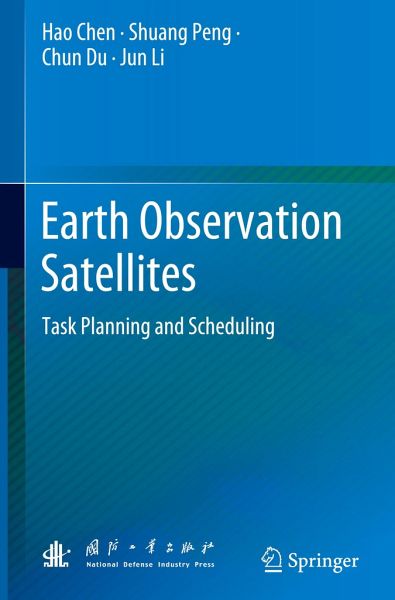
This book highlights the practical models and algorithms of earth observation satellite (EOS) task scheduling. EOS task scheduling is a typical complex combinatorial optimization problem with NP-Hard computational complexity. It is a key technology in aerospace scheduling and has attracted global attention. Based on the actual needs of the EOS operation control center, the book summarizes and reviews the state of the art in this research and engineering field. In both deterministic scenarios and dynamic scenarios, the book elaborates on the typical models, algorithms, and systems in centralized, distributed, and onboard autonomous task scheduling. The book also makes an outlook on the promising technologies for EOS task planning and scheduling in the future. It is a valuable reference for professionals, researchers, and students in satellite-related technology.
This book is a translation of an original Chinese edition. The translation was done with thehelp of artificial intelligence. A subsequent human revision was done primarily in terms of content, so that the book will read stylistically differently from a conventional translation.
This book is a translation of an original Chinese edition. The translation was done with thehelp of artificial intelligence. A subsequent human revision was done primarily in terms of content, so that the book will read stylistically differently from a conventional translation.