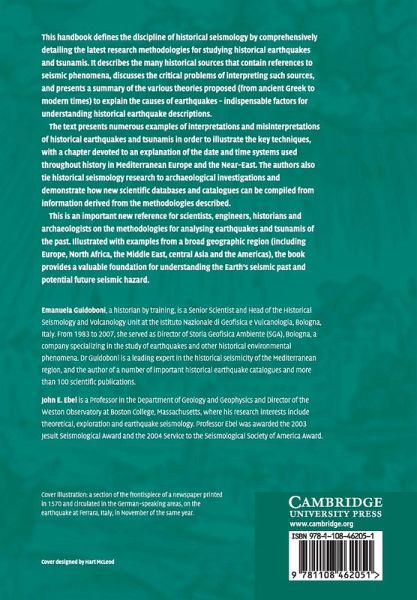
Emanuela Guidoboni is a senior scientist and head of the historical seismology and volcanology unit at the Istituto Nazionale di Geofisica e Vulcanologia, Bologna, Italy. From 1983 to 2007, she served as director of SGA-Storia Geofisica Ambiente, Bologna, a company specializing in the study of earthquakes and other historical environmental phenomena. A historian by training, Dr Guidoboni is a leading expert in the historical seismicity of the Mediterranean region, and the author of a number of important historical earthquake catalogues and more than 100 scientific publications.
Inhaltsangabe
Part I. Defining Historical Seismology: 1. What is historical seismology? 2. The importance of historical earthquake and tsunami data Part II. Issues Concerning the Interpretation of Historical Earthquake and Ttsunami Data: 3. Written historical sources and their use 4. Types of scientific sources 5. Other types of sources 6. Potential problems in historical records 7. Determination of historical earthquakes: dates and times Part III. Practical Guidelines for the Analysis of Historical Earthquake Data: 8. Planning the goals of the analysis of historical earthquakes 9. Processing historical records 10. From interpretation of historical records to historical seismic scenarios 11. Traces of earthquakes in archaeological sites and in monuments 12. Deriving earthquake source and shaking parameters from historical data 13. Cooperation in historical seismology research Index.
Part I. Defining Historical Seismology: 1. What is historical seismology? 2. The importance of historical earthquake and tsunami data Part II. Issues Concerning the Interpretation of Historical Earthquake and Ttsunami Data: 3. Written historical sources and their use 4. Types of scientific sources 5. Other types of sources 6. Potential problems in historical records 7. Determination of historical earthquakes: dates and times Part III. Practical Guidelines for the Analysis of Historical Earthquake Data: 8. Planning the goals of the analysis of historical earthquakes 9. Processing historical records 10. From interpretation of historical records to historical seismic scenarios 11. Traces of earthquakes in archaeological sites and in monuments 12. Deriving earthquake source and shaking parameters from historical data 13. Cooperation in historical seismology research Index.
Es gelten unsere Allgemeinen Geschäftsbedingungen: www.buecher.de/agb
Impressum
www.buecher.de ist ein Internetauftritt der buecher.de internetstores GmbH
Geschäftsführung: Monica Sawhney | Roland Kölbl | Günter Hilger
Sitz der Gesellschaft: Batheyer Straße 115 - 117, 58099 Hagen
Postanschrift: Bürgermeister-Wegele-Str. 12, 86167 Augsburg
Amtsgericht Hagen HRB 13257
Steuernummer: 321/5800/1497
USt-IdNr: DE450055826