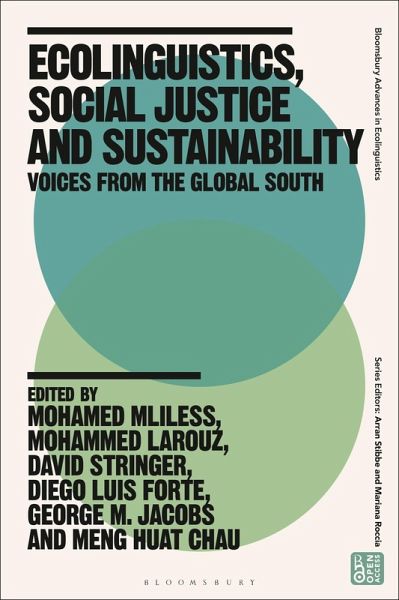
Decentring the growing field of ecolinguistics from its historically Western orientation, this open access book offers a comprehensive exploration of the intricate relationship between language and the environment in the Global South. It brings forward new perspectives and voices to broaden our understanding of the role of language in addressing ecological challenges. Through a series of thought-provoking chapters, the book navigates through various dimensions of ecolinguistics, shedding light on critical issues and innovative approaches across diverse contexts. Case studies include the…mehr
Decentring the growing field of ecolinguistics from its historically Western orientation, this open access book offers a comprehensive exploration of the intricate relationship between language and the environment in the Global South. It brings forward new perspectives and voices to broaden our understanding of the role of language in addressing ecological challenges. Through a series of thought-provoking chapters, the book navigates through various dimensions of ecolinguistics, shedding light on critical issues and innovative approaches across diverse contexts. Case studies include the representation of ecotourism in Morocco, the implementation of ecological ideology in Oman, colonial legacies in Argentina's food production discourse, ecological identity in Kenya, the role of civets in Indonesian coffee production and life stories about Senegalese ecologies. Through a blend of theoretical insights and practical applications, the book advocates for a holistic understanding of ecolinguistics that transcends geographical boundaries and cultural nuances. The ebook editions of this book are available open access under a CC BY-NC-ND 4.0 licence on bloomsburycollections.com. Open access was funded by the Bloomsbury Open Collections Library Collective.
Mohamed Mliless is an independent researcher in Ecolinguistics and Critical Environmental Discourse Analysis, Meknes, Morocco. Mohammed Larouz is Dean of the School of Arts and Humanities at Moulay Ismail University of Meknes, Morocco. David Stringer is Associate Professor of Second Language Studies at Indiana University Bloomington, USA. Diego Luis Forte is an Academic Consultant for the Ministry of Agriculture of Argentina and a Professor of Multimodality at the University of Buenos Aires, Argentina. George M Jacobs teaches and writes for Kampung Senang Charity and Education Foundation, Singapore. Meng Huat Chau is Professor of Applied Linguistics and Language Education at Zhejiang International Studies University, China.
Inhaltsangabe
List of Figures List of Tables List of Contributors Foreword Hildo Honório do Couto Acknowledgements List of Abbreviations Introduction Mohamed Mliless (Independent Researcher Morocco) 1. Advances Challenges and Opportunities for Ecolinguistics in Latin America Mariana Roccia (University of Gloucestershire UK) 2. Investigating the Discrepancies between Environmental Education and Students' Environmental Practices: A Mixed-Method Approach Hassane Razkane (Chouaib Doukkali University El Jadida Morocco) El Ayachi El Baghdady (Chouaib Doukkali University El Jadida Morocco) Adil Youssef Sayeh (Chouaib Doukkali University El Jadida Morocco) and Mohamed Yeou (Chouaib Doukkali University El Jadida Morocco) 3. Implementing the Ecological Ideology through the Integration of Ecolinguistic Materials into the EFL Context at Higher Education in Oman Iman Jabbar Abbas (University of Technology and Applied Sciences Sultanate of Oman) and Ouarda Khouni 4. Children's Books for Enjoyment Language Learning and the Sustainable Development Goals Chenghao Zhu (Universiti Malaya Malaysia) Meng Huat Chau (Zhejiang International Studies University China) Hisham M. El-Tahawy (Arab Open University Bahrain) Jasper Roe (James Cook University Singapore) and George M. Jacobs (James Cook University Singapore) 5. Integrating Ecolinguistic Perspective of Outstanding Universal Values of Subak in English Learning: A Mental Model Analysis Agung Sri Jayantini (Universitas Mahasaraswati Denpasar Indonesia) Sang Putu kaler Surata (Universitas Mahasaraswati Denpasar Indonesia) and Ronald Umbas (Institute of Social and Political Science Wira Bhakti) 6. Representation of Ecotourism in Morocco: An Ecolinguistic and Visual Analysis of YouTube Videos Mohamed Mliless (Independent researcher Morocco) Mohammed Larouz and Mohamed Louza (Cadi Ayyad University Morocco) 7. Colonial Thought Eco-Industrialism and Speciesism in the Discourse of Argentina's Food Production Control Agency Diego L. Forte (National Library of Argentina Argentina) 8. Ecological Identity in Kenya via Lexicogrammar of Swahili Exploring Ecological Identity in Kenya Peter Githinji (Kenyatta University Kenya) and Philip W. Rudd (Pittsburg State University USA) 9. A Biographical Approach to Decolonial Ecolinguistics Learning from Life Stories on the Margins about Senegalese Ecologies Mouhamed Abdallah Ly (University of Dakar Senegal) and Monika Christine Rohmer (University of Bayreuth Germany) 10. An Ecolinguistic Analysis of the Role of Civets in Indonesian "Civet Coffee" Ingrid Gavilán Tatin (Universitas Negeri Yogyakarta Indonesia) George M. Jacobs (James Cook University Singapore) Meng Huat Chau ( Zhejiang International Studies University China) Chenghao Zhu (Universiti Malaya Malaysia) and Aditya Alam Soeta Bangsa (Universitas Negeri Yogyakarta Indonesia) Conclusion Mohamed Mliless (Independent Researcher Morocco) Index
List of Figures List of Tables List of Contributors Foreword Hildo Honório do Couto Acknowledgements List of Abbreviations Introduction Mohamed Mliless (Independent Researcher Morocco) 1. Advances Challenges and Opportunities for Ecolinguistics in Latin America Mariana Roccia (University of Gloucestershire UK) 2. Investigating the Discrepancies between Environmental Education and Students' Environmental Practices: A Mixed-Method Approach Hassane Razkane (Chouaib Doukkali University El Jadida Morocco) El Ayachi El Baghdady (Chouaib Doukkali University El Jadida Morocco) Adil Youssef Sayeh (Chouaib Doukkali University El Jadida Morocco) and Mohamed Yeou (Chouaib Doukkali University El Jadida Morocco) 3. Implementing the Ecological Ideology through the Integration of Ecolinguistic Materials into the EFL Context at Higher Education in Oman Iman Jabbar Abbas (University of Technology and Applied Sciences Sultanate of Oman) and Ouarda Khouni 4. Children's Books for Enjoyment Language Learning and the Sustainable Development Goals Chenghao Zhu (Universiti Malaya Malaysia) Meng Huat Chau (Zhejiang International Studies University China) Hisham M. El-Tahawy (Arab Open University Bahrain) Jasper Roe (James Cook University Singapore) and George M. Jacobs (James Cook University Singapore) 5. Integrating Ecolinguistic Perspective of Outstanding Universal Values of Subak in English Learning: A Mental Model Analysis Agung Sri Jayantini (Universitas Mahasaraswati Denpasar Indonesia) Sang Putu kaler Surata (Universitas Mahasaraswati Denpasar Indonesia) and Ronald Umbas (Institute of Social and Political Science Wira Bhakti) 6. Representation of Ecotourism in Morocco: An Ecolinguistic and Visual Analysis of YouTube Videos Mohamed Mliless (Independent researcher Morocco) Mohammed Larouz and Mohamed Louza (Cadi Ayyad University Morocco) 7. Colonial Thought Eco-Industrialism and Speciesism in the Discourse of Argentina's Food Production Control Agency Diego L. Forte (National Library of Argentina Argentina) 8. Ecological Identity in Kenya via Lexicogrammar of Swahili Exploring Ecological Identity in Kenya Peter Githinji (Kenyatta University Kenya) and Philip W. Rudd (Pittsburg State University USA) 9. A Biographical Approach to Decolonial Ecolinguistics Learning from Life Stories on the Margins about Senegalese Ecologies Mouhamed Abdallah Ly (University of Dakar Senegal) and Monika Christine Rohmer (University of Bayreuth Germany) 10. An Ecolinguistic Analysis of the Role of Civets in Indonesian "Civet Coffee" Ingrid Gavilán Tatin (Universitas Negeri Yogyakarta Indonesia) George M. Jacobs (James Cook University Singapore) Meng Huat Chau ( Zhejiang International Studies University China) Chenghao Zhu (Universiti Malaya Malaysia) and Aditya Alam Soeta Bangsa (Universitas Negeri Yogyakarta Indonesia) Conclusion Mohamed Mliless (Independent Researcher Morocco) Index
Es gelten unsere Allgemeinen Geschäftsbedingungen: www.buecher.de/agb
Impressum
www.buecher.de ist ein Internetauftritt der buecher.de internetstores GmbH
Geschäftsführung: Monica Sawhney | Roland Kölbl | Günter Hilger
Sitz der Gesellschaft: Batheyer Straße 115 - 117, 58099 Hagen
Postanschrift: Bürgermeister-Wegele-Str. 12, 86167 Augsburg
Amtsgericht Hagen HRB 13257
Steuernummer: 321/5800/1497
USt-IdNr: DE450055826