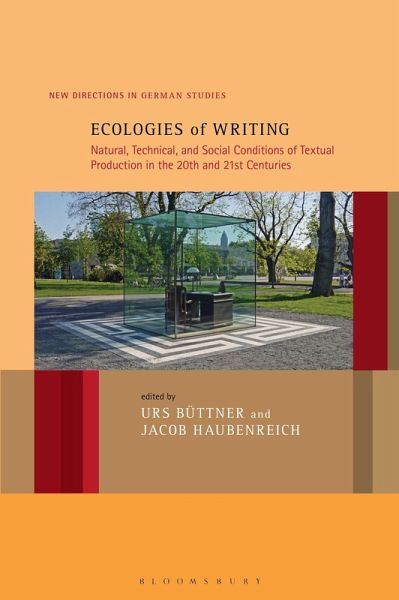
Natural, Technical, and Social Conditions of Textual Production in the Twentieth and Twenty-First Centuries Herausgeber: Büttner, Urs; Meyer, Imke; Haubenreich, Jacob
Natural, Technical, and Social Conditions of Textual Production in the Twentieth and Twenty-First Centuries Herausgeber: Büttner, Urs; Meyer, Imke; Haubenreich, Jacob
Uses case studies from 20th-century German literature and theory to explore the material, social, economic, and environmental bases of writing and its craft.
Uses case studies from 20th-century German literature and theory to explore the material, social, economic, and environmental bases of writing and its craft.
Urs Büttner is Feodor Lynen Fellow of the Alexander von Humboldt Foundation at the University of Oxford, UK. He previously held positions at Leibniz University Hannover, Free University Berlin and Heinrich Heine University Düsseldorf. He taught as Max Kade Professor at the University of Illinois at Urbana-Champaign and received a Visiting Scholarship at the Institute of Advanced Studies at the University of Durham. Jacob Haubenreich is Assistant Professor in the Department of Modern Languages and Literatures at Johns Hopkins University, USA. He has previously held positions at Southern Illinois University, Carbondale and the College of the Holy Cross, as well as positions as Visiting Scholar at the Austrian Academy of Sciences and in the Marbach Weimar Wolfenbüttel Research Association.
Inhaltsangabe
Introduction: An Expanded Perspective on Textual Creation Urs Büttner (Heinrich Heine Universität Düsseldorf, Germany) and Jacob Haubenreich (Johns Hopkins University, USA) Part I. Materialities 1. The Field of Writing: The Ambulatory Art of Noticing Third Nature in Sebald and Kinsky, Jason Groves (University of Washington, USA) 2. Street Writing and Contemporary German Streetscapes, Peter Schweppe (Montana State University, USA) Part II. Mediality and Technical Devices 3. Lines of Force: Writing Theory and the Energetic Scripts of Modernism, Susanne Strätling (Freie Universität Berlin, Germany) 4. An Updated Superscript: Paradoxes of Writing Amidst Generative AI, Richard Gibson (Wheaton College, USA) Part III. Mind and Body 5. "This Conflict between the Soul's Inclination and the Body's Capabilities": Writing Hygiene in Thomas Mann's Death in Venice, Urs Büttner (Heinrich Heine Universität Düsseldorf, Germany) 6. Immersion and its Discontents: Kafka's Ecology of Attention, Carolin Duttlinger (University of Oxford, UK) Part IV. Social Conditions 7. In the Machine Room: Writing between Author and Editor, ca. 1900-2000, Ines Barner (ETH Zurich, Switzerland) translated by Eric Hounshell 8. Writing as Work: Towards a Theory of Literary Production, Carolin Amlinger (University of Basel, Switzerland) Notes on Contributors Index
Introduction: An Expanded Perspective on Textual Creation Urs Büttner (Heinrich Heine Universität Düsseldorf, Germany) and Jacob Haubenreich (Johns Hopkins University, USA) Part I. Materialities 1. The Field of Writing: The Ambulatory Art of Noticing Third Nature in Sebald and Kinsky, Jason Groves (University of Washington, USA) 2. Street Writing and Contemporary German Streetscapes, Peter Schweppe (Montana State University, USA) Part II. Mediality and Technical Devices 3. Lines of Force: Writing Theory and the Energetic Scripts of Modernism, Susanne Strätling (Freie Universität Berlin, Germany) 4. An Updated Superscript: Paradoxes of Writing Amidst Generative AI, Richard Gibson (Wheaton College, USA) Part III. Mind and Body 5. "This Conflict between the Soul's Inclination and the Body's Capabilities": Writing Hygiene in Thomas Mann's Death in Venice, Urs Büttner (Heinrich Heine Universität Düsseldorf, Germany) 6. Immersion and its Discontents: Kafka's Ecology of Attention, Carolin Duttlinger (University of Oxford, UK) Part IV. Social Conditions 7. In the Machine Room: Writing between Author and Editor, ca. 1900-2000, Ines Barner (ETH Zurich, Switzerland) translated by Eric Hounshell 8. Writing as Work: Towards a Theory of Literary Production, Carolin Amlinger (University of Basel, Switzerland) Notes on Contributors Index
Es gelten unsere Allgemeinen Geschäftsbedingungen: www.buecher.de/agb
Impressum
www.buecher.de ist ein Internetauftritt der buecher.de internetstores GmbH
Geschäftsführung: Monica Sawhney | Roland Kölbl | Günter Hilger
Sitz der Gesellschaft: Batheyer Straße 115 - 117, 58099 Hagen
Postanschrift: Bürgermeister-Wegele-Str. 12, 86167 Augsburg
Amtsgericht Hagen HRB 13257
Steuernummer: 321/5800/1497
USt-IdNr: DE450055826