
Eschenbach
Economic Analysis of Industrial Projects
Eschenbach
Economic Analysis of Industrial Projects
- Gebundenes Buch
- Merkliste
- Auf die Merkliste
- Bewerten Bewerten
- Teilen
- Produkt teilen
- Produkterinnerung
- Produkterinnerung
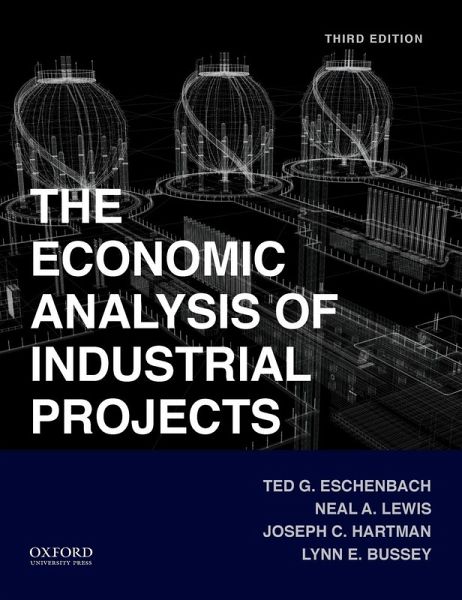
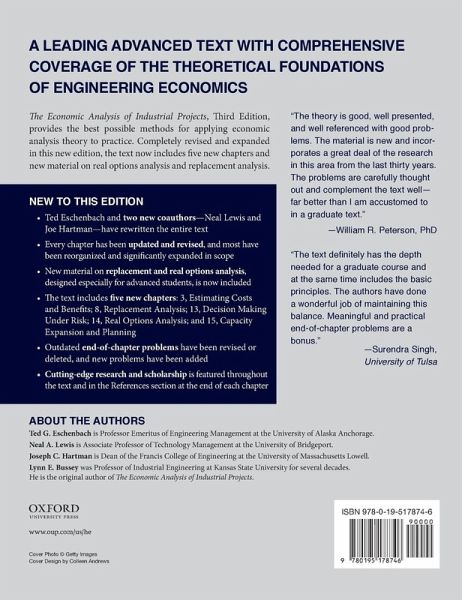
Economic Analysis of Industrial Projects, Third Edition, provides the best possible methods for applying economic analysis theory to practice. Completely revised and expanded in this new edition, the text now includes five new chapters and new material on real options analysis and replacement analysis.
Andere Kunden interessierten sich auch für
 Industrial Dynamics, Innovation Policy, and Economic Growth through Technological Advancements180,99 €
 Technologies for economic and functional lightweight design174,99 €
 P. V. RaoTechno-Economic Analysis on Retrofitted Briquette Boilers24,99 €
 H. C. OngTechno-Economic Analysis of Biodiesel Production43,99 €
 Yongsheng MaSenior Design Projects in Mechanical Engineering43,99 €
 Henry E RiggsFinancial and Economic Analysis for Engineering and Technology Management159,99 €
 Yongsheng MaSenior Design Projects in Mechanical Engineering61,99 €
-
-
-




Economic Analysis of Industrial Projects, Third Edition, provides the best possible methods for applying economic analysis theory to practice. Completely revised and expanded in this new edition, the text now includes five new chapters and new material on real options analysis and replacement analysis.
Produktdetails
- Produktdetails
- Verlag: ACADEMIC
- 3. Auflage
- Seitenzahl: 528
- Erscheinungstermin: 16. Juli 2012
- Englisch
- Abmessung: 241mm x 196mm x 33mm
- Gewicht: 1169g
- ISBN-13: 9780195178746
- ISBN-10: 0195178742
- Artikelnr.: 47868069
- Herstellerkennzeichnung
- Libri GmbH
- Europaallee 1
- 36244 Bad Hersfeld
- gpsr@libri.de
- Verlag: ACADEMIC
- 3. Auflage
- Seitenzahl: 528
- Erscheinungstermin: 16. Juli 2012
- Englisch
- Abmessung: 241mm x 196mm x 33mm
- Gewicht: 1169g
- ISBN-13: 9780195178746
- ISBN-10: 0195178742
- Artikelnr.: 47868069
- Herstellerkennzeichnung
- Libri GmbH
- Europaallee 1
- 36244 Bad Hersfeld
- gpsr@libri.de
Ted G. Eschenbach is Professor Emeritus of Engineering Management at the University of Alaska Anchorage. Neal A. Lewis is an Associate Professor of Technology Management at the University of Bridgeport. Joseph C. Hartman is Dean of the Francis College of Engineering at the University of Massachusetts Lowell. Lynn Bussey was a Professor of Industrial Engineering at Kansas State University for several decades. He is the original author of Economic Analysis of Industrial Projects.
* PART ONE: Basic Concepts * 1. The Firm Economic Exchanges and Objectives * 1.1 Introduction * 1.2 Economic ExchangeÄThe Input
Output Basis of the Firm * 1.3 Functions of the Firm: Financing, Investing, Producing * 1.4 Objectives of the Firm * 1.5 Sources and Uses of Funds * 1.6 Summary * References * Problems * 2. Interest, Interest Factors, and Equivalence * 2.1 What is Interest? *
2.1.1 Perfect capital market assumptions *
2.1.2 The consumption basis of single
period exchange *
2.1.3 Multi
period exchange *
2.1.4 Fundamental interest equation *
2.1.5 The equilibrium market price concept of interest rates * 2.2 Notation and Cash Flow Diagrams * 2.3 Tabulated Compound Interest Factors *
2.3.1 Factors relating P and F *
2.3.2 Factors relating A and F *
2.3.3 Factors relating P and A *
2.3.4 Arithmetic gradient conversion factors * 2.4 Examples of Time Value of Money Calculations * 2.5 Geometric Gradients * 2.6 Nominal and Effective Interest Rates * 2.7 Continuous Interest Factors * 2.8 Extended Engineering Economy Factors and Spreadsheets and Calculators *
2.8.1 Advantages of extended engineering economy factors *
2.8.2 Notation for extended engineering economy factors *
2.8.3 Spreadsheet annuity functions *
2.8.4 Time value of money (TVM) calculators * 2.9 Spreadsheets and Cash Flow Tables *
2.9.1 Advantages of spreadsheets for economic analysis *
2.9.2 Effective and efficient spreadsheet construction * 2.10 Economic Interpretation of Equivalent Annual Amount * 2.11 Summary * References * Problems * 3. Estimating Costs and Benefits
Lead Coauthor Heather Nachtmann * 3.1 Introduction * 3.2 Cash Flow Estimates * 3.3 Life Cycle Estimation * 3.4 Classification of Estimates * 3.5 Estimation Data * 3.6 Basic Estimation Techniques
Indexes and Per Unit *
3.6.1 Indexes *
3.6.2 Unit Technique * 3.7 Factor Technique * 3.8 Cost Estimation Relationships *
3.8.1 Development Process *
3.8.2 Capacity Functions *
3.8.3 Learning Curves * 3.9 Growth Curves * 3.10 Estimating Product Costs *
3.10.1 Direct costs *
3.10.2 Indirect costs * 3.11 Sensitivity Analysis * 3.12 Summary * References * Problems * 4. Depreciation: Techniques and Strategies * 4.1 Introduction * 4.2 Depreciation Strategies * 4.3 Definitions *
4.3.1 Depreciable property *
4.3.2 Basis of property *
4.3.3 Recovery period *
4.3.4 Salvage value *
4.3.5 Symbols and notation * 4.4 Basis and Book Value Determination *
4.4.1 Definition of initial basis and book value *
4.4.2 Special first
year write
offs *
4.4.3 Like
for
like replacement * 4.5 Methods of Depreciation *
4.5.1 Introduction *
4.5.2 The straight
line method *
4.5.3 The declining balance method *
4.5.4 The sum
of
the
years' digits (SOYD) method *
4.5.5 Switching *
4.5.6 Units of production *
4.5.7 Reasons for accelerated depreciation *
4.5.8 Modified Accelerated Cost Recovery System (MACRS) *
4.5.9 Job Creation and Worker Assistance Act *
4.5.10 Comparing book values with different depreciation methods * 4.6 The Present Value of the Cash Flow Due to Depreciation *
4.6.1 Straight
line method *
4.6.2 Declining balance method *
4.6.3 Sum
of
years' digits method *
4.6.4 Modified accelerated cost recovery system * 4.7 Simple Depreciation Strategies *
4.7.1 Accelerated depreciation is better *
4.7.2 Declining balance method versus the straight
line method *
4.7.3 The declining balance method versus the sum
of
years' digits method * 4.8 Complications Involving Depreciation Strategies * 4.9 Summary of Conclusions: Depreciation * 4.10 Depletion of Resources *
4.10.1 Entitlement to depletion *
4.10.2 Methods for computing depletion deductions *
4.10.3 The depletion deduction *
4.10.4 Typical percentage depletion rates * 4.11 Amortization of Prepaid Expenses and Intangible Property * References * Problems * 5. Corporate Tax Considerations * 5.1 Introduction * 5.2 Ordinary Income Tax Liability * 5.3 Federal Income Tax Rates *
5.3.1 Investment tax credit * 5.4 Generalized Cash Flows from Operations * 5.5 Tax Liability When Selling Fixed Assets *
5.5.1 What are Section 1231 assets? *
5.5.2 Tax treatment of 1231 assets * 5.6 Typical Calculations for After
Tax Cash Flows * 5.7 After
Tax Replacement Analysis * 5.8 Value
added Tax * References * Problems * 6. The Financing Function * 6.1 Introduction * 6.2 Costs of Capital for Specific Financing Sources * 6.3 Cost of Debt Capital *
6.3.1 Short
term capital costs *
6.3.2 Capital costs for bonds * 6.4 Cost of Preferred Stock * 6.5 Cost of Equity Capital (Common Stock) *
6.5.1 Dividend valuation model *
6.5.2 The Gordon
Shapiro growth model *
6.5.3 The Solomon growth model *
6.5.4 Note on book value of stock *
6.5.5 Capital asset pricing model (CAPM) *
6.5.6 Cost of retained earnings *
6.5.7 Treasury stock * 6.6 Weighted Average Cost of Capital * 6.7 Marginal Cost of Capital *
6.7.1 Market values imply a marginal cost approach *
6.7.2 Marginal cost
marginal revenue approach *
6.7.3 A discounted cash flow approach *
6.7.4 Mathematical approach to marginal cost of capital * 6.8 Numerical Example of the Marginal Weighted Average Cost of Capital *
6.8.1 Calculation of the present weighted average cost of capital *
6.8.2 The future weighted average cost of capital after provision for new capital *
6.8.3 The marginal cost of capital * 6.9 MARR and Risk * 6.10 WACC and the Pecking Order Model * 6.11 Summary * References * Problems * PART TWO: Deterministic Investment Analysis * 7. Economic Measures * 7.1 Introduction * 7.2 Assumptions for Unconstrained Selection * 7.3 Some Measures of Investment Worth (Acceptance Criteria) * 7.4 The Payback Period *
7.4.1 Payback rate of return *
7.4.2 Discounted payback * 7.5 Criteria Using Discounted Cash Flows * 7.6 The Net Present Value Criterion *
7.6.1 Production
consumption opportunities of the firm *
7.6.2 The present value criterion for project selection *
7.6.3 Multi
period analysis *
7.6.4 Characteristics of net present value * 7.7 The Benefit
Cost Ratio Criteria * 7.8 Internal Rate of Return *
7.8.1 Defining the internal rate of return *
7.8.2 The fundamental meaning of internal rate of return *
7.8.3 Conventional and nonconventional investments (and loans) *
7.8.4 Conventional investments and internal rate of return * 7.9 Nonconventional Investment *
7.9.1 Nonconventional investment defined *
7.9.2 Conventional, pure investments *
7.9.3 Analyzing nonconventional investments *
7.9.4 Numerical examples * 7.10 Roots for the PW Equation *
7.10.1 Using the root space for P, A, and F *
7.10.2 Defining the root space for P, A, and F *
7.10.3 Practical implications of the root space for P, A, and F * 7.11 Internal Rate of Return and the Lorie
Savage Problem *
7.11.1 Multiple positive roots for rate of return *
7.11.2 Return on invested capital *
7.11.3 Present worth and the Lorie
Savage problem * 7.12 Subscription/Membership Problem * 7.13 Summary * References * Problems * 8. Replacement Analysis * 8.1 Introduction * 8.2 Infinite Horizon Stationary Replacement Policies *
8.2.1 Stationary costs (no technological change) *
8.2.2 Technological change and stationary results * 8.3 Non
Stationary Replacement Policies *
8.3.1 Age
based state space approach *
8.3.2 Length of service state space approach *
8.3.3 Applying dynamic programming to an infinite horizon problem *
8.3.4 Solving with linear programming * 8.4 After
Tax Replacement Analysis * 8.5 Parallel Replacement Analysis * 8.6 Summary and Further Topics * References * Problems * 9. Methods of Selection Among Multiple Projects * 9.1 Introduction * 9.2 Project Dependence * 9.3 Capital Rationing * 9.4 Comparison Methodologies * 9.5 The Reinvestment Rate Problem * 9.6 The Reinvestment Assumption Underlying Net Present Value * 9.7 The Reinvestment Assumption Underlying the Internal Rate of Return: Fisher's Intersection * 9.8 Incremental Rates of Return *
9.8.1 Incremental rate of return applied to the constrained project selection problem *
9.8.2 Inclusion of constraints * 9.9 The Weingartner Formulation *
9.9.1 Objective function *
9.9.2 Constraints *
9.9.3 The completed Weingartner model *
9.9.4 Constrained project selection using Solver * 9.10 Constrained Project Selection by Ranking on IRR *
9.10.1 The opportunity cost of foregone investments *
9.10.2 Perfect market assumptions *
9.10.3 Internally imposed budget constraint *
9.10.4 Contrasting IRR and WACC assumptions *
9.10.5 Summary of ranking on IRR * 9.11 Summary * References * Problems * PART THREE: Investment Analysis under Risk and Uncertainty * 10. Optimization in Project Selection (Extended Deterministic Formulations) * 10.1 Introduction * 10.2 Invalidation of the Separation Theorem * 10.3 Alternative Models of the Selection Problem *
10.3.1 Weingartner's horizon models *
10.3.2 The Bernhard generalized horizon model *
10.3.3 Notation *
10.3.4 Objective function *
10.3.5 Constraints *
10.3.6 Problems in the measurement of terminal wealth *
10.3.7 Additional restrictions *
10.3.8 The Kuhn
Tucker conditions *
10.3.9 Properties of *
10.3.10 Special cases * 10.4 Project Selection by Goal Programming Methods *
10.4.1 Goal programming format *
10.4.2 An example of formulating and solving a goal programming problem *
10.4.3 Project selection by goal programming * 10.5 Summary * Appendix 10.A Compilation of Project Selection Problem * References * Problems * 11. Utility Theory * 11.1 Introduction *
11.1.1 Definitions of Probability * 11.2 Choices under Uncertainty: The St. Petersburg Paradox * 11.3 The Bernoulli Principle: Expected Utility *
11.3.1 The Bernoulli solution. *
11.3.2 Preference theory: the Neumann
Morgenstern hypothesis *
11.3.3 The axiomatic basis of expected utility * 11.4 Procuring a Neumann Morgenstern Utility Function *
11.4.1 The standard lottery method. *
11.4.2 Empirical determinations of utility functions * 11.5 Risk Aversion and Utility Functions *
11.5.1 Risk aversion as a function of wealth *
11.5.2 Other risk
avoiding utility functions *
11.5.3 Linear utility functions: Expected monetary value *
11.5.4 Complex utility functions: Risk seekers and insurance buyers *
11.5.5. Reconciling firm's utility and behavior by employees and managers * 11.6 Summary * References * Problems * 12. Stochastic Cash Flows * 12.1 Introduction * 12.2 Single Risky ProjectsÄRandom Cash Flows *
12.2.1 Estimates of cash flows *
12.2.2 Expectation and variance of project net present value *
12.2.3 Autocorrelations among cash flows (same project) *
12.2.4 Probability statements about net present value * 12.3 Multiple Risky Projects and Constraints *
12.3.1 Variance of cross
correlated cash flow streams *
12.3.2 The candidate set of projects *
12.3.3 Multiple project selection by maximizing expected net present value * 12.4 Accounting for Uncertain Future States * 12.5 Summary * References * Problems * 13, Decision Making Under Risk * 13.1 Introduction * 13.2 Decision Networks * 13.3 Decision Trees * 13.4 Sequential Decision Trees * 13.5 Decision Trees and Risk *
13.5.1 Stochastic decision trees *
13.5.2 Applications * 13.6 Expected Value of Perfect Information * 13.7 Simulation * 13.8 Summary * References * Problems * 14. Real Options Analysis * 14.1 Introduction * 14.2 Financial Options * 14.3 Real Options *
14.3.1 Historical development *
14.3.2 The real option model *
14.3.3 Interest rates *
14.3.4 Time *
14.3.5 Present value of future cash flows * 14.4 Real Option Volatility *
14.4.1 Actionable volatility *
14.4.2 Logarithmic cash flow method *
14.4.3 Stock proxy method *
14.4.4 Management estimates method. *
14.4.5 Logarithmic present value returns method (CA method) *
14.4.6 Standard deviation of cash flows *
14.4.7 Internal Rate of Return *
14.4.8. Actionable volatility revisited * 14.5 Binomial Lattices * 14.6 The Deferral Option: Dementia Drug Example *
14.6.1 Definition and NPV calculation *
14.6.2 Volatility *
14.6.3 Black
Scholes results *
14.6.4 Binomial lattices * 14.7 The Deferral Option: Oil Well Example *
14.7.1 NPV. *
14.7.2 Delay option formulation *
14.7.3 Black
Scholes results *
14.7.4 Binomial lattices * 14.8 The Abandonment Option * 14.9 Compound Options *
14.9.1 Multi
stage options modeling *
14.9.2 Multi
stage option example *
14.9.3 Closed form solution *
14.9.4 Volatility issues in multi
stage modeling * 14.10 Current Issues with Real Options * 14.11 Summary * Appendix 14.A Derivation of the Black
Scholes Equation * References * Problems * 15. Capacity Expansion and Planning * 15.1 Introduction * 15.2 Expansion Analysis *
15.2.1 Dynamic deterministic evaluation *
15.2.2 Dynamic probabilistic evaluation * 15.3 Capacity Planning Strategies *
15.3.1 Maximizing market share strategy *
15.3.2 Maximizing utilization of capacity strategy * 15.4 Summary * References * Problems * 16. Project Selection Using Capital Asset Pricing Theory * 16.1 Introduction * 16.2 Portfolio Theory *
16.2.1 Securities and portfolios *
16.2.2 Mean and variance of a portfolio *
16.2.3 Dominance among securities and portfolios *
16.2.4 Efficient portfolios *
16.2.5 The risk in a portfolio * 16.3 Security Market Line and Capital Asset Pricing Model (CAPM) *
16.3.1 Combinations of risky and riskless assets *
16.3.2 The security market line *
16.3.3 The capital asset pricing model (CAPM) * 16.4 Firm's Security Market Line and Project Acceptance *
16.4.1 Projects and the capital asset pricing model (CAPM) *
16.4.2 Risk/return trade
offs and the firm's security market line * 16.5 The Firm's Portfolio of Projects *
16.5.1 Why do firms use project portfolios? *
16.5.2 Can security portfolio theory be extended to project portfolios? *
16.5.3 Reasonable inferences from security portfolio theory to project portfolios *
16.5.4 Can the capital asset pricing model for securities be extended to projects? * 16.6 Summary * References * Problems * Appendix * Index
Output Basis of the Firm * 1.3 Functions of the Firm: Financing, Investing, Producing * 1.4 Objectives of the Firm * 1.5 Sources and Uses of Funds * 1.6 Summary * References * Problems * 2. Interest, Interest Factors, and Equivalence * 2.1 What is Interest? *
2.1.1 Perfect capital market assumptions *
2.1.2 The consumption basis of single
period exchange *
2.1.3 Multi
period exchange *
2.1.4 Fundamental interest equation *
2.1.5 The equilibrium market price concept of interest rates * 2.2 Notation and Cash Flow Diagrams * 2.3 Tabulated Compound Interest Factors *
2.3.1 Factors relating P and F *
2.3.2 Factors relating A and F *
2.3.3 Factors relating P and A *
2.3.4 Arithmetic gradient conversion factors * 2.4 Examples of Time Value of Money Calculations * 2.5 Geometric Gradients * 2.6 Nominal and Effective Interest Rates * 2.7 Continuous Interest Factors * 2.8 Extended Engineering Economy Factors and Spreadsheets and Calculators *
2.8.1 Advantages of extended engineering economy factors *
2.8.2 Notation for extended engineering economy factors *
2.8.3 Spreadsheet annuity functions *
2.8.4 Time value of money (TVM) calculators * 2.9 Spreadsheets and Cash Flow Tables *
2.9.1 Advantages of spreadsheets for economic analysis *
2.9.2 Effective and efficient spreadsheet construction * 2.10 Economic Interpretation of Equivalent Annual Amount * 2.11 Summary * References * Problems * 3. Estimating Costs and Benefits
Lead Coauthor Heather Nachtmann * 3.1 Introduction * 3.2 Cash Flow Estimates * 3.3 Life Cycle Estimation * 3.4 Classification of Estimates * 3.5 Estimation Data * 3.6 Basic Estimation Techniques
Indexes and Per Unit *
3.6.1 Indexes *
3.6.2 Unit Technique * 3.7 Factor Technique * 3.8 Cost Estimation Relationships *
3.8.1 Development Process *
3.8.2 Capacity Functions *
3.8.3 Learning Curves * 3.9 Growth Curves * 3.10 Estimating Product Costs *
3.10.1 Direct costs *
3.10.2 Indirect costs * 3.11 Sensitivity Analysis * 3.12 Summary * References * Problems * 4. Depreciation: Techniques and Strategies * 4.1 Introduction * 4.2 Depreciation Strategies * 4.3 Definitions *
4.3.1 Depreciable property *
4.3.2 Basis of property *
4.3.3 Recovery period *
4.3.4 Salvage value *
4.3.5 Symbols and notation * 4.4 Basis and Book Value Determination *
4.4.1 Definition of initial basis and book value *
4.4.2 Special first
year write
offs *
4.4.3 Like
for
like replacement * 4.5 Methods of Depreciation *
4.5.1 Introduction *
4.5.2 The straight
line method *
4.5.3 The declining balance method *
4.5.4 The sum
of
the
years' digits (SOYD) method *
4.5.5 Switching *
4.5.6 Units of production *
4.5.7 Reasons for accelerated depreciation *
4.5.8 Modified Accelerated Cost Recovery System (MACRS) *
4.5.9 Job Creation and Worker Assistance Act *
4.5.10 Comparing book values with different depreciation methods * 4.6 The Present Value of the Cash Flow Due to Depreciation *
4.6.1 Straight
line method *
4.6.2 Declining balance method *
4.6.3 Sum
of
years' digits method *
4.6.4 Modified accelerated cost recovery system * 4.7 Simple Depreciation Strategies *
4.7.1 Accelerated depreciation is better *
4.7.2 Declining balance method versus the straight
line method *
4.7.3 The declining balance method versus the sum
of
years' digits method * 4.8 Complications Involving Depreciation Strategies * 4.9 Summary of Conclusions: Depreciation * 4.10 Depletion of Resources *
4.10.1 Entitlement to depletion *
4.10.2 Methods for computing depletion deductions *
4.10.3 The depletion deduction *
4.10.4 Typical percentage depletion rates * 4.11 Amortization of Prepaid Expenses and Intangible Property * References * Problems * 5. Corporate Tax Considerations * 5.1 Introduction * 5.2 Ordinary Income Tax Liability * 5.3 Federal Income Tax Rates *
5.3.1 Investment tax credit * 5.4 Generalized Cash Flows from Operations * 5.5 Tax Liability When Selling Fixed Assets *
5.5.1 What are Section 1231 assets? *
5.5.2 Tax treatment of 1231 assets * 5.6 Typical Calculations for After
Tax Cash Flows * 5.7 After
Tax Replacement Analysis * 5.8 Value
added Tax * References * Problems * 6. The Financing Function * 6.1 Introduction * 6.2 Costs of Capital for Specific Financing Sources * 6.3 Cost of Debt Capital *
6.3.1 Short
term capital costs *
6.3.2 Capital costs for bonds * 6.4 Cost of Preferred Stock * 6.5 Cost of Equity Capital (Common Stock) *
6.5.1 Dividend valuation model *
6.5.2 The Gordon
Shapiro growth model *
6.5.3 The Solomon growth model *
6.5.4 Note on book value of stock *
6.5.5 Capital asset pricing model (CAPM) *
6.5.6 Cost of retained earnings *
6.5.7 Treasury stock * 6.6 Weighted Average Cost of Capital * 6.7 Marginal Cost of Capital *
6.7.1 Market values imply a marginal cost approach *
6.7.2 Marginal cost
marginal revenue approach *
6.7.3 A discounted cash flow approach *
6.7.4 Mathematical approach to marginal cost of capital * 6.8 Numerical Example of the Marginal Weighted Average Cost of Capital *
6.8.1 Calculation of the present weighted average cost of capital *
6.8.2 The future weighted average cost of capital after provision for new capital *
6.8.3 The marginal cost of capital * 6.9 MARR and Risk * 6.10 WACC and the Pecking Order Model * 6.11 Summary * References * Problems * PART TWO: Deterministic Investment Analysis * 7. Economic Measures * 7.1 Introduction * 7.2 Assumptions for Unconstrained Selection * 7.3 Some Measures of Investment Worth (Acceptance Criteria) * 7.4 The Payback Period *
7.4.1 Payback rate of return *
7.4.2 Discounted payback * 7.5 Criteria Using Discounted Cash Flows * 7.6 The Net Present Value Criterion *
7.6.1 Production
consumption opportunities of the firm *
7.6.2 The present value criterion for project selection *
7.6.3 Multi
period analysis *
7.6.4 Characteristics of net present value * 7.7 The Benefit
Cost Ratio Criteria * 7.8 Internal Rate of Return *
7.8.1 Defining the internal rate of return *
7.8.2 The fundamental meaning of internal rate of return *
7.8.3 Conventional and nonconventional investments (and loans) *
7.8.4 Conventional investments and internal rate of return * 7.9 Nonconventional Investment *
7.9.1 Nonconventional investment defined *
7.9.2 Conventional, pure investments *
7.9.3 Analyzing nonconventional investments *
7.9.4 Numerical examples * 7.10 Roots for the PW Equation *
7.10.1 Using the root space for P, A, and F *
7.10.2 Defining the root space for P, A, and F *
7.10.3 Practical implications of the root space for P, A, and F * 7.11 Internal Rate of Return and the Lorie
Savage Problem *
7.11.1 Multiple positive roots for rate of return *
7.11.2 Return on invested capital *
7.11.3 Present worth and the Lorie
Savage problem * 7.12 Subscription/Membership Problem * 7.13 Summary * References * Problems * 8. Replacement Analysis * 8.1 Introduction * 8.2 Infinite Horizon Stationary Replacement Policies *
8.2.1 Stationary costs (no technological change) *
8.2.2 Technological change and stationary results * 8.3 Non
Stationary Replacement Policies *
8.3.1 Age
based state space approach *
8.3.2 Length of service state space approach *
8.3.3 Applying dynamic programming to an infinite horizon problem *
8.3.4 Solving with linear programming * 8.4 After
Tax Replacement Analysis * 8.5 Parallel Replacement Analysis * 8.6 Summary and Further Topics * References * Problems * 9. Methods of Selection Among Multiple Projects * 9.1 Introduction * 9.2 Project Dependence * 9.3 Capital Rationing * 9.4 Comparison Methodologies * 9.5 The Reinvestment Rate Problem * 9.6 The Reinvestment Assumption Underlying Net Present Value * 9.7 The Reinvestment Assumption Underlying the Internal Rate of Return: Fisher's Intersection * 9.8 Incremental Rates of Return *
9.8.1 Incremental rate of return applied to the constrained project selection problem *
9.8.2 Inclusion of constraints * 9.9 The Weingartner Formulation *
9.9.1 Objective function *
9.9.2 Constraints *
9.9.3 The completed Weingartner model *
9.9.4 Constrained project selection using Solver * 9.10 Constrained Project Selection by Ranking on IRR *
9.10.1 The opportunity cost of foregone investments *
9.10.2 Perfect market assumptions *
9.10.3 Internally imposed budget constraint *
9.10.4 Contrasting IRR and WACC assumptions *
9.10.5 Summary of ranking on IRR * 9.11 Summary * References * Problems * PART THREE: Investment Analysis under Risk and Uncertainty * 10. Optimization in Project Selection (Extended Deterministic Formulations) * 10.1 Introduction * 10.2 Invalidation of the Separation Theorem * 10.3 Alternative Models of the Selection Problem *
10.3.1 Weingartner's horizon models *
10.3.2 The Bernhard generalized horizon model *
10.3.3 Notation *
10.3.4 Objective function *
10.3.5 Constraints *
10.3.6 Problems in the measurement of terminal wealth *
10.3.7 Additional restrictions *
10.3.8 The Kuhn
Tucker conditions *
10.3.9 Properties of *
10.3.10 Special cases * 10.4 Project Selection by Goal Programming Methods *
10.4.1 Goal programming format *
10.4.2 An example of formulating and solving a goal programming problem *
10.4.3 Project selection by goal programming * 10.5 Summary * Appendix 10.A Compilation of Project Selection Problem * References * Problems * 11. Utility Theory * 11.1 Introduction *
11.1.1 Definitions of Probability * 11.2 Choices under Uncertainty: The St. Petersburg Paradox * 11.3 The Bernoulli Principle: Expected Utility *
11.3.1 The Bernoulli solution. *
11.3.2 Preference theory: the Neumann
Morgenstern hypothesis *
11.3.3 The axiomatic basis of expected utility * 11.4 Procuring a Neumann Morgenstern Utility Function *
11.4.1 The standard lottery method. *
11.4.2 Empirical determinations of utility functions * 11.5 Risk Aversion and Utility Functions *
11.5.1 Risk aversion as a function of wealth *
11.5.2 Other risk
avoiding utility functions *
11.5.3 Linear utility functions: Expected monetary value *
11.5.4 Complex utility functions: Risk seekers and insurance buyers *
11.5.5. Reconciling firm's utility and behavior by employees and managers * 11.6 Summary * References * Problems * 12. Stochastic Cash Flows * 12.1 Introduction * 12.2 Single Risky ProjectsÄRandom Cash Flows *
12.2.1 Estimates of cash flows *
12.2.2 Expectation and variance of project net present value *
12.2.3 Autocorrelations among cash flows (same project) *
12.2.4 Probability statements about net present value * 12.3 Multiple Risky Projects and Constraints *
12.3.1 Variance of cross
correlated cash flow streams *
12.3.2 The candidate set of projects *
12.3.3 Multiple project selection by maximizing expected net present value * 12.4 Accounting for Uncertain Future States * 12.5 Summary * References * Problems * 13, Decision Making Under Risk * 13.1 Introduction * 13.2 Decision Networks * 13.3 Decision Trees * 13.4 Sequential Decision Trees * 13.5 Decision Trees and Risk *
13.5.1 Stochastic decision trees *
13.5.2 Applications * 13.6 Expected Value of Perfect Information * 13.7 Simulation * 13.8 Summary * References * Problems * 14. Real Options Analysis * 14.1 Introduction * 14.2 Financial Options * 14.3 Real Options *
14.3.1 Historical development *
14.3.2 The real option model *
14.3.3 Interest rates *
14.3.4 Time *
14.3.5 Present value of future cash flows * 14.4 Real Option Volatility *
14.4.1 Actionable volatility *
14.4.2 Logarithmic cash flow method *
14.4.3 Stock proxy method *
14.4.4 Management estimates method. *
14.4.5 Logarithmic present value returns method (CA method) *
14.4.6 Standard deviation of cash flows *
14.4.7 Internal Rate of Return *
14.4.8. Actionable volatility revisited * 14.5 Binomial Lattices * 14.6 The Deferral Option: Dementia Drug Example *
14.6.1 Definition and NPV calculation *
14.6.2 Volatility *
14.6.3 Black
Scholes results *
14.6.4 Binomial lattices * 14.7 The Deferral Option: Oil Well Example *
14.7.1 NPV. *
14.7.2 Delay option formulation *
14.7.3 Black
Scholes results *
14.7.4 Binomial lattices * 14.8 The Abandonment Option * 14.9 Compound Options *
14.9.1 Multi
stage options modeling *
14.9.2 Multi
stage option example *
14.9.3 Closed form solution *
14.9.4 Volatility issues in multi
stage modeling * 14.10 Current Issues with Real Options * 14.11 Summary * Appendix 14.A Derivation of the Black
Scholes Equation * References * Problems * 15. Capacity Expansion and Planning * 15.1 Introduction * 15.2 Expansion Analysis *
15.2.1 Dynamic deterministic evaluation *
15.2.2 Dynamic probabilistic evaluation * 15.3 Capacity Planning Strategies *
15.3.1 Maximizing market share strategy *
15.3.2 Maximizing utilization of capacity strategy * 15.4 Summary * References * Problems * 16. Project Selection Using Capital Asset Pricing Theory * 16.1 Introduction * 16.2 Portfolio Theory *
16.2.1 Securities and portfolios *
16.2.2 Mean and variance of a portfolio *
16.2.3 Dominance among securities and portfolios *
16.2.4 Efficient portfolios *
16.2.5 The risk in a portfolio * 16.3 Security Market Line and Capital Asset Pricing Model (CAPM) *
16.3.1 Combinations of risky and riskless assets *
16.3.2 The security market line *
16.3.3 The capital asset pricing model (CAPM) * 16.4 Firm's Security Market Line and Project Acceptance *
16.4.1 Projects and the capital asset pricing model (CAPM) *
16.4.2 Risk/return trade
offs and the firm's security market line * 16.5 The Firm's Portfolio of Projects *
16.5.1 Why do firms use project portfolios? *
16.5.2 Can security portfolio theory be extended to project portfolios? *
16.5.3 Reasonable inferences from security portfolio theory to project portfolios *
16.5.4 Can the capital asset pricing model for securities be extended to projects? * 16.6 Summary * References * Problems * Appendix * Index
* PART ONE: Basic Concepts * 1. The Firm Economic Exchanges and Objectives * 1.1 Introduction * 1.2 Economic ExchangeÄThe Input
Output Basis of the Firm * 1.3 Functions of the Firm: Financing, Investing, Producing * 1.4 Objectives of the Firm * 1.5 Sources and Uses of Funds * 1.6 Summary * References * Problems * 2. Interest, Interest Factors, and Equivalence * 2.1 What is Interest? *
2.1.1 Perfect capital market assumptions *
2.1.2 The consumption basis of single
period exchange *
2.1.3 Multi
period exchange *
2.1.4 Fundamental interest equation *
2.1.5 The equilibrium market price concept of interest rates * 2.2 Notation and Cash Flow Diagrams * 2.3 Tabulated Compound Interest Factors *
2.3.1 Factors relating P and F *
2.3.2 Factors relating A and F *
2.3.3 Factors relating P and A *
2.3.4 Arithmetic gradient conversion factors * 2.4 Examples of Time Value of Money Calculations * 2.5 Geometric Gradients * 2.6 Nominal and Effective Interest Rates * 2.7 Continuous Interest Factors * 2.8 Extended Engineering Economy Factors and Spreadsheets and Calculators *
2.8.1 Advantages of extended engineering economy factors *
2.8.2 Notation for extended engineering economy factors *
2.8.3 Spreadsheet annuity functions *
2.8.4 Time value of money (TVM) calculators * 2.9 Spreadsheets and Cash Flow Tables *
2.9.1 Advantages of spreadsheets for economic analysis *
2.9.2 Effective and efficient spreadsheet construction * 2.10 Economic Interpretation of Equivalent Annual Amount * 2.11 Summary * References * Problems * 3. Estimating Costs and Benefits
Lead Coauthor Heather Nachtmann * 3.1 Introduction * 3.2 Cash Flow Estimates * 3.3 Life Cycle Estimation * 3.4 Classification of Estimates * 3.5 Estimation Data * 3.6 Basic Estimation Techniques
Indexes and Per Unit *
3.6.1 Indexes *
3.6.2 Unit Technique * 3.7 Factor Technique * 3.8 Cost Estimation Relationships *
3.8.1 Development Process *
3.8.2 Capacity Functions *
3.8.3 Learning Curves * 3.9 Growth Curves * 3.10 Estimating Product Costs *
3.10.1 Direct costs *
3.10.2 Indirect costs * 3.11 Sensitivity Analysis * 3.12 Summary * References * Problems * 4. Depreciation: Techniques and Strategies * 4.1 Introduction * 4.2 Depreciation Strategies * 4.3 Definitions *
4.3.1 Depreciable property *
4.3.2 Basis of property *
4.3.3 Recovery period *
4.3.4 Salvage value *
4.3.5 Symbols and notation * 4.4 Basis and Book Value Determination *
4.4.1 Definition of initial basis and book value *
4.4.2 Special first
year write
offs *
4.4.3 Like
for
like replacement * 4.5 Methods of Depreciation *
4.5.1 Introduction *
4.5.2 The straight
line method *
4.5.3 The declining balance method *
4.5.4 The sum
of
the
years' digits (SOYD) method *
4.5.5 Switching *
4.5.6 Units of production *
4.5.7 Reasons for accelerated depreciation *
4.5.8 Modified Accelerated Cost Recovery System (MACRS) *
4.5.9 Job Creation and Worker Assistance Act *
4.5.10 Comparing book values with different depreciation methods * 4.6 The Present Value of the Cash Flow Due to Depreciation *
4.6.1 Straight
line method *
4.6.2 Declining balance method *
4.6.3 Sum
of
years' digits method *
4.6.4 Modified accelerated cost recovery system * 4.7 Simple Depreciation Strategies *
4.7.1 Accelerated depreciation is better *
4.7.2 Declining balance method versus the straight
line method *
4.7.3 The declining balance method versus the sum
of
years' digits method * 4.8 Complications Involving Depreciation Strategies * 4.9 Summary of Conclusions: Depreciation * 4.10 Depletion of Resources *
4.10.1 Entitlement to depletion *
4.10.2 Methods for computing depletion deductions *
4.10.3 The depletion deduction *
4.10.4 Typical percentage depletion rates * 4.11 Amortization of Prepaid Expenses and Intangible Property * References * Problems * 5. Corporate Tax Considerations * 5.1 Introduction * 5.2 Ordinary Income Tax Liability * 5.3 Federal Income Tax Rates *
5.3.1 Investment tax credit * 5.4 Generalized Cash Flows from Operations * 5.5 Tax Liability When Selling Fixed Assets *
5.5.1 What are Section 1231 assets? *
5.5.2 Tax treatment of 1231 assets * 5.6 Typical Calculations for After
Tax Cash Flows * 5.7 After
Tax Replacement Analysis * 5.8 Value
added Tax * References * Problems * 6. The Financing Function * 6.1 Introduction * 6.2 Costs of Capital for Specific Financing Sources * 6.3 Cost of Debt Capital *
6.3.1 Short
term capital costs *
6.3.2 Capital costs for bonds * 6.4 Cost of Preferred Stock * 6.5 Cost of Equity Capital (Common Stock) *
6.5.1 Dividend valuation model *
6.5.2 The Gordon
Shapiro growth model *
6.5.3 The Solomon growth model *
6.5.4 Note on book value of stock *
6.5.5 Capital asset pricing model (CAPM) *
6.5.6 Cost of retained earnings *
6.5.7 Treasury stock * 6.6 Weighted Average Cost of Capital * 6.7 Marginal Cost of Capital *
6.7.1 Market values imply a marginal cost approach *
6.7.2 Marginal cost
marginal revenue approach *
6.7.3 A discounted cash flow approach *
6.7.4 Mathematical approach to marginal cost of capital * 6.8 Numerical Example of the Marginal Weighted Average Cost of Capital *
6.8.1 Calculation of the present weighted average cost of capital *
6.8.2 The future weighted average cost of capital after provision for new capital *
6.8.3 The marginal cost of capital * 6.9 MARR and Risk * 6.10 WACC and the Pecking Order Model * 6.11 Summary * References * Problems * PART TWO: Deterministic Investment Analysis * 7. Economic Measures * 7.1 Introduction * 7.2 Assumptions for Unconstrained Selection * 7.3 Some Measures of Investment Worth (Acceptance Criteria) * 7.4 The Payback Period *
7.4.1 Payback rate of return *
7.4.2 Discounted payback * 7.5 Criteria Using Discounted Cash Flows * 7.6 The Net Present Value Criterion *
7.6.1 Production
consumption opportunities of the firm *
7.6.2 The present value criterion for project selection *
7.6.3 Multi
period analysis *
7.6.4 Characteristics of net present value * 7.7 The Benefit
Cost Ratio Criteria * 7.8 Internal Rate of Return *
7.8.1 Defining the internal rate of return *
7.8.2 The fundamental meaning of internal rate of return *
7.8.3 Conventional and nonconventional investments (and loans) *
7.8.4 Conventional investments and internal rate of return * 7.9 Nonconventional Investment *
7.9.1 Nonconventional investment defined *
7.9.2 Conventional, pure investments *
7.9.3 Analyzing nonconventional investments *
7.9.4 Numerical examples * 7.10 Roots for the PW Equation *
7.10.1 Using the root space for P, A, and F *
7.10.2 Defining the root space for P, A, and F *
7.10.3 Practical implications of the root space for P, A, and F * 7.11 Internal Rate of Return and the Lorie
Savage Problem *
7.11.1 Multiple positive roots for rate of return *
7.11.2 Return on invested capital *
7.11.3 Present worth and the Lorie
Savage problem * 7.12 Subscription/Membership Problem * 7.13 Summary * References * Problems * 8. Replacement Analysis * 8.1 Introduction * 8.2 Infinite Horizon Stationary Replacement Policies *
8.2.1 Stationary costs (no technological change) *
8.2.2 Technological change and stationary results * 8.3 Non
Stationary Replacement Policies *
8.3.1 Age
based state space approach *
8.3.2 Length of service state space approach *
8.3.3 Applying dynamic programming to an infinite horizon problem *
8.3.4 Solving with linear programming * 8.4 After
Tax Replacement Analysis * 8.5 Parallel Replacement Analysis * 8.6 Summary and Further Topics * References * Problems * 9. Methods of Selection Among Multiple Projects * 9.1 Introduction * 9.2 Project Dependence * 9.3 Capital Rationing * 9.4 Comparison Methodologies * 9.5 The Reinvestment Rate Problem * 9.6 The Reinvestment Assumption Underlying Net Present Value * 9.7 The Reinvestment Assumption Underlying the Internal Rate of Return: Fisher's Intersection * 9.8 Incremental Rates of Return *
9.8.1 Incremental rate of return applied to the constrained project selection problem *
9.8.2 Inclusion of constraints * 9.9 The Weingartner Formulation *
9.9.1 Objective function *
9.9.2 Constraints *
9.9.3 The completed Weingartner model *
9.9.4 Constrained project selection using Solver * 9.10 Constrained Project Selection by Ranking on IRR *
9.10.1 The opportunity cost of foregone investments *
9.10.2 Perfect market assumptions *
9.10.3 Internally imposed budget constraint *
9.10.4 Contrasting IRR and WACC assumptions *
9.10.5 Summary of ranking on IRR * 9.11 Summary * References * Problems * PART THREE: Investment Analysis under Risk and Uncertainty * 10. Optimization in Project Selection (Extended Deterministic Formulations) * 10.1 Introduction * 10.2 Invalidation of the Separation Theorem * 10.3 Alternative Models of the Selection Problem *
10.3.1 Weingartner's horizon models *
10.3.2 The Bernhard generalized horizon model *
10.3.3 Notation *
10.3.4 Objective function *
10.3.5 Constraints *
10.3.6 Problems in the measurement of terminal wealth *
10.3.7 Additional restrictions *
10.3.8 The Kuhn
Tucker conditions *
10.3.9 Properties of *
10.3.10 Special cases * 10.4 Project Selection by Goal Programming Methods *
10.4.1 Goal programming format *
10.4.2 An example of formulating and solving a goal programming problem *
10.4.3 Project selection by goal programming * 10.5 Summary * Appendix 10.A Compilation of Project Selection Problem * References * Problems * 11. Utility Theory * 11.1 Introduction *
11.1.1 Definitions of Probability * 11.2 Choices under Uncertainty: The St. Petersburg Paradox * 11.3 The Bernoulli Principle: Expected Utility *
11.3.1 The Bernoulli solution. *
11.3.2 Preference theory: the Neumann
Morgenstern hypothesis *
11.3.3 The axiomatic basis of expected utility * 11.4 Procuring a Neumann Morgenstern Utility Function *
11.4.1 The standard lottery method. *
11.4.2 Empirical determinations of utility functions * 11.5 Risk Aversion and Utility Functions *
11.5.1 Risk aversion as a function of wealth *
11.5.2 Other risk
avoiding utility functions *
11.5.3 Linear utility functions: Expected monetary value *
11.5.4 Complex utility functions: Risk seekers and insurance buyers *
11.5.5. Reconciling firm's utility and behavior by employees and managers * 11.6 Summary * References * Problems * 12. Stochastic Cash Flows * 12.1 Introduction * 12.2 Single Risky ProjectsÄRandom Cash Flows *
12.2.1 Estimates of cash flows *
12.2.2 Expectation and variance of project net present value *
12.2.3 Autocorrelations among cash flows (same project) *
12.2.4 Probability statements about net present value * 12.3 Multiple Risky Projects and Constraints *
12.3.1 Variance of cross
correlated cash flow streams *
12.3.2 The candidate set of projects *
12.3.3 Multiple project selection by maximizing expected net present value * 12.4 Accounting for Uncertain Future States * 12.5 Summary * References * Problems * 13, Decision Making Under Risk * 13.1 Introduction * 13.2 Decision Networks * 13.3 Decision Trees * 13.4 Sequential Decision Trees * 13.5 Decision Trees and Risk *
13.5.1 Stochastic decision trees *
13.5.2 Applications * 13.6 Expected Value of Perfect Information * 13.7 Simulation * 13.8 Summary * References * Problems * 14. Real Options Analysis * 14.1 Introduction * 14.2 Financial Options * 14.3 Real Options *
14.3.1 Historical development *
14.3.2 The real option model *
14.3.3 Interest rates *
14.3.4 Time *
14.3.5 Present value of future cash flows * 14.4 Real Option Volatility *
14.4.1 Actionable volatility *
14.4.2 Logarithmic cash flow method *
14.4.3 Stock proxy method *
14.4.4 Management estimates method. *
14.4.5 Logarithmic present value returns method (CA method) *
14.4.6 Standard deviation of cash flows *
14.4.7 Internal Rate of Return *
14.4.8. Actionable volatility revisited * 14.5 Binomial Lattices * 14.6 The Deferral Option: Dementia Drug Example *
14.6.1 Definition and NPV calculation *
14.6.2 Volatility *
14.6.3 Black
Scholes results *
14.6.4 Binomial lattices * 14.7 The Deferral Option: Oil Well Example *
14.7.1 NPV. *
14.7.2 Delay option formulation *
14.7.3 Black
Scholes results *
14.7.4 Binomial lattices * 14.8 The Abandonment Option * 14.9 Compound Options *
14.9.1 Multi
stage options modeling *
14.9.2 Multi
stage option example *
14.9.3 Closed form solution *
14.9.4 Volatility issues in multi
stage modeling * 14.10 Current Issues with Real Options * 14.11 Summary * Appendix 14.A Derivation of the Black
Scholes Equation * References * Problems * 15. Capacity Expansion and Planning * 15.1 Introduction * 15.2 Expansion Analysis *
15.2.1 Dynamic deterministic evaluation *
15.2.2 Dynamic probabilistic evaluation * 15.3 Capacity Planning Strategies *
15.3.1 Maximizing market share strategy *
15.3.2 Maximizing utilization of capacity strategy * 15.4 Summary * References * Problems * 16. Project Selection Using Capital Asset Pricing Theory * 16.1 Introduction * 16.2 Portfolio Theory *
16.2.1 Securities and portfolios *
16.2.2 Mean and variance of a portfolio *
16.2.3 Dominance among securities and portfolios *
16.2.4 Efficient portfolios *
16.2.5 The risk in a portfolio * 16.3 Security Market Line and Capital Asset Pricing Model (CAPM) *
16.3.1 Combinations of risky and riskless assets *
16.3.2 The security market line *
16.3.3 The capital asset pricing model (CAPM) * 16.4 Firm's Security Market Line and Project Acceptance *
16.4.1 Projects and the capital asset pricing model (CAPM) *
16.4.2 Risk/return trade
offs and the firm's security market line * 16.5 The Firm's Portfolio of Projects *
16.5.1 Why do firms use project portfolios? *
16.5.2 Can security portfolio theory be extended to project portfolios? *
16.5.3 Reasonable inferences from security portfolio theory to project portfolios *
16.5.4 Can the capital asset pricing model for securities be extended to projects? * 16.6 Summary * References * Problems * Appendix * Index
Output Basis of the Firm * 1.3 Functions of the Firm: Financing, Investing, Producing * 1.4 Objectives of the Firm * 1.5 Sources and Uses of Funds * 1.6 Summary * References * Problems * 2. Interest, Interest Factors, and Equivalence * 2.1 What is Interest? *
2.1.1 Perfect capital market assumptions *
2.1.2 The consumption basis of single
period exchange *
2.1.3 Multi
period exchange *
2.1.4 Fundamental interest equation *
2.1.5 The equilibrium market price concept of interest rates * 2.2 Notation and Cash Flow Diagrams * 2.3 Tabulated Compound Interest Factors *
2.3.1 Factors relating P and F *
2.3.2 Factors relating A and F *
2.3.3 Factors relating P and A *
2.3.4 Arithmetic gradient conversion factors * 2.4 Examples of Time Value of Money Calculations * 2.5 Geometric Gradients * 2.6 Nominal and Effective Interest Rates * 2.7 Continuous Interest Factors * 2.8 Extended Engineering Economy Factors and Spreadsheets and Calculators *
2.8.1 Advantages of extended engineering economy factors *
2.8.2 Notation for extended engineering economy factors *
2.8.3 Spreadsheet annuity functions *
2.8.4 Time value of money (TVM) calculators * 2.9 Spreadsheets and Cash Flow Tables *
2.9.1 Advantages of spreadsheets for economic analysis *
2.9.2 Effective and efficient spreadsheet construction * 2.10 Economic Interpretation of Equivalent Annual Amount * 2.11 Summary * References * Problems * 3. Estimating Costs and Benefits
Lead Coauthor Heather Nachtmann * 3.1 Introduction * 3.2 Cash Flow Estimates * 3.3 Life Cycle Estimation * 3.4 Classification of Estimates * 3.5 Estimation Data * 3.6 Basic Estimation Techniques
Indexes and Per Unit *
3.6.1 Indexes *
3.6.2 Unit Technique * 3.7 Factor Technique * 3.8 Cost Estimation Relationships *
3.8.1 Development Process *
3.8.2 Capacity Functions *
3.8.3 Learning Curves * 3.9 Growth Curves * 3.10 Estimating Product Costs *
3.10.1 Direct costs *
3.10.2 Indirect costs * 3.11 Sensitivity Analysis * 3.12 Summary * References * Problems * 4. Depreciation: Techniques and Strategies * 4.1 Introduction * 4.2 Depreciation Strategies * 4.3 Definitions *
4.3.1 Depreciable property *
4.3.2 Basis of property *
4.3.3 Recovery period *
4.3.4 Salvage value *
4.3.5 Symbols and notation * 4.4 Basis and Book Value Determination *
4.4.1 Definition of initial basis and book value *
4.4.2 Special first
year write
offs *
4.4.3 Like
for
like replacement * 4.5 Methods of Depreciation *
4.5.1 Introduction *
4.5.2 The straight
line method *
4.5.3 The declining balance method *
4.5.4 The sum
of
the
years' digits (SOYD) method *
4.5.5 Switching *
4.5.6 Units of production *
4.5.7 Reasons for accelerated depreciation *
4.5.8 Modified Accelerated Cost Recovery System (MACRS) *
4.5.9 Job Creation and Worker Assistance Act *
4.5.10 Comparing book values with different depreciation methods * 4.6 The Present Value of the Cash Flow Due to Depreciation *
4.6.1 Straight
line method *
4.6.2 Declining balance method *
4.6.3 Sum
of
years' digits method *
4.6.4 Modified accelerated cost recovery system * 4.7 Simple Depreciation Strategies *
4.7.1 Accelerated depreciation is better *
4.7.2 Declining balance method versus the straight
line method *
4.7.3 The declining balance method versus the sum
of
years' digits method * 4.8 Complications Involving Depreciation Strategies * 4.9 Summary of Conclusions: Depreciation * 4.10 Depletion of Resources *
4.10.1 Entitlement to depletion *
4.10.2 Methods for computing depletion deductions *
4.10.3 The depletion deduction *
4.10.4 Typical percentage depletion rates * 4.11 Amortization of Prepaid Expenses and Intangible Property * References * Problems * 5. Corporate Tax Considerations * 5.1 Introduction * 5.2 Ordinary Income Tax Liability * 5.3 Federal Income Tax Rates *
5.3.1 Investment tax credit * 5.4 Generalized Cash Flows from Operations * 5.5 Tax Liability When Selling Fixed Assets *
5.5.1 What are Section 1231 assets? *
5.5.2 Tax treatment of 1231 assets * 5.6 Typical Calculations for After
Tax Cash Flows * 5.7 After
Tax Replacement Analysis * 5.8 Value
added Tax * References * Problems * 6. The Financing Function * 6.1 Introduction * 6.2 Costs of Capital for Specific Financing Sources * 6.3 Cost of Debt Capital *
6.3.1 Short
term capital costs *
6.3.2 Capital costs for bonds * 6.4 Cost of Preferred Stock * 6.5 Cost of Equity Capital (Common Stock) *
6.5.1 Dividend valuation model *
6.5.2 The Gordon
Shapiro growth model *
6.5.3 The Solomon growth model *
6.5.4 Note on book value of stock *
6.5.5 Capital asset pricing model (CAPM) *
6.5.6 Cost of retained earnings *
6.5.7 Treasury stock * 6.6 Weighted Average Cost of Capital * 6.7 Marginal Cost of Capital *
6.7.1 Market values imply a marginal cost approach *
6.7.2 Marginal cost
marginal revenue approach *
6.7.3 A discounted cash flow approach *
6.7.4 Mathematical approach to marginal cost of capital * 6.8 Numerical Example of the Marginal Weighted Average Cost of Capital *
6.8.1 Calculation of the present weighted average cost of capital *
6.8.2 The future weighted average cost of capital after provision for new capital *
6.8.3 The marginal cost of capital * 6.9 MARR and Risk * 6.10 WACC and the Pecking Order Model * 6.11 Summary * References * Problems * PART TWO: Deterministic Investment Analysis * 7. Economic Measures * 7.1 Introduction * 7.2 Assumptions for Unconstrained Selection * 7.3 Some Measures of Investment Worth (Acceptance Criteria) * 7.4 The Payback Period *
7.4.1 Payback rate of return *
7.4.2 Discounted payback * 7.5 Criteria Using Discounted Cash Flows * 7.6 The Net Present Value Criterion *
7.6.1 Production
consumption opportunities of the firm *
7.6.2 The present value criterion for project selection *
7.6.3 Multi
period analysis *
7.6.4 Characteristics of net present value * 7.7 The Benefit
Cost Ratio Criteria * 7.8 Internal Rate of Return *
7.8.1 Defining the internal rate of return *
7.8.2 The fundamental meaning of internal rate of return *
7.8.3 Conventional and nonconventional investments (and loans) *
7.8.4 Conventional investments and internal rate of return * 7.9 Nonconventional Investment *
7.9.1 Nonconventional investment defined *
7.9.2 Conventional, pure investments *
7.9.3 Analyzing nonconventional investments *
7.9.4 Numerical examples * 7.10 Roots for the PW Equation *
7.10.1 Using the root space for P, A, and F *
7.10.2 Defining the root space for P, A, and F *
7.10.3 Practical implications of the root space for P, A, and F * 7.11 Internal Rate of Return and the Lorie
Savage Problem *
7.11.1 Multiple positive roots for rate of return *
7.11.2 Return on invested capital *
7.11.3 Present worth and the Lorie
Savage problem * 7.12 Subscription/Membership Problem * 7.13 Summary * References * Problems * 8. Replacement Analysis * 8.1 Introduction * 8.2 Infinite Horizon Stationary Replacement Policies *
8.2.1 Stationary costs (no technological change) *
8.2.2 Technological change and stationary results * 8.3 Non
Stationary Replacement Policies *
8.3.1 Age
based state space approach *
8.3.2 Length of service state space approach *
8.3.3 Applying dynamic programming to an infinite horizon problem *
8.3.4 Solving with linear programming * 8.4 After
Tax Replacement Analysis * 8.5 Parallel Replacement Analysis * 8.6 Summary and Further Topics * References * Problems * 9. Methods of Selection Among Multiple Projects * 9.1 Introduction * 9.2 Project Dependence * 9.3 Capital Rationing * 9.4 Comparison Methodologies * 9.5 The Reinvestment Rate Problem * 9.6 The Reinvestment Assumption Underlying Net Present Value * 9.7 The Reinvestment Assumption Underlying the Internal Rate of Return: Fisher's Intersection * 9.8 Incremental Rates of Return *
9.8.1 Incremental rate of return applied to the constrained project selection problem *
9.8.2 Inclusion of constraints * 9.9 The Weingartner Formulation *
9.9.1 Objective function *
9.9.2 Constraints *
9.9.3 The completed Weingartner model *
9.9.4 Constrained project selection using Solver * 9.10 Constrained Project Selection by Ranking on IRR *
9.10.1 The opportunity cost of foregone investments *
9.10.2 Perfect market assumptions *
9.10.3 Internally imposed budget constraint *
9.10.4 Contrasting IRR and WACC assumptions *
9.10.5 Summary of ranking on IRR * 9.11 Summary * References * Problems * PART THREE: Investment Analysis under Risk and Uncertainty * 10. Optimization in Project Selection (Extended Deterministic Formulations) * 10.1 Introduction * 10.2 Invalidation of the Separation Theorem * 10.3 Alternative Models of the Selection Problem *
10.3.1 Weingartner's horizon models *
10.3.2 The Bernhard generalized horizon model *
10.3.3 Notation *
10.3.4 Objective function *
10.3.5 Constraints *
10.3.6 Problems in the measurement of terminal wealth *
10.3.7 Additional restrictions *
10.3.8 The Kuhn
Tucker conditions *
10.3.9 Properties of *
10.3.10 Special cases * 10.4 Project Selection by Goal Programming Methods *
10.4.1 Goal programming format *
10.4.2 An example of formulating and solving a goal programming problem *
10.4.3 Project selection by goal programming * 10.5 Summary * Appendix 10.A Compilation of Project Selection Problem * References * Problems * 11. Utility Theory * 11.1 Introduction *
11.1.1 Definitions of Probability * 11.2 Choices under Uncertainty: The St. Petersburg Paradox * 11.3 The Bernoulli Principle: Expected Utility *
11.3.1 The Bernoulli solution. *
11.3.2 Preference theory: the Neumann
Morgenstern hypothesis *
11.3.3 The axiomatic basis of expected utility * 11.4 Procuring a Neumann Morgenstern Utility Function *
11.4.1 The standard lottery method. *
11.4.2 Empirical determinations of utility functions * 11.5 Risk Aversion and Utility Functions *
11.5.1 Risk aversion as a function of wealth *
11.5.2 Other risk
avoiding utility functions *
11.5.3 Linear utility functions: Expected monetary value *
11.5.4 Complex utility functions: Risk seekers and insurance buyers *
11.5.5. Reconciling firm's utility and behavior by employees and managers * 11.6 Summary * References * Problems * 12. Stochastic Cash Flows * 12.1 Introduction * 12.2 Single Risky ProjectsÄRandom Cash Flows *
12.2.1 Estimates of cash flows *
12.2.2 Expectation and variance of project net present value *
12.2.3 Autocorrelations among cash flows (same project) *
12.2.4 Probability statements about net present value * 12.3 Multiple Risky Projects and Constraints *
12.3.1 Variance of cross
correlated cash flow streams *
12.3.2 The candidate set of projects *
12.3.3 Multiple project selection by maximizing expected net present value * 12.4 Accounting for Uncertain Future States * 12.5 Summary * References * Problems * 13, Decision Making Under Risk * 13.1 Introduction * 13.2 Decision Networks * 13.3 Decision Trees * 13.4 Sequential Decision Trees * 13.5 Decision Trees and Risk *
13.5.1 Stochastic decision trees *
13.5.2 Applications * 13.6 Expected Value of Perfect Information * 13.7 Simulation * 13.8 Summary * References * Problems * 14. Real Options Analysis * 14.1 Introduction * 14.2 Financial Options * 14.3 Real Options *
14.3.1 Historical development *
14.3.2 The real option model *
14.3.3 Interest rates *
14.3.4 Time *
14.3.5 Present value of future cash flows * 14.4 Real Option Volatility *
14.4.1 Actionable volatility *
14.4.2 Logarithmic cash flow method *
14.4.3 Stock proxy method *
14.4.4 Management estimates method. *
14.4.5 Logarithmic present value returns method (CA method) *
14.4.6 Standard deviation of cash flows *
14.4.7 Internal Rate of Return *
14.4.8. Actionable volatility revisited * 14.5 Binomial Lattices * 14.6 The Deferral Option: Dementia Drug Example *
14.6.1 Definition and NPV calculation *
14.6.2 Volatility *
14.6.3 Black
Scholes results *
14.6.4 Binomial lattices * 14.7 The Deferral Option: Oil Well Example *
14.7.1 NPV. *
14.7.2 Delay option formulation *
14.7.3 Black
Scholes results *
14.7.4 Binomial lattices * 14.8 The Abandonment Option * 14.9 Compound Options *
14.9.1 Multi
stage options modeling *
14.9.2 Multi
stage option example *
14.9.3 Closed form solution *
14.9.4 Volatility issues in multi
stage modeling * 14.10 Current Issues with Real Options * 14.11 Summary * Appendix 14.A Derivation of the Black
Scholes Equation * References * Problems * 15. Capacity Expansion and Planning * 15.1 Introduction * 15.2 Expansion Analysis *
15.2.1 Dynamic deterministic evaluation *
15.2.2 Dynamic probabilistic evaluation * 15.3 Capacity Planning Strategies *
15.3.1 Maximizing market share strategy *
15.3.2 Maximizing utilization of capacity strategy * 15.4 Summary * References * Problems * 16. Project Selection Using Capital Asset Pricing Theory * 16.1 Introduction * 16.2 Portfolio Theory *
16.2.1 Securities and portfolios *
16.2.2 Mean and variance of a portfolio *
16.2.3 Dominance among securities and portfolios *
16.2.4 Efficient portfolios *
16.2.5 The risk in a portfolio * 16.3 Security Market Line and Capital Asset Pricing Model (CAPM) *
16.3.1 Combinations of risky and riskless assets *
16.3.2 The security market line *
16.3.3 The capital asset pricing model (CAPM) * 16.4 Firm's Security Market Line and Project Acceptance *
16.4.1 Projects and the capital asset pricing model (CAPM) *
16.4.2 Risk/return trade
offs and the firm's security market line * 16.5 The Firm's Portfolio of Projects *
16.5.1 Why do firms use project portfolios? *
16.5.2 Can security portfolio theory be extended to project portfolios? *
16.5.3 Reasonable inferences from security portfolio theory to project portfolios *
16.5.4 Can the capital asset pricing model for securities be extended to projects? * 16.6 Summary * References * Problems * Appendix * Index