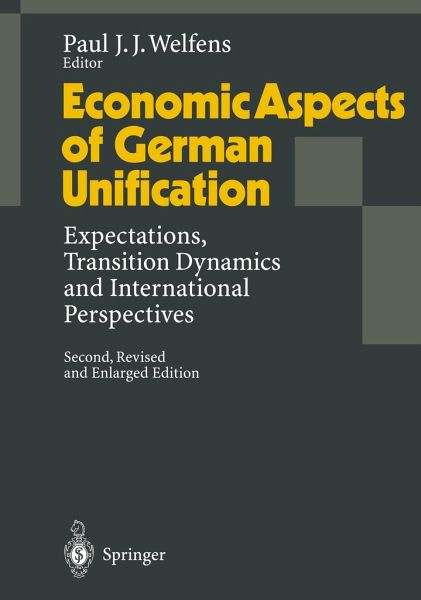
Paul J. J. Welfens The editor is pleased to present a second edition of Economic Aspects of German Unification which includes new chapters and several postscripts. Almost five years after unification output in the ex-GDR is back to its 1989 level. Due to a massive intra-German resource transfer consumption per capita in eastern Germany has not fallen as much as output and employment which reduced by one-fifth within three years. Given high West German transfers which represented about 5% of West German GDP and more than 50% of East German GDP the fall of industrial output could have been much…mehr
Paul J. J. Welfens The editor is pleased to present a second edition of Economic Aspects of German Unification which includes new chapters and several postscripts. Almost five years after unification output in the ex-GDR is back to its 1989 level. Due to a massive intra-German resource transfer consumption per capita in eastern Germany has not fallen as much as output and employment which reduced by one-fifth within three years. Given high West German transfers which represented about 5% of West German GDP and more than 50% of East German GDP the fall of industrial output could have been much stronger than had politically been feasible. Hence structural change necessary for productivity growth was dramatic in the ex-GDR where the goods producing sector (manufacturing, mining, energy and construction) strongly changed its proportions; within four years construction almost doubled, and the share of investment goods production reduced by 10 percentage points between 1990 and 1994 and is· now down to 21. 1 %. Mining lost two-thirds of its share in the producing sector which itself was reduced relative to GDP. The share of the services industry increased by 5 percentage points between 1991 and 1994, but with a share of 27. 7% in East Germany's GDP it was still about 9 percentage points lower than in western Germany. By contrast, government accounted for 20. 9% of GDP in eastern Germany, but for only 13. 2% in western Germany.
Paul J. J. Welfens, geb. 1957 in Düren, Studium der Volkswirtschaftslehre in Wuppertal, Duisburg und Paris, Promotion 1985, Habilitation1989. Inhaber des Lehrstuhls für Volkswirtschaftslehre - Schwerpunkt Makroökonomische Theorie und Politik an der Bergischen Universität Wuppertal; Präsident des Europäischen Instituts für Internationale Wirtschaftsbeziehungen (EIIW); Jean-Monnet-Professor für Europäische Wirtschaftsintegration; zuvor Distinguished Research Fellow am AICGS/The Johns Hopkins University, Professor an der Universität Münster bzw. Potsdam, Visiting Alfred Grosser Professor Sciences Po, Paris.
Inhaltsangabe
Introduction: Economic Aspects of German Unification.- I. Structural and Macroeconomic Changes.- A. The Structural Renewal of Eastern Germany: Some Initial Observations.- B. Integrating the East German States into the German Economy: Opportunities, Burdens and Options.- C. Sectoral Shocks and Structural Adjustment in the East German Transformation Process.- D. Intergovernmental Fiscal Relations after German Unification: Problems and Solutions.- E. Macroeconomic Aspects of German Unification.- F. Comments.- G. Transforming a Socialist Economy: Currency Unification, Banking Reform and Capital Markets.- H. Comments.- II. National Challenges.- I. Labor Markets and Social Security Systems Facing Unification: Systemic Challenges in Germany.- J. Comments.- K. Environmental Protection: Problems and Prospects in East and West Germany.- L. Comments.- M. Structural Adjustment and Privatization of the East German Economy.- N. Comments.- O. Government Support for Restructuring the East German Economy.- P. Comments.- III. International Perspectives.- Q. German Economic Unification and European Integration: Prosperity without Stability?.- R. External Aspects of German Unification: The Polish View.- S. Comments.- T. Economic Reform in the USSR and Prospects for Trade and Economic Relations with Unified Germany.- U. Comments.- V. German Unification as an Incentive for Institutional and Organizational Changes within the EC: A French View.- W. Global Economic Rivalry: New Perspectives on Germany (the EC), Japan and the United States.- X. Comments.- Y. EC Integration and Economic Reforms in CMEA Countries: A United Germany as a Bridge Between East and West?.- Z. Comments.- Map of Western and Eastern Germany.- Appendix: Selected Data on Western German and Eastern Germany.- List of Authors and Conference Participants.- List of Tables and Figures.
Introduction: Economic Aspects of German Unification.- I. Structural and Macroeconomic Changes.- A. The Structural Renewal of Eastern Germany: Some Initial Observations.- B. Integrating the East German States into the German Economy: Opportunities, Burdens and Options.- C. Sectoral Shocks and Structural Adjustment in the East German Transformation Process.- D. Intergovernmental Fiscal Relations after German Unification: Problems and Solutions.- E. Macroeconomic Aspects of German Unification.- F. Comments.- G. Transforming a Socialist Economy: Currency Unification, Banking Reform and Capital Markets.- H. Comments.- II. National Challenges.- I. Labor Markets and Social Security Systems Facing Unification: Systemic Challenges in Germany.- J. Comments.- K. Environmental Protection: Problems and Prospects in East and West Germany.- L. Comments.- M. Structural Adjustment and Privatization of the East German Economy.- N. Comments.- O. Government Support for Restructuring the East German Economy.- P. Comments.- III. International Perspectives.- Q. German Economic Unification and European Integration: Prosperity without Stability?.- R. External Aspects of German Unification: The Polish View.- S. Comments.- T. Economic Reform in the USSR and Prospects for Trade and Economic Relations with Unified Germany.- U. Comments.- V. German Unification as an Incentive for Institutional and Organizational Changes within the EC: A French View.- W. Global Economic Rivalry: New Perspectives on Germany (the EC), Japan and the United States.- X. Comments.- Y. EC Integration and Economic Reforms in CMEA Countries: A United Germany as a Bridge Between East and West?.- Z. Comments.- Map of Western and Eastern Germany.- Appendix: Selected Data on Western German and Eastern Germany.- List of Authors and Conference Participants.- List of Tables and Figures.
Es gelten unsere Allgemeinen Geschäftsbedingungen: www.buecher.de/agb
Impressum
www.buecher.de ist ein Internetauftritt der buecher.de internetstores GmbH
Geschäftsführung: Monica Sawhney | Roland Kölbl | Günter Hilger
Sitz der Gesellschaft: Batheyer Straße 115 - 117, 58099 Hagen
Postanschrift: Bürgermeister-Wegele-Str. 12, 86167 Augsburg
Amtsgericht Hagen HRB 13257
Steuernummer: 321/5800/1497
USt-IdNr: DE450055826