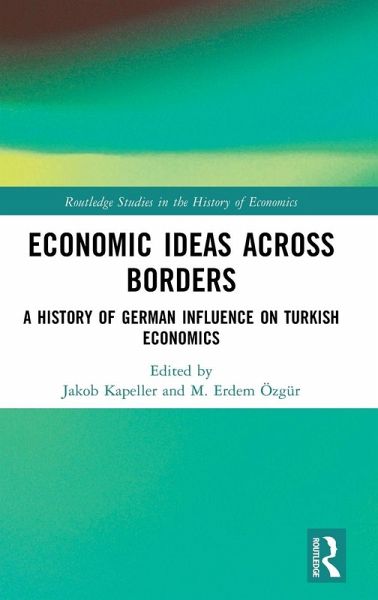
Exploring the cross-cultural exchange of ideas between German and Turkish scholars, policymakers and institutions, this book sheds light on how German theories were interpreted and applied in Turkey during the nineteenth and twentieth centuries. Situating the flow of ideas within broader patterns of economic globalization, the contributors to this edited volume explore historical, economic, and ideological developments in Turkey and Germany. Within economic thought, there is a particular focus on the influence of the German Historical School in Turkish economic thought; the contributions of…mehr
Exploring the cross-cultural exchange of ideas between German and Turkish scholars, policymakers and institutions, this book sheds light on how German theories were interpreted and applied in Turkey during the nineteenth and twentieth centuries. Situating the flow of ideas within broader patterns of economic globalization, the contributors to this edited volume explore historical, economic, and ideological developments in Turkey and Germany. Within economic thought, there is a particular focus on the influence of the German Historical School in Turkish economic thought; the contributions of German refugee scholars in the 1930s, through their publications, courses they offered and their relations with the other members of academia; and Marxian Asiatic Mode of Production debates of the 1960s. In terms of economic policy, the book also discusses agrarian populism in the 1930s; German soft power in interwar Turkey; the first Gastarbeiter Agreement and its effects; German investments in Turkey after the Second World War and the role of sports in shaping relations between Germany and Turkey. The book will be of great interest to readers in the history of economic thought, intellectual history, economic history and the histories of Germany and Turkey more broadly.
Jakob Kapeller is Professor of Socio-Economics at the Institute for Socio-Economics, Faculty of Social Sciences, University Duisburg-Essen. In addition, he is heading the Institute for Comprehensive Economy (ICAE) at Johannes Kepler University Linz. M. Erdem Özgür is Professor of Economics at the Department of Economics, Faculty of Business, Dokuz Eylül University, ¿zmir, Turkey.
Inhaltsangabe
Introduction: The German Impact on Turkish Economic and Institutional Development Jakob Kapeller and M. Erdem Özgür Part I: Ottoman Empire and Early Twentieth Century 1 The Effect of Cameralism on Ottoman Economic Thought Revisited Mesut Sert 2 German Influence in Turn-of-the-century Ottoman Economic Thought: Efforts to Save the Empire M. Erdem Özgür 3 Re-evaluating Human Capital in Turkish Economic Thought: Another Case of German Influence Erkan Gürp nar Part II: Interwar Period and WWII Era 4 The Effects of Historismus and Staatswissenschaften on Kadro Thought and Policy Eyüp Özveren 5 German Economists in Turkish Universities: Intellectual Migration and Institutional Transformation Hakk Bilen 6 German Refugee Economists and the Development of Turkish Economic Thought: A Study of Early Influences, Contributions, and Legacies Nur Merve K l çkan 7 German Soft Power in Interwar Turkey: Economic Benefits and New Spheres of Influence Mert Do ukan Perk 8 Blood, Soil, and Fertility: National Regeneration through the Rural Ideal in Interwar Germany and Turkey M. As m Karaömerlio lu 9 Transforming Commercial Law in the Turkish Republic: The Legacy of Ernst Hirsch Seven A r Part III: Post-WWII to Contemporary Period 10 The Asiatic Mode of Production Debates in Turkey Alp Yücel Kaya 11 Sencer Divitçio lu (1927-2014) and the Asiatic Mode of Production Revisited Altu Yalç ntä 12 The 1961 German-Turkish Gastarbeiter Contract: The Shifting Dynamics of Turkish Migration to Germany Alisait Y lk n 13 Building Bridges Through Football: Migration, Identity, and German Influence in Turkish Football Tolga Genç 14 Post-World War II Economic Relations between Germany and Turkey: A Study of Influence and Partnership Cem Di budak Index
Introduction: The German Impact on Turkish Economic and Institutional Development Jakob Kapeller and M. Erdem Özgür Part I: Ottoman Empire and Early Twentieth Century 1 The Effect of Cameralism on Ottoman Economic Thought Revisited Mesut Sert 2 German Influence in Turn-of-the-century Ottoman Economic Thought: Efforts to Save the Empire M. Erdem Özgür 3 Re-evaluating Human Capital in Turkish Economic Thought: Another Case of German Influence Erkan Gürp nar Part II: Interwar Period and WWII Era 4 The Effects of Historismus and Staatswissenschaften on Kadro Thought and Policy Eyüp Özveren 5 German Economists in Turkish Universities: Intellectual Migration and Institutional Transformation Hakk Bilen 6 German Refugee Economists and the Development of Turkish Economic Thought: A Study of Early Influences, Contributions, and Legacies Nur Merve K l çkan 7 German Soft Power in Interwar Turkey: Economic Benefits and New Spheres of Influence Mert Do ukan Perk 8 Blood, Soil, and Fertility: National Regeneration through the Rural Ideal in Interwar Germany and Turkey M. As m Karaömerlio lu 9 Transforming Commercial Law in the Turkish Republic: The Legacy of Ernst Hirsch Seven A r Part III: Post-WWII to Contemporary Period 10 The Asiatic Mode of Production Debates in Turkey Alp Yücel Kaya 11 Sencer Divitçio lu (1927-2014) and the Asiatic Mode of Production Revisited Altu Yalç ntä 12 The 1961 German-Turkish Gastarbeiter Contract: The Shifting Dynamics of Turkish Migration to Germany Alisait Y lk n 13 Building Bridges Through Football: Migration, Identity, and German Influence in Turkish Football Tolga Genç 14 Post-World War II Economic Relations between Germany and Turkey: A Study of Influence and Partnership Cem Di budak Index
Es gelten unsere Allgemeinen Geschäftsbedingungen: www.buecher.de/agb
Impressum
www.buecher.de ist ein Internetauftritt der buecher.de internetstores GmbH
Geschäftsführung: Monica Sawhney | Roland Kölbl | Günter Hilger
Sitz der Gesellschaft: Batheyer Straße 115 - 117, 58099 Hagen
Postanschrift: Bürgermeister-Wegele-Str. 12, 86167 Augsburg
Amtsgericht Hagen HRB 13257
Steuernummer: 321/5800/1497
USt-IdNr: DE450055826