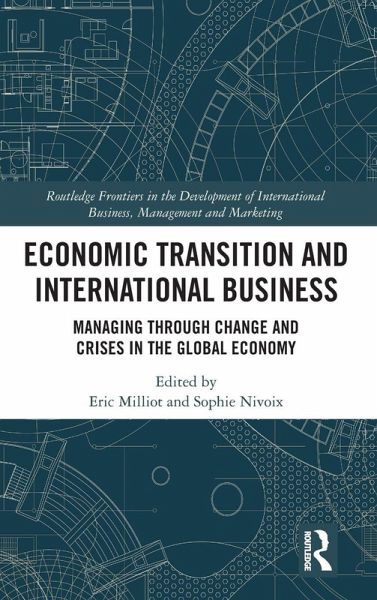
Economic Transition and International Business brings together academic experts in International Business and sheds new light on the international phenomenon of transitions in the worldwide economy. It includes both academic investigations as well as in-depth empirical studies.
Economic Transition and International Business brings together academic experts in International Business and sheds new light on the international phenomenon of transitions in the worldwide economy. It includes both academic investigations as well as in-depth empirical studies.
Eric Milliot is Professor of Management Science at the University of Nantes (France). President of Atlas AFMI (Association Francophone de Management International), he is - in this capacity - deputy editor-in-chief of International Management journal and director of the Atlas series at Vuibert (Paris). Sophie Nivoix is associate professor of Finance at the University of Poitiers (France) and member of the research group CEREGE (EA 1722). She is the head of the Masters Administration Economique et Sociale at the Faculté de Droit et des Sciences Sociales (Law and Social Sciences Faculty) of Poitiers (France).
Inhaltsangabe
PART 1. Crises as transition indicators 1. A neo-institutional analysis of the effects of the crisis on financial regulation in the G20 countries 2. The sociological branch of neo-institutional theory: a relevant framework for analysing the effects of the economic crisis on fast-growing economies? 3. A sustainable review of conventions between economic actors 4. Behaviour of individuals and crises: towards a new paradigm in finance? PART 2. The impact of transitions on agents 5. China looking for a new model 6. The shifting power of influence of consumer associations in Europe: the transition to the status of institutional stakeholder 7. Internationalisation of SMEs from Transition Economies: the case of Moroccan SMEs 8. The factors of influence in the export decision of Algerian manufacturing SMEs Part 3. Decision-making and managerial transitions 9. Location and Anchoring of Foreign Investment by Multinational Companies in Evolving Territories: the role of the top subsidiary manager 10. Managing international joint-ventures: an organizational learning perspective 11. Innovation strategies without borders: what prospects for Chinese companies? 12. Creative Pathways and Designers' Figures: An Exploration of Designer Studios and Strategies in Montreal's Fashion Industry Conclusion: Towards a world in transition
PART 1. Crises as transition indicators 1. A neo-institutional analysis of the effects of the crisis on financial regulation in the G20 countries 2. The sociological branch of neo-institutional theory: a relevant framework for analysing the effects of the economic crisis on fast-growing economies? 3. A sustainable review of conventions between economic actors 4. Behaviour of individuals and crises: towards a new paradigm in finance? PART 2. The impact of transitions on agents 5. China looking for a new model 6. The shifting power of influence of consumer associations in Europe: the transition to the status of institutional stakeholder 7. Internationalisation of SMEs from Transition Economies: the case of Moroccan SMEs 8. The factors of influence in the export decision of Algerian manufacturing SMEs Part 3. Decision-making and managerial transitions 9. Location and Anchoring of Foreign Investment by Multinational Companies in Evolving Territories: the role of the top subsidiary manager 10. Managing international joint-ventures: an organizational learning perspective 11. Innovation strategies without borders: what prospects for Chinese companies? 12. Creative Pathways and Designers' Figures: An Exploration of Designer Studios and Strategies in Montreal's Fashion Industry Conclusion: Towards a world in transition
Es gelten unsere Allgemeinen Geschäftsbedingungen: www.buecher.de/agb
Impressum
www.buecher.de ist ein Internetauftritt der buecher.de internetstores GmbH
Geschäftsführung: Monica Sawhney | Roland Kölbl | Günter Hilger
Sitz der Gesellschaft: Batheyer Straße 115 - 117, 58099 Hagen
Postanschrift: Bürgermeister-Wegele-Str. 12, 86167 Augsburg
Amtsgericht Hagen HRB 13257
Steuernummer: 321/5800/1497
USt-IdNr: DE450055826