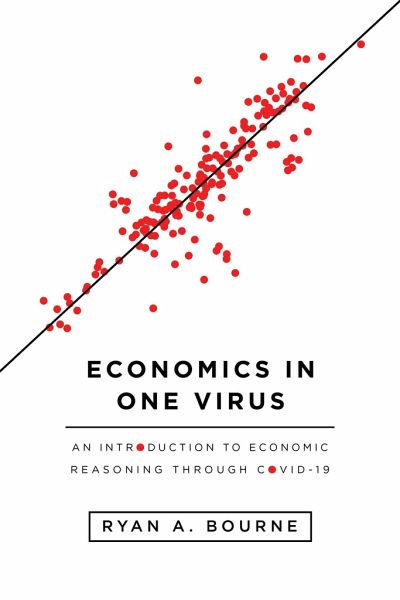
"A truly excellent book that explains where our pandemic response went wrong, and how we can understand those failings using the tools of economics." —Tyler Cowen, coauthor of the blog Marginal Revolution Have you ever stopped to wonder why hand sanitizer was missing from your pharmacy for months after the COVID-19 pandemic hit? Why some employers and employees were arguing over workers being re-hired during the first COVID-19 lockdown? Why passenger airlines were able to get their own ring-fenced bailout from Congress? Economics in One Virus answers all these pandemic-related questions and…mehr
"A truly excellent book that explains where our pandemic response went wrong, and how we can understand those failings using the tools of economics." —Tyler Cowen, coauthor of the blog Marginal Revolution Have you ever stopped to wonder why hand sanitizer was missing from your pharmacy for months after the COVID-19 pandemic hit? Why some employers and employees were arguing over workers being re-hired during the first COVID-19 lockdown? Why passenger airlines were able to get their own ring-fenced bailout from Congress? Economics in One Virus answers all these pandemic-related questions and many more, drawing on the dramatic events of 2020 to bring to life some of the most important principles of economic thought. Packed with supporting data and the best new academic evidence, this book offers a crash-course in economics analysis through the applied case-study of the COVID-19 pandemic, to help explain everything from why the U.S. was underprepared for the pandemic to how economists go about valuing the lives saved from lockdowns. After completing this highly readable, fast-paced, and provocative virus-themed economic tour, readers will be able to make much better sense of the events that they've lived through. Perhaps more importantly, the insights on everything from the role of the price mechanism to trade and specialization will grant even those wholly new to economics the skills to think like an economist in their own lives and when evaluating the choices of their political leaders.
Ryan A. Bourne occupies the R. Evan Scharf Chair for the Public Understanding of Economics at the Cato Institute and is a columnist for The Times (UK). He has written on a variety of economic issues, including fiscal policy, inequality, price and wage controls, and infrastructure spending. Bourne is the author of Economics in One Virus: An Introduction to Economic Reasoning through COVID-19 (2021) and editor of The War on Prices: How Popular Misconceptions about Inflation, Prices, and Value Create Bad Policy (2024). He has extensive broadcast and print media experience and has appeared on CNN, CNBC, BBC News, Sky News, and Fox Business Network.
Inhaltsangabe
INTRODUCTION CHAPTER 1: What Does It Mean to Be Economically “Worse Off” during a Pandemic? An introduction to economic welfare CHAPTER 2: Should I Be Free to Risk Infecting Your Grandma with a Deadly Virus? An introduction to externalities CHAPTER 3: Did We Close Down the Economy? An introduction to public and private action CHAPTER 4: How Much Would You Spend to Save My Life? An introduction to the value of a statistical life CHAPTER 5: When Is a Lockdown Cure Worse than the Disease? An introduction to cost-benefit analysis CHAPTER 6 Why Was I Banned from Going Fishing? An introduction to thinking on the margin CHAPTER 7: What Good Is a Pandemic Plan with So Many Unknowns? An introduction to uncertainty and the knowledge problem CHAPTER 8: Why Did Protests and Marches Not Lead to Obvious Spikes in COVID-19 Cases? An introduction to endogeneity CHAPTER 9: Why Couldn't I Get a COVID-19 Test Back in February and March 2020? An introduction to regulatory trade-offs CHAPTER 10: Why Was There No Hand Sanitizer in My Pharmacy for Months? An introduction to the price mechanism CHAPTER 11: Does the Pandemic Show That We Need More U.S.-Based Manufacturing? An introduction to trade and specialization CHAPTER 12: Why Is That Guy in the Mask Getting So Close? An introduction to moral hazard CHAPTER 13: Why Did Airlines Get a Special Bailout, But Not My Industry? An introduction to public choice economics CHAPTER 14: Why Didn't My Workers Want to Be Rehired? An introduction to incentives CHAPTER 15: Why Weren't We Well Prepared for the Pandemic? An introduction to political incentives CHAPTER 16: Can We Really Just Turn an Economy off and Back on Again? An introduction to the nature of an economy CONCLUSION: What is Economics Good For? ACKNOWLEDGEMENTS NOTES INDEX ABOUT THE AUTHOR
INTRODUCTION CHAPTER 1: What Does It Mean to Be Economically “Worse Off” during a Pandemic? An introduction to economic welfare CHAPTER 2: Should I Be Free to Risk Infecting Your Grandma with a Deadly Virus? An introduction to externalities CHAPTER 3: Did We Close Down the Economy? An introduction to public and private action CHAPTER 4: How Much Would You Spend to Save My Life? An introduction to the value of a statistical life CHAPTER 5: When Is a Lockdown Cure Worse than the Disease? An introduction to cost-benefit analysis CHAPTER 6 Why Was I Banned from Going Fishing? An introduction to thinking on the margin CHAPTER 7: What Good Is a Pandemic Plan with So Many Unknowns? An introduction to uncertainty and the knowledge problem CHAPTER 8: Why Did Protests and Marches Not Lead to Obvious Spikes in COVID-19 Cases? An introduction to endogeneity CHAPTER 9: Why Couldn't I Get a COVID-19 Test Back in February and March 2020? An introduction to regulatory trade-offs CHAPTER 10: Why Was There No Hand Sanitizer in My Pharmacy for Months? An introduction to the price mechanism CHAPTER 11: Does the Pandemic Show That We Need More U.S.-Based Manufacturing? An introduction to trade and specialization CHAPTER 12: Why Is That Guy in the Mask Getting So Close? An introduction to moral hazard CHAPTER 13: Why Did Airlines Get a Special Bailout, But Not My Industry? An introduction to public choice economics CHAPTER 14: Why Didn't My Workers Want to Be Rehired? An introduction to incentives CHAPTER 15: Why Weren't We Well Prepared for the Pandemic? An introduction to political incentives CHAPTER 16: Can We Really Just Turn an Economy off and Back on Again? An introduction to the nature of an economy CONCLUSION: What is Economics Good For? ACKNOWLEDGEMENTS NOTES INDEX ABOUT THE AUTHOR
Es gelten unsere Allgemeinen Geschäftsbedingungen: www.buecher.de/agb
Impressum
www.buecher.de ist ein Internetauftritt der buecher.de internetstores GmbH
Geschäftsführung: Monica Sawhney | Roland Kölbl | Günter Hilger
Sitz der Gesellschaft: Batheyer Straße 115 - 117, 58099 Hagen
Postanschrift: Bürgermeister-Wegele-Str. 12, 86167 Augsburg
Amtsgericht Hagen HRB 13257
Steuernummer: 321/5800/1497
USt-IdNr: DE450055826