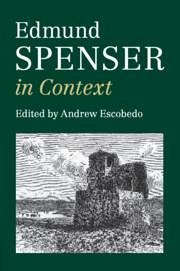
Edmund Spenser's poetry remains an indispensable touchstone of English literary history. Yet for modern readers his deliberate use of archaic language and his allegorical mode of writing can become barriers to understanding his poetry. This volume of thirty-seven essays, written by distinguished scholars, offers a rich introduction to the literary, political and religious contexts that shaped Spenser's poetry, including the environment in which he lived, the genres he drew upon, and the influences that helped to fashion his art. The collection reveals the multiple personae that Spenser…mehr
Edmund Spenser's poetry remains an indispensable touchstone of English literary history. Yet for modern readers his deliberate use of archaic language and his allegorical mode of writing can become barriers to understanding his poetry. This volume of thirty-seven essays, written by distinguished scholars, offers a rich introduction to the literary, political and religious contexts that shaped Spenser's poetry, including the environment in which he lived, the genres he drew upon, and the influences that helped to fashion his art. The collection reveals the multiple personae that Spenser constructs within his work: to read Spenser is to read a rich archive of literary forms, and this volume provides the contexts in which to do so. A reading list at the end of the volume will prove invaluable to further study.
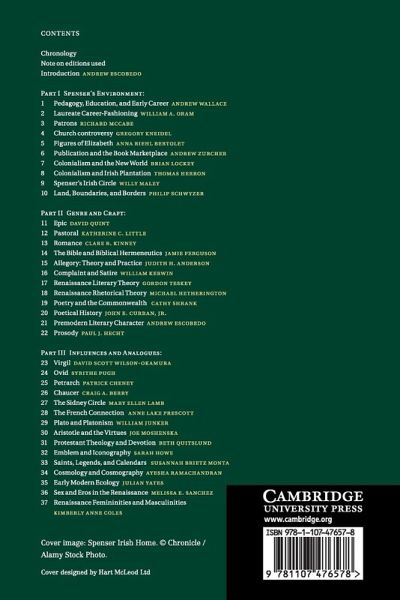
Introduction Andrew Escobedo Part I. Spenser's Environment: 1. Pedagogy, education, and early career Andrew Wallace 2. Laureate career-fashioning William A. Oram 3. Patrons Richard McCabe 4. Church controversy Gregory Kneidel 5. Figures of Elizabeth Anna Riehl Bertolet 6. Publication and the book marketplace Andrew Zurcher 7. Colonialism and the New World Brian Lockey 8. Colonialism and Irish plantation Thomas Herron 9. Spenser's Irish circle Willy Maley 10. Land, boundaries, and borders Philip Schwyzer Part II. Genre and Craft: 11. Epic David Quint 12. Pastoral Katherine Little 13. Romance Clare Kinney 14. The Bible and biblical hermeneutics Jamie Ferguson 15. Allegory: theory and practice Judith H. Anderson 16. Complaint and satire William Kerwinl 17. Renaissance literary theory Gordon Teskey 18. Renaissance rhetorical theory Michael Hetherington 19. Poetry and the Commonwealth Cathy Shrank 20. Poetical history John E. Curran, Jr 21. Premodern literary character Andrew Escobedo 22. Prosody Paul J. Hecht Part III. Influences and Analogues: 23. Virgil David Scott Wilson-Okamura 24. Ovid Syrithe Pugh 25. Petrarch Patrick Cheney 26. Chaucer Craig A. Berry 27. The Sidney circle Mary Ellen Lamb 28. Spenser's French connection Anne Lake Prescott 29. Plato and Platonism William Junker 30. Aristotle and the virtues Joe Moshenska 31. Protestant theology and devotion Beth Quitslund 32. Emblem and iconography Sarah Howe 33. Saints, legends, and calendars Susannah Brietz Monta 34. Cosmology and cosmography Ayesha Ramachandran 35. Early modern ecology Julian Yates 36. Sex and eroticism in the Renaissance Melissa E. Sanchez 37. Gender in the 1590 Faerie Queene Kimberly Anne Coles Further reading Index.
Introduction Andrew Escobedo Part I. Spenser's Environment: 1. Pedagogy, education, and early career Andrew Wallace 2. Laureate career-fashioning William A. Oram 3. Patrons Richard McCabe 4. Church controversy Gregory Kneidel 5. Figures of Elizabeth Anna Riehl Bertolet 6. Publication and the book marketplace Andrew Zurcher 7. Colonialism and the New World Brian Lockey 8. Colonialism and Irish plantation Thomas Herron 9. Spenser's Irish circle Willy Maley 10. Land, boundaries, and borders Philip Schwyzer Part II. Genre and Craft: 11. Epic David Quint 12. Pastoral Katherine Little 13. Romance Clare Kinney 14. The Bible and biblical hermeneutics Jamie Ferguson 15. Allegory: theory and practice Judith H. Anderson 16. Complaint and satire William Kerwinl 17. Renaissance literary theory Gordon Teskey 18. Renaissance rhetorical theory Michael Hetherington 19. Poetry and the Commonwealth Cathy Shrank 20. Poetical history John E. Curran, Jr 21. Premodern literary character Andrew Escobedo 22. Prosody Paul J. Hecht Part III. Influences and Analogues: 23. Virgil David Scott Wilson-Okamura 24. Ovid Syrithe Pugh 25. Petrarch Patrick Cheney 26. Chaucer Craig A. Berry 27. The Sidney circle Mary Ellen Lamb 28. Spenser's French connection Anne Lake Prescott 29. Plato and Platonism William Junker 30. Aristotle and the virtues Joe Moshenska 31. Protestant theology and devotion Beth Quitslund 32. Emblem and iconography Sarah Howe 33. Saints, legends, and calendars Susannah Brietz Monta 34. Cosmology and cosmography Ayesha Ramachandran 35. Early modern ecology Julian Yates 36. Sex and eroticism in the Renaissance Melissa E. Sanchez 37. Gender in the 1590 Faerie Queene Kimberly Anne Coles Further reading Index.
Es gelten unsere Allgemeinen Geschäftsbedingungen: www.buecher.de/agb
Impressum
www.buecher.de ist ein Internetauftritt der buecher.de internetstores GmbH
Geschäftsführung: Monica Sawhney | Roland Kölbl | Günter Hilger
Sitz der Gesellschaft: Batheyer Straße 115 - 117, 58099 Hagen
Postanschrift: Bürgermeister-Wegele-Str. 12, 86167 Augsburg
Amtsgericht Hagen HRB 13257
Steuernummer: 321/5800/1497
USt-IdNr: DE450055826